By Financial Desk
October 3, 2026
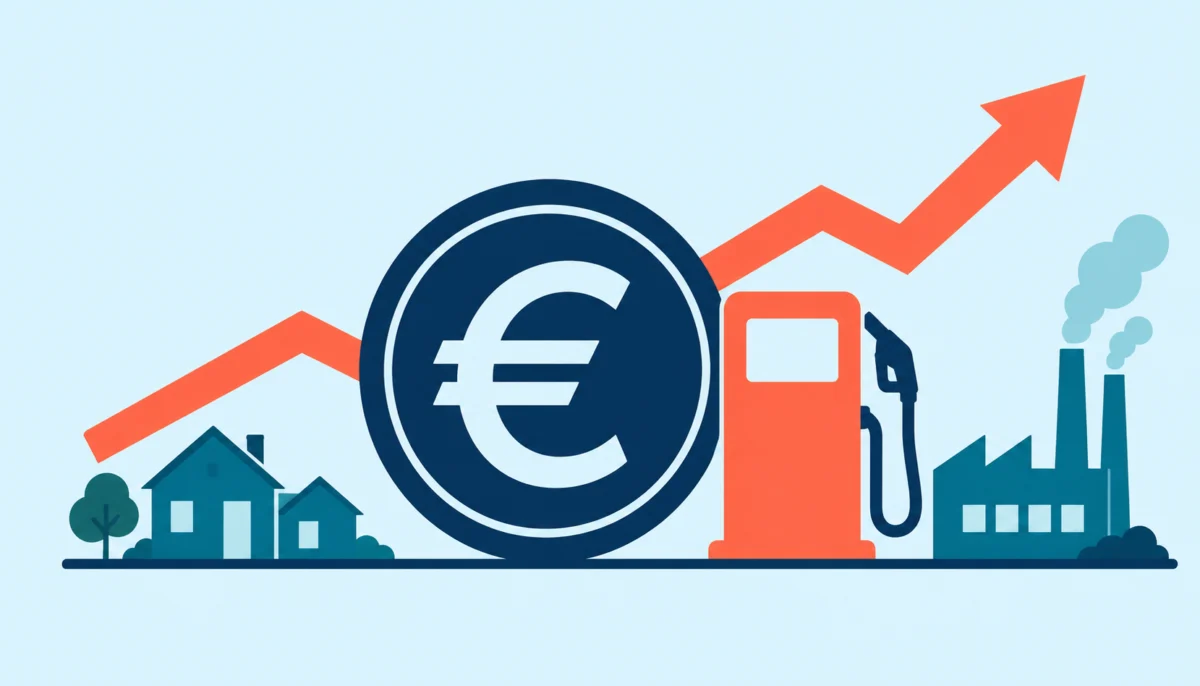
The Eurozone’s economic recovery is facing a formidable new headwind. According to flash estimates released by Eurostat on October 2, 2026, headline inflation across the currency bloc accelerated to 3.8% in September, a sharp increase from the 3.2% recorded in August. This resurgence has placed energy volatility back at the epicenter of the region’s economic outlook, complicating the European Central Bank’s (ECB) delicate balancing act: curbing price growth without strangling consumer demand or pushing vulnerable businesses into insolvency.
Main Facts: The Inflationary Spike
The primary driver of the September surge is, once again, the energy sector. Eurostat data indicates that annual energy inflation leaped to 18.8%, up from 14.3% the previous month. While energy remains the most volatile component, the "stickiness" of underlying inflation is also becoming a concern. Services prices rose by 3.2%, while the core basket—including food, alcohol, and tobacco—saw a 1.4% increase, and non-energy industrial goods climbed by 1.1%.
It is critical to note that these are preliminary "flash" estimates. They represent the movement of a weighted consumer price basket over a twelve-month period and do not reflect the uniform reality for every household. For the average European consumer, the impact is highly asymmetric, depending on housing tenure, commuting distance, and the specific energy contract structures in their respective member states.
Chronology: A Season of Policy Tightening
The September inflation data arrives in a high-stakes political and economic environment. The timeline of recent developments illustrates a rapidly shifting landscape:
- May 13, 2026: ECB Executive Board member Philip Lane publishes a comprehensive analysis on supply-side energy shocks, providing a framework to distinguish between direct price hikes, indirect production cost increases, and "second-round" effects like wage growth.
- September 10, 2026: The ECB Governing Council, citing inflationary pressures linked to ongoing geopolitical instability in the Middle East, announces a 25-basis-point hike to its three key interest rates. The deposit facility rate is increased to 2.50%, effective September 16.
- October 2, 2026: Eurostat releases the flash estimate for September, confirming that despite the recent rate hike, inflationary pressures have intensified rather than abated.
This chronology underscores the challenge for policymakers. The ECB’s September decision was based on internal projections that anticipated average headline inflation of 3.0% for 2026. The September monthly reading of 3.8% is a clear outlier, though the ECB has consistently maintained that it evaluates the economy on a meeting-by-meeting basis, avoiding rigid long-term commitments to specific interest rate paths.
Supporting Data: The Anatomy of the Shock
Understanding the 3.8% figure requires disaggregating the components and acknowledging the transmission mechanisms. An energy price shock functions differently than a broad-based demand shock.
The Household Squeeze
For households, energy and fuel costs are notoriously difficult to cut in the short term. Unlike discretionary spending on entertainment or luxury goods, heating and transportation are essential "sunk" costs for most families. As a larger percentage of disposable income is diverted to utility providers, discretionary spending power contracts. The speed at which this occurs depends on retail price adjustment mechanisms—some households may see immediate impacts, while others with fixed-rate contracts may be shielded for several months.
Corporate Exposure and Hedging
Businesses face a complex allocation problem. A manufacturer’s exposure to the current energy spike is heavily mitigated—or exacerbated—by its procurement strategy. Firms that hedged energy costs months in advance may report stable margins in the short term, while transport operators or smaller firms with "spot price" exposure are likely feeling immediate margin compression.
Crucially, higher nominal revenue does not equate to higher profit. If a firm raises its prices to cover input costs but experiences a corresponding drop in sales volume, its cash flow position will deteriorate. Credit analysts are currently pivoting their focus away from nominal sales growth and toward "cash generated after operating costs," which provides a more accurate picture of a company’s ability to service debt in an inflationary environment.
Official Responses and the Policy Dilemma
The ECB finds itself in a classic central banking trap. Interest rates are a blunt instrument: they are highly effective at cooling demand-pull inflation, but they are largely powerless to increase the supply of energy or repair fractured global supply chains.
By tightening monetary policy, the ECB aims to anchor long-term inflation expectations. However, the risk is that by the time the policy transmits through the economy, it may hit businesses that are already suffering from the dual burden of high energy bills and rising interest expenses. This "transmission" occurs through three primary channels identified by Philip Lane:
- Direct: Immediate impact on household energy bills.
- Indirect: Rising production costs leading to price list adjustments.
- Second-Round: Demands for higher wages and changes in pricing expectations.
The ECB’s Governing Council has made it clear that they remain data-dependent. The September inflation reading provides a vital data point, but it does not dictate a future policy move. Any further rate increases would require the Council to conclude that inflation is becoming entrenched in the "second-round" of wage and price setting.
Implications for Fiscal Policy and Sovereign Risk
The burden of inflation is not borne by the market alone; governments are now under immense pressure to provide fiscal relief. However, this creates a secondary risk: sovereign debt sustainability.
The Fiscal Balancing Act
Governments that choose to subsidize energy prices through tax cuts or direct transfers face a difficult trade-off. While these measures protect households in the short term, they increase budget deficits. For countries with high debt-to-GDP ratios, the cost of borrowing to fund these subsidies could potentially negate the benefits.
Analysts are currently scrutinizing national budgets for the "exit strategy" of these relief programs. A country that keeps a retail price cap in place indefinitely risks a massive fiscal cliff when that support is eventually withdrawn, as the underlying energy price shock may still be present.
A Warning for Investors
The Eurozone is not a monolith. Analysts must avoid using the aggregate 3.8% inflation rate as a proxy for the health of individual member states. The true vulnerability of a nation lies in its debt maturity profile, its energy import dependency, and the fiscal space available to its treasury. Investors are urged to look beyond the headline number and conduct deep-dive analyses into:
- Corporate Liquidity: Can firms sustain operations if customers extend payment terms due to their own energy cost crises?
- Sovereign Funding: Is the government’s borrowing calendar compatible with the current interest rate environment?
- Cyclical Earnings: How much of a company’s revenue is tied to discretionary consumer spending, which is now at risk of a significant contraction?
Conclusion: The Path Ahead
As we look toward the final quarter of 2026, the economic environment remains fraught with uncertainty. September’s 3.8% inflation reading serves as a stark reminder that the post-pandemic stabilization remains fragile. The "winning" firms of the next year will likely be those with strong balance sheets, minimal reliance on short-term debt, and the pricing power to weather the energy storm.
For the ECB, the mission remains unchanged: maintaining the 2% medium-term target while preventing the cost-of-living crisis from evolving into a permanent wage-price spiral. As more data on wage settlements and activity levels emerges in the coming weeks, the central bank will need to demonstrate both resolve and flexibility. For now, the Eurozone is in a state of watchful waiting, with the market awaiting the final inflation figures to determine whether this month’s acceleration is a temporary tremor or the beginning of a sustained inflationary shift.