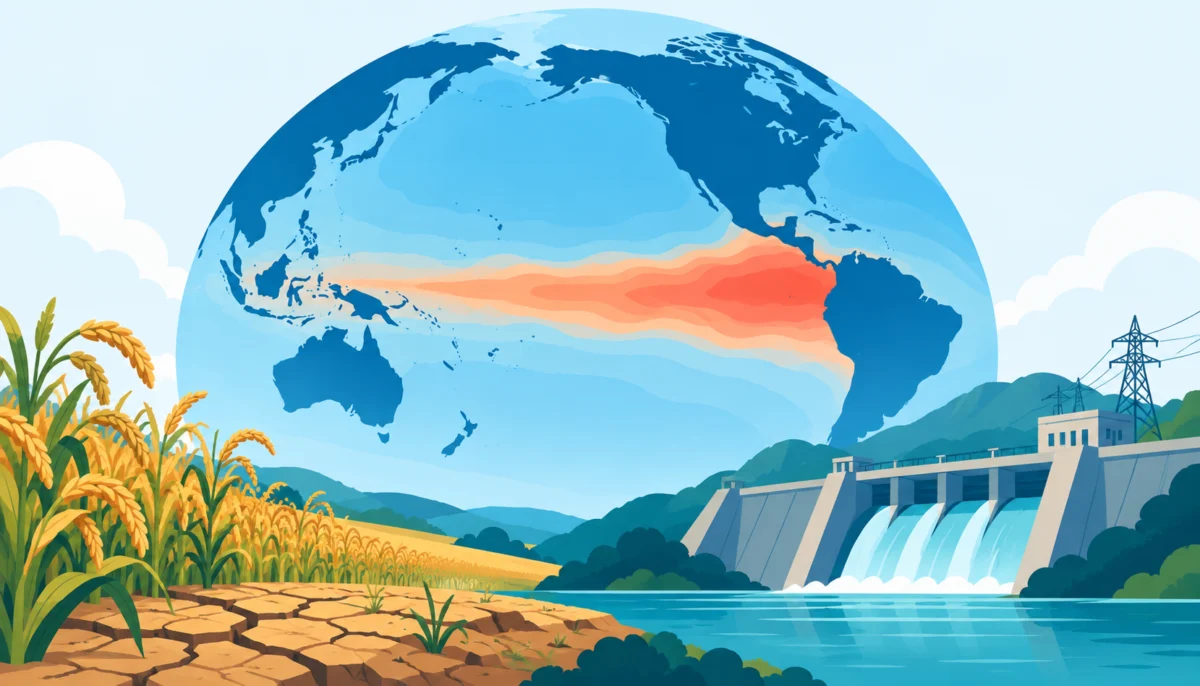
The World Meteorological Organization (WMO) has issued a sobering forecast: the current El Niño event is intensifying, with a near-100% probability of persisting through February 2027. With sea-surface temperatures in the Niño 3.4 region projected to peak at an anomaly of approximately 3.7°C around December, the global economy is bracing for a period of profound climatic volatility. As governments and corporations navigate this window of uncertainty, the focus must shift from broad meteorological data to granular, localized risk assessments.
The coming months will not merely be a test of weather resilience, but a critical stress test for supply chains, fiscal stability, and energy security. For stakeholders—ranging from agricultural lenders to sovereign risk analysts—the challenge lies in identifying where climate-induced disruptions will intersect with existing financial vulnerabilities.
The Chronology of an Escalating Crisis
The path toward the current situation has been marked by a series of accelerating indicators that demand careful sequencing for accurate risk modeling:
- June 2026: The Food and Agriculture Organization (FAO) released its comprehensive agricultural risk assessment. By analyzing 41 years of satellite data, the FAO mapped regions most susceptible to drought under intense El Niño conditions, specifically highlighting the Sahel, Southern Africa, South and Southeast Asia, and the Caribbean’s "Dry Corridor."
- September 10, 2026: The US Climate Prediction Center issued a definitive diagnostic discussion, assigning a >90% probability to a "very strong" El Niño during the Northern Hemisphere’s autumn and winter.
- October 8, 2026: The WMO confirmed the strengthening trend, providing the latest seasonal update (October–December 2026). This update highlighted not only the El Niño anomaly but also a positive Indian Ocean Dipole and warming tropical Atlantic waters, signaling a complex, multi-layered climate disruption.
- December 2026 (Projected): The expected peak of sea-surface temperature anomalies, representing the point of maximum physical stress for global agricultural and hydrological systems.
- February 2027 and Beyond: The projected tail-end of the event, during which the long-term economic repercussions—such as debt defaults, budget deficits, and commodity price spikes—will likely materialize in financial reports.
Supporting Data and Meteorological Context
To understand the severity of the situation, analysts must differentiate between global climate signals and regional outcomes. The WMO’s projected 3.7°C anomaly in the Niño 3.4 region is a powerful indicator, but it is not a direct proxy for crop yields or GDP growth.
The interaction between El Niño and the Indian Ocean Dipole creates a "double-barrelled" threat. When these systems align, they disrupt monsoon patterns in Asia and rainfall in East Africa with greater intensity than a single-factor event would suggest. However, the data remains a probabilistic forecast. For instance, while the US Climate Prediction Center’s September assessment aligns with the WMO’s findings, it explicitly cautions that regional impacts—such as the exact timing and volume of rainfall in specific agricultural zones—remain subject to local meteorological variables.
For the analyst, the trap lies in relying on national averages. A country-wide rainfall index can mask the reality of a drought-stricken farming district that serves as a vital node in a global supply chain. Consequently, granular data—such as local crop calendars, reservoir inflow rates, and specific irrigation capacities—must supersede broad regional forecasts when conducting due diligence.
Official Responses and Anticipatory Measures
International bodies have already begun mobilizing to mitigate the most acute human and economic risks. The FAO and the World Food Programme (WFP) have launched a joint anticipatory appeal seeking $202 million to support 8.8 million people across 22 high-risk countries. This funding is earmarked for early cash assistance and support for pastoralists, acting as a "first responder" layer of protection.
However, from an institutional perspective, these appeals serve as a benchmark for government readiness rather than a solution to systemic economic disruption. The gap between the $202 million target and the actual deployment of funds is a critical indicator for sovereign risk analysts. Countries that fail to secure this support early may find themselves forced to dip into limited foreign exchange reserves or accumulate debt to manage food imports, thereby escalating their sovereign risk profiles.
Implications: The Triad of Economic Risk
The economic fallout of this El Niño will manifest primarily through three channels: agriculture, energy, and fiscal policy.
1. The Agricultural Supply Chain
For food processors and commodity traders, the risk is not just the loss of output, but the breakdown of the "cash cycle." If a primary supplier in a drought-exposed region fails, the processor must pivot to a new origin. Even if the processor can maintain profit margins through price adjustments, the timing of those adjustments is crucial. If a firm cannot pass on costs to consumers due to price sensitivity, it will face an immediate liquidity squeeze.
Credit analysis must now incorporate "volume-at-risk" scenarios. A producer with an intact harvest might see higher revenues due to rising prices, but a producer with a failed crop has no product to sell, rendering them insolvent regardless of market prices.
2. The Energy-Water Nexus
The 2016 IMF analysis of El Niño serves as a foundational warning: weather volatility is a direct threat to hydroelectric-dependent nations. When rainfall fails, reservoirs deplete, forcing utilities to burn expensive imported fossil fuels to meet baseload demand.
If a utility operates under a fixed retail tariff, this cost surge destroys cash flow. If the government absorbs the cost to prevent consumer price hikes, the risk migrates from the private sector to the public balance sheet. Manufacturers must also account for this—a factory that seems immune to agricultural drought may suffer significant downtime due to energy rationing or localized power grid instability.
3. Inflationary and Fiscal Pressures
The ripple effects of El Niño often lead to stubborn, cost-push inflation. As food prices rise, central banks face a "policy trap": do they raise interest rates to combat inflation that was caused by supply-side shocks, or do they maintain accommodative policies to support a struggling economy?
Governments with high debt-to-GDP ratios are at the greatest risk. The need for emergency imports, combined with the political necessity of subsidizing food and energy, will inevitably widen fiscal deficits. Investors should look for nations with thin foreign exchange reserves and heavy reliance on short-term external financing as the most vulnerable to a "sudden stop" in capital flows.
Analyst’s View: Strategic Recommendations
To navigate the remainder of the 2026–2027 cycle, stakeholders should adopt a more rigorous analytical framework:
- For Lenders: Conduct "stress-test" simulations on borrower cash cycles. Move beyond static collateral valuations and evaluate how a potential 20% to 30% reduction in output—combined with a 15% increase in input costs—would affect the ability to service debt in Q1 2027.
- For Sovereign Risk Analysts: Trace the "compensation chain." Identify who is legally and financially responsible for covering the shortfall in food or power. If the government is the backstop, calculate the impact on the national budget using current reserve levels and upcoming debt refinancing schedules.
- For Investors: Demand transparency regarding supply chain diversity. A company’s reliance on a single geographic region for raw materials is now a significant balance-sheet risk. Evaluate the "price-adjustment rights" within long-term contracts; can the firm pass through sudden commodity inflation to its customers?
Conclusion: Planning in the Window of Opportunity
The near-certainty of El Niño’s persistence through February 2027 provides a vital, albeit limited, window for strategic preparation. The meteorological forecast is settled; the economic outcome is not.
The companies and nations that will emerge from this period with the least damage are those that have already begun "mapping the dependencies." By pairing high-frequency local data—reservoir levels, crop-condition reports, and corporate liquidity guidance—with the broad WMO climate signals, decision-makers can distinguish between a looming crisis and a manageable disruption.
Ultimately, the goal is to shift from reactive firefighting to proactive risk management. As the December peak approaches, the emphasis must be on securing liquidity, diversifying sourcing, and stress-testing fiscal buffers. The evidence is clear: the climate signal is loud, but the economic resilience of the future will be built on the quiet, meticulous work of planning for the worst while the weather is still, for the moment, within our collective control.