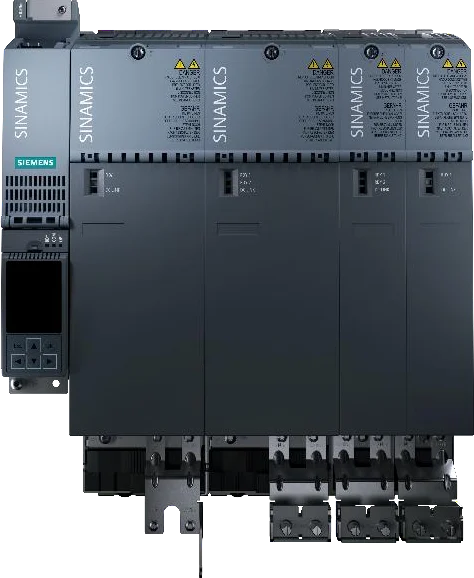
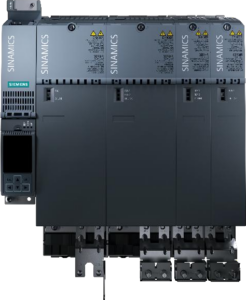
CHICAGO — In a major leap forward for industrial automation and smart manufacturing, Siemens has officially announced the global rollout of its next-generation Sinamics S220 drive system. Building upon the proven foundations of the industry-standard Sinamics S120 platform, the newly engineered drive system is designed to meet the rigorous demands of modern, highly digitized production environments. Part of the expansive Siemens Xcelerator portfolio, the Sinamics S220 integrates advanced computing capabilities, heightened cybersecurity frameworks, and streamlined digital engineering workflows to optimize multi-axis motion control across a broad spectrum of industrial applications.
The official debut of the Sinamics S220 marks a strategic milestone for Siemens as manufacturers increasingly pivot toward software-defined, highly connected, and energy-efficient factory floors. The system is scheduled for its premier public demonstration at the upcoming Automate trade show in Chicago, running from June 22–25, 2026, at Booth 1214.
Main Facts: Core Architecture and Technical Specifications
At the heart of the Sinamics S220 is the newly developed CU320-3 control unit, a high-performance processing hub engineered to handle complex, multi-axis motion tasks with unprecedented precision.
High-Density Multi-Axis Control
The CU320-3 is capable of managing up to 12 individual axes on a single control unit. This high degree of centralization significantly reduces hardware footprint requirements in control cabinets while streamlining wiring and installation complexities.
Advanced Processing and Communication
To support this multi-axis load, the CU320-3 is equipped with a powerful built-in multicore processor. This processing muscle is paired with the Drive-Cliq-Express interface, which facilitates lightning-fast data transfer rates of up to 1 Gbit/s. Furthermore, Siemens has integrated an innovative sensorless control method utilizing three voltage sensors per axis. This technique executes rapid test pulses to approach encoder-level performance without the physical constraints, vulnerabilities, and maintenance overhead associated with traditional motor encoders, simultaneously boosting energy efficiency and system robustness.
Scalability and Power Range
The Sinamics S220 is built for extreme versatility. At launch, Siemens is offering air-cooled motor modules in both book-size and chassis formats designed for standard 3AC 380 to 480 V industrial power systems.
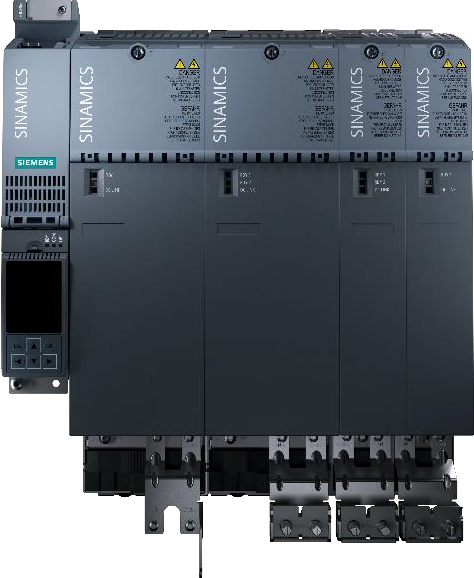
- Power Capacity: Rated currents span from 3 A (representing 1.1 kW) up to a massive 1,518 A (representing 900 kW).
- Expansion: Systems can be seamlessly scaled through up to eight parallel connections.
- Infeeds: For power supply management, regenerative active infeeds ranging from 210 kW to 921 kW are available, also fully scalable via parallel connection.
- Universal Modules: To simplify inventory management for maintenance teams and adapt to shifting application requirements, Siemens has introduced air-cooled universal modules capable of operating interchangeably as either motor modules or active line modules. Just six distinct devices cover the entire functional and performance spectrum.
Chronology: The Evolution to the Sinamics S220
The path to the release of the Sinamics S220 reflects Siemens’ long-term strategy of converging traditional electrical engineering with advanced software integration and data analytics.
- The Foundation (Sinamics S120 Era): For nearly two decades, the Sinamics S120 modular motion control system served as an industry workhorse for high-performance machine building and plant engineering, praised for its flexibility in coordinating multiple drives. However, as Industry 4.0 matured, the limitations of older control architectures regarding edge computing, high-frequency data logging, and rapid cybersecurity protocols became apparent.
- The Digital Transformation Push: Over recent years, Siemens accelerated its digital enterprise framework under the Siemens Xcelerator banner. The company began systematically re-engineering its hardware portfolios to be "digital twin-ready," focusing heavily on seamless software integration via the TIA Portal.
- Development of the CU320-3 and Enhanced Safety: Recognizing the need for faster response times in increasingly collaborative robotic and automated cells, Siemens engineers redesigned the internal safety and control architectures. They compressed the safety cycle down from 12 ms to 4 ms and embedded native support for advanced cryptographic protocols based on the IEC 62443 standard.
- Market Introduction (June 2026): Siemens finalizes the commercial launch of the Sinamics S220, positioning it as the premier motion control solution for modern automated manufacturing, culminating in its premier live showcase at Automate 2026 in Chicago.
Supporting Data: Digitalization, Safety, and Sustainability
The Sinamics S220 is more than a traditional power conversion tool; it is a data-rich edge node designed to thrive in interconnected industrial ecosystems.
Digital Engineering and Virtual Commissioning
Engineered specifically for digital industrial environments, the S220 integrates smoothly with the Totally Integrated Automation (TIA) Portal. It supports virtual commissioning workflows via DriveSim Designer, allowing engineers to test, tweak, and validate motion programs in a virtual space before deploying them to physical hardware. To enhance usability on the factory floor, Siemens has introduced intuitive configuration assistants and a long-awaited undo function. Operators can interface with the drive via a compact panel integrated directly onto the CU320-3, a remote version known as SDI Pro featuring a larger display and built-in web server, or via an optional Smart WiFi adapter for secure remote access.
Next-Generation Safety Architecture
Safety is a critical differentiator for the S220. Siemens has slashed the internal safety cycle time to a blistering 4 ms—a threefold improvement over previous generations—allowing for significantly faster response times in emergency stops and collaborative zones. The drive achieves SIL 3 certification across all operating states. Furthermore, automatic background testing ensures that safety loops are continuously verified without requiring production downtime, while offline-parameterizable safety functions drastically reduce engineering overhead.
Industrial Cybersecurity
Developed in strict compliance with the IEC 62443-4-1 secure development lifecycle standard, the S220 features robust built-in cybersecurity defenses. These include granular user and access control mechanisms, fully encrypted drive data, and rigorous integrity and authentication checks for both firmware updates and configuration profiles.
Environmental Performance and Sustainability
In alignment with global corporate sustainability goals, the Sinamics S220 pairs a compact physical footprint—which minimizes the required floor space in crowded control cabinets—with deep energy visibility tools. Through Industrial Edge applications, users can capture, monitor, and visualize real-time energy consumption and carbon dioxide ($CO_2$) emissions. Demonstrating complete transparency, the drive comes backed by an ISO 14021-certified environmental product declaration (EPD), documenting its ecological impact throughout its entire lifecycle.
Official Responses and Industry Perspectives
While Siemens continues to roll out comprehensive technical documentation for the Sinamics S220, industry analysts and automation experts have already begun evaluating the broader market impact of the new platform.
Industrial automation observers note that the convergence of high-speed multi-axis control (up to 12 axes on a single CU320-3 unit) with native edge connectivity addresses two major pain points for machine builders: cabinet real estate scarcity and the complexity of retrofitting older machines for Industry 4.0 data collection.
By utilizing the X128 interface for high-frequency data transmission, maintenance teams can now feed rich operational parameters directly into predictive maintenance algorithms. This shifts facility management strategies from reactive repair schedules to proactive, condition-based interventions—a capability that enterprise customers increasingly demand to eliminate unplanned downtime.
Furthermore, the emphasis on rapid virtual commissioning via DriveSim Designer aligns with broader industry trends toward modular machine building and accelerated time-to-market. Allowing software validation to occur concurrently with mechanical assembly reduces project delivery timelines significantly.
Implications: What the Sinamics S220 Means for the Future of Manufacturing
The launch of the Siemens Sinamics S220 has profound implications for original equipment manufacturers (OEMs), system integrators, and plant operators alike.
- Streamlined Hardware Inventories: By introducing air-cooled universal modules that can function interchangeably as motor modules or active line modules—with just six devices covering the entire performance tier—Siemens is helping facilities dramatically lower spare parts inventory costs and simplify supply chain logistics.
- Elevated Safety Standards in Collaborative Spaces: The reduction of the safety cycle to 4 ms opens up new possibilities for high-speed, high-payload industrial robotics working in close proximity to human operators, bridging the historical gap between maximum throughput and absolute workplace safety.
- Decentralized Intelligence and Predictive Maintenance: With robust cybersecurity embedded at the silicon and firmware levels via IEC 62443 compliance, manufacturers can safely stream high-frequency operational data to the cloud or local edge servers without fearing malicious network intrusion. This unlocks advanced machine learning models for anomaly detection and component wear analysis.
- Accelerated Sustainable Operations: As regulatory pressures mount regarding corporate carbon footprints, the integration of ISO 14021-certified lifecycle declarations and real-time $CO_2$ tracking empowers industrial facilities to transparently report and continuously optimize their energy efficiency metrics.
As Siemens prepares to demonstrate the capabilities of the Sinamics S220 live at Automate 2026, the industrial automation sector stands on the precipice of a new era where motion control, digital simulation, and airtight security converge into a single, unified platform.