In the rapidly evolving landscape of Industry 4.0, the integration of Artificial Intelligence (AI) into Industrial Control Systems (ICS) presents both a technological frontier and a significant security challenge. As manufacturing facilities move toward more autonomous operations, the "edge"—the point where digital intelligence meets physical machinery—has become the primary battleground for both innovation and defense.
At the recent Industrial AI Summit 2026, the session "From Months to Days: Accelerate Industrial AI with a Modern Data Architecture" tackled these pressing concerns. Featuring insights from Denis Leite, Director of Digital Transformation at Mekatronik, and Aron Semle, CTO of HighByte, the discussion moved beyond theoretical frameworks to address the practical, often messy realities of deploying AI in sensitive industrial environments.
The Security Imperative: Hardening the Edge in an AI-Driven Era
One of the most frequent concerns voiced by OT (Operational Technology) leaders is the inherent vulnerability introduced when external applications interface with legacy control systems. The question remains: If OT is the weak link, how can we design edge architectures that don’t compromise safety for the sake of intelligence?
Two Layers of Defense
Denis Leite argues that edge security must be bifurcated into two distinct, yet complementary, strategies. "The first aspect is the security of the infrastructure itself," Leite notes. "This includes device hardening, OS-level security, network segmentation, robust access control, and firmware integrity. These are non-negotiable foundations. A Unified Namespace (UNS) or a DataOps architecture does not render these traditional cybersecurity practices obsolete; it sits on top of them."
The second, and more nuanced, layer involves the flow of information. In a conventional point-to-point architecture, an external AI application might establish a direct link to a PLC (Programmable Logic Controller) via protocols like OPC UA, granting it the power to write data directly to the controller. Leite suggests this is a critical point of failure.
The "Validation Gateway" Architecture
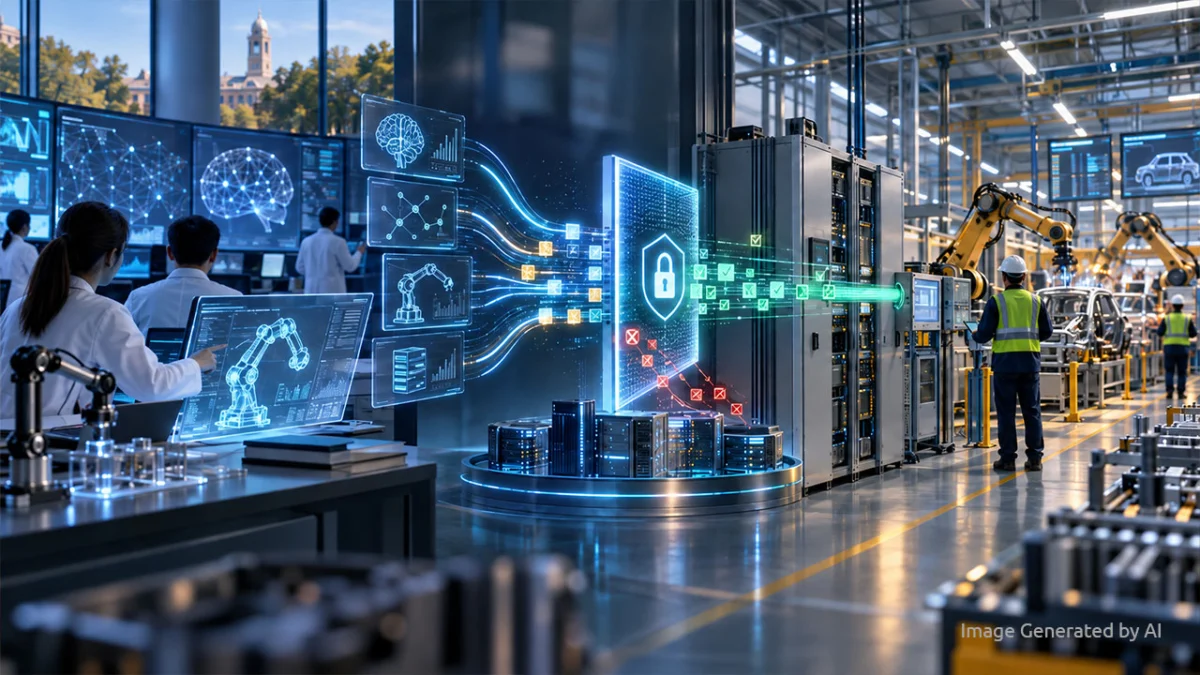
By leveraging a DataOps architecture, manufacturers can introduce an intermediate layer of logic between the AI and the machine. Instead of allowing an AI to write directly to a PLC, the application publishes a "recommendation" to the UNS.
"The value calculated by the external application does not have to be the value that is directly written to the PLC," Leite explains. "The intermediate DataOps layer acts as a validator. It checks whether the requested value falls within safe operational bounds, verifies the current state of the process, and ensures the command is contextually reasonable."
This creates a critical boundary: the AI proposes an outcome, but the OT architecture—governed by strict, pre-programmed safety logic—remains the final arbiter of whether that outcome is executed. By using MQTT brokers with granular access-control mechanisms, firms can define exactly which clients can publish or subscribe to specific namespaces, effectively siloing the AI from sensitive control logic.
Bridging the Academic-Industrial Gap: A Product-Driven Approach
Beyond security, the session explored a perennial challenge in the industrial sector: the disconnect between university-led innovation and the realities of commercial product implementation. When universities and private enterprises collaborate, communication breakdowns often lead to "lab-only" solutions that fail to scale in a production environment.
The Role of Trust and Track Records
Mekatronik’s approach to this collaboration, particularly with the University of Pernambuco (UPE), offers a blueprint for success. According to Leite, the bridge is built on three pillars: people, trust, and a history of delivery.
"Mekatronik has been working with manufacturing companies for two decades," says Leite. "That commitment to results gives us the credibility to bring research projects to the table. In many cases, the professionals we work with at these companies are former colleagues. That personal connection creates a safe environment to explore technological risks."
Research vs. Product Implementation
A critical point of the discussion was whether university projects should always follow the rigorous discipline of product implementation. Leite draws a sharp distinction: "Research needs room for experimentation, uncertainty, and, frankly, failure. However, when we transition a project into an industrial solution, the mindset must shift."
The goal is not to force universities to act like corporations, but to create an ecosystem where each stakeholder contributes their core competency:
- Technology Partners: Providers like HighByte and Siemens supply mature, proven technologies for connectivity and data orchestration, preventing researchers from "reinventing the wheel" regarding edge computing or MLOps.
- Academia: Focuses their intellectual energy on the novel industrial problems—predictive maintenance models, complex optimization algorithms, and high-level logic.
- Industry: Provides the environment, the domain expertise, and the validation of real-world value.
Chronology of the Modern Industrial Data Shift
The transition toward the data-centric architectures discussed at the summit did not happen overnight. It is the result of a multi-year shift in how industrial data is perceived and managed.
- The Era of Silos (2015–2018): Industrial data was trapped in proprietary, point-to-point connections. Scaling AI models was a manual, bespoke effort for every single machine.
- The Rise of Connectivity (2019–2022): The introduction of standardized protocols like MQTT and the early adoption of edge computing allowed for more flexible data collection, but governance remained fragmented.
- The DataOps & UNS Revolution (2023–Present): Companies began treating industrial data as a product. The implementation of the Unified Namespace (UNS) allowed for a "single source of truth," where DataOps layers could manage the flow of information between OT and IT, enabling the secure, scalable AI deployments we see today.
Implications for the Future of Manufacturing
The implications of this architectural shift are profound. By decoupling the application from the hardware, manufacturers gain unprecedented agility.
Scalability and Governance
As AI models proliferate, the traditional method of managing hundreds of direct connections to PLCs becomes a maintenance nightmare. A properly governed UNS allows IT and OT teams to scale AI deployments without exponentially increasing their security footprint. If a new AI application is added, it connects to the UNS, not the machine, drastically reducing the number of interfaces that require monitoring.
The Cultural Shift
Perhaps the most significant takeaway from the summit is that industrial transformation is not merely a technological problem—it is a human one. The success of the UPE-Mekatronik partnership demonstrates that when industry and academia align on a shared goal, supported by mature technology partners, the "valley of death" between research and deployment can be bridged.
"We don’t think the gap between universities and industry is closed by making universities behave more like companies," Leite concludes. "It is closed by bringing together the right people and ensuring that we use proven, established technologies to solve the problems we already know, leaving our brightest minds free to tackle the problems that truly require innovation."
Conclusion: A New Standard for Industrial AI
The Industrial AI Summit 2026 underscored that the path to success in Industrial AI is paved with rigorous data governance and intentional, human-centric collaboration. By designing security into the architecture rather than treating it as a bolt-on, and by fostering an ecosystem where research is transitioned into production with discipline, manufacturers can move from months to days in their deployment cycles.
As the industry continues to mature, the lessons shared by Mekatronik and their partners serve as a roadmap for any organization looking to navigate the complexities of modernizing their industrial footprint. The future of manufacturing lies not just in the intelligence of the AI, but in the structural integrity of the data architecture that supports it.
This article summarizes key takeaways from the "From Months to Days: Accelerate Industrial AI with a Modern Data Architecture" session at the Industrial AI Summit 2026. The session was moderated by Hamish Mackenzie and featured industry insights from Denis Leite (Mekatronik) and Aron Semle (HighByte). The session was sponsored by HighByte.