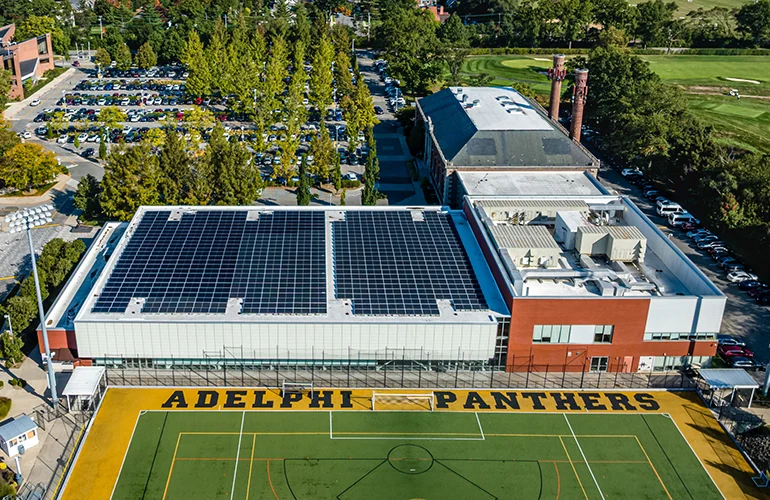
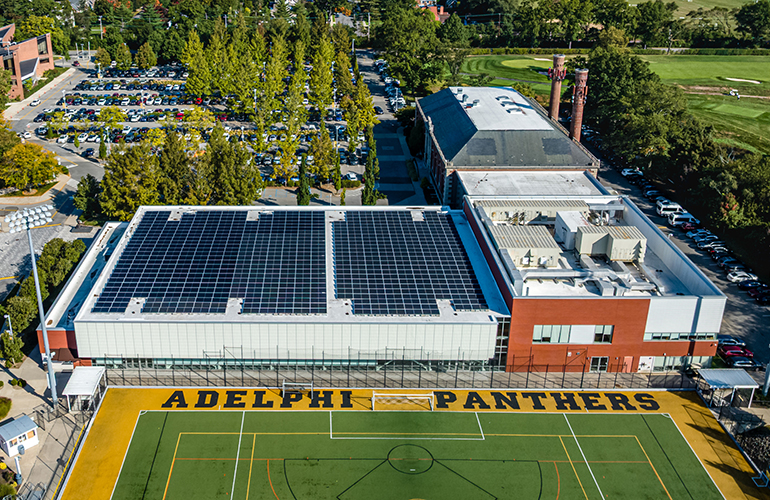
GARDEN CITY, N.Y. — Adelphi University is continuing its long-standing commitment to environmental stewardship with the official commercial operation of a new 295-kilowatt (kW) rooftop solar system. Installed atop the institution’s LEED-certified Center for Recreation and Sports on its 75-acre main campus in Garden City, Long Island, the clean energy project marks a significant milestone in the university’s ongoing transition toward comprehensive campus sustainability.
Comprising 546 high-efficiency solar panels, the array is designed to offset a substantial portion of the heavily utilized athletic facility’s daily electricity consumption. Developed, owned, and operated by Greenskies Clean Energy under a long-term power purchase agreement (PPA), the project represents a collaborative effort among higher education administrators, commercial renewable energy advisors, and green technology developers.
While the new solar array is a standalone victory for the university’s carbon reduction goals, its creation was born out of an unexpected infrastructure challenge. The seamless integration of a brand-new roof and a modern photovoltaic system highlights how unexpected capital hurdles can be transformed into long-term strategic advantages.
Chronology of the Project: From Infrastructure Challenge to Clean Energy Triumph
The path to powering the Center for Recreation and Sports with solar energy was not a straight line; rather, it began with an urgent facilities management issue.
The Premature Roof Failure
The initiative kicked off with an unforeseen setback when the gymnasium roof of the university’s main athletic facility suffered a premature failure. Compounding the issue, the original manufacturer of the roof was no longer in business, leaving university facilities management with a critical maintenance emergency. A complete roof replacement was unavoidable, presenting the administration with a major unexpected capital expenditure.
Seizing the Opportunity (2022)
Faced with the mandatory expense of a roof replacement, Robert Shipley, Adelphi’s assistant vice president for facilities management, recognized an opportunity to maximize the university’s investment. Instead of simply replacing the failed membrane, Shipley and his team asked a forward-thinking question: How could the institution leverage this necessary construction to advance its broader institutional goals?
The decision was made to pair the roof replacement with a commercial-scale solar installation. In 2022, Adelphi engaged SolarKal, a commercial solar advisory and marketplace firm, to help navigate the complex market of solar developers, financial structures, and technological requirements.
Development and Construction
With SolarKal acting as an advisor to guide the procurement and partner-selection process, Adelphi ultimately selected Greenskies Clean Energy to spearhead the development and construction of the array. Greenskies managed the intricate logistics required to install 546 solar panels on a large, active recreational facility, carefully coordinating the structural reinforcement of the new roof, the physical placement of the photovoltaic hardware, and the eventual grid interconnection with local utilities.
Commercial Operation
Following meticulous planning, engineering, and construction phases, the system officially reached commercial operation. The 295-kW array is now actively generating clean, renewable electricity, seamlessly feeding power directly into the Center for Recreation and Sports and reducing the campus’s reliance on fossil fuels.
Supporting Data and Adelphi’s Historical Sustainability Portfolio
To fully understand the magnitude of Adelphi University’s latest solar initiative, it must be viewed within the context of the institution’s two-decade-long history of targeted investments in energy efficiency and sustainable infrastructure.
Project Specifications
- System Capacity: 295 kW DC
- Component Count: 546 high-efficiency solar panels
- Location: Rooftop of the Center for Recreation and Sports (a LEED-certified facility)
- Campus Size: 75 acres (main campus in Garden City, New York)
- Financial Model: Power Purchase Agreement (PPA) with Greenskies Clean Energy, minimizing upfront capital outlays for the university.
Adelphi’s Sustainability Timeline
The 295-kW solar array is far from Adelphi’s first foray into green engineering. The university has a documented history of pioneering environmental projects dating back over twenty years:
- 2003 – Geothermal Innovation: Adelphi launched its first major sustainability milestone by implementing a comprehensive geothermal heating and cooling project, significantly reducing the campus’s thermal energy demands.
- 2011 – Early Solar Adoption: The university installed its first campus solar project—a 50-kW photovoltaic array on the roof of the campus library. Though modest by today’s commercial standards, this installation demonstrated the viability of solar technology within the campus microgrid.
- 2016 – Cogeneration Plant: Demonstrating its appetite for large-scale infrastructure overhauls, Adelphi brought a 2-megawatt (MW) combined heat and power (cogeneration) plant online. This system vastly improved energy efficiency by generating electricity while simultaneously capturing waste heat for campus use.
- 2026 – Sports Center Solar Array: The completion of the 295-kW rooftop system on the Center for Recreation and Sports cements the institution’s ongoing transition toward decentralized, renewable power generation.
Official Responses and Stakeholder Perspectives
The successful realization of the Adelphi solar project was praised by leadership across all participating organizations, emphasizing the strength of cross-sector partnerships in driving the clean energy transition.
University Administration
Carol Ann Boyle, vice president of campus operations at Adelphi University, emphasized that the project is a physical manifestation of the school’s core institutional values.
"Smart growth and sustainable infrastructure are key priorities for Adelphi University, and this project aligns directly with those goals," Boyle stated. "Bringing more solar online is a major step toward Adelphi’s cleaner, more sustainable future."
Robert Shipley, assistant vice president for facilities management, reflected on the strategic decision to combine the roof replacement with renewable energy infrastructure.
"We had to replace the roof, so the question became: How do we make the most of that investment?" Shipley said. "Pairing the new roof with solar gave us an opportunity to solve an immediate problem while doing something that will benefit Adelphi for years to come."
Advisory and Development Partners
Neil Sharma, co-founder and chief commercial officer (CCO) of SolarKal, noted the personal and professional significance of seeing the multi-year effort come to fruition.
"As a New Yorker with a personal connection to Adelphi, this has always felt like a hometown project to me," Sharma remarked. "After working toward it for years, it’s especially rewarding to see it come to life. We had the right partners, worked through the challenges, and ultimately delivered a great project with lasting value for Adelphi."
Carson Mislick, director of project delivery at Greenskies Clean Energy, pointed to the complexities inherent in executing a combined roofing and solar endeavor.
"Projects like this take close coordination from development through construction and interconnection," Mislick explained. "We’re proud to have worked alongside Adelphi and SolarKal to bring the project across the finish line and deliver a system that will support the University’s long-term sustainability goals."
Broader Implications for Higher Education and Renewable Energy
The completion of the Adelphi University solar project carries several broader implications for the higher education sector, urban campus design, and the commercial solar industry in the Northeast.
The Rise of "Opportunity-Driven" Sustainability
One of the most notable takeaways from Adelphi’s experience is the concept of "opportunity-driven" green infrastructure. Many universities and commercial property owners defer sustainability upgrades due to perceived costs or the complexity of retrofitting existing buildings. However, Adelphi’s strategy demonstrates that unavoidable capital expenses—such as emergency roof replacements—can serve as ideal catalysts for renewable energy adoption. By bundling roofing and solar contracts, property owners can optimize labor costs, secure warranties that align between the roof and the racking systems, and immediately mitigate the long-term energy consumption of large, energy-intensive buildings like gymnasiums and recreation centers.
Power Purchase Agreements (PPAs) as Enablers
The use of a Power Purchase Agreement (PPA) with Greenskies Clean Energy underscores how third-party financing models continue to drive the adoption of clean energy in institutional settings. Under a PPA, the developer assumes the upfront capital costs of engineering, procuring, and constructing the solar array, while the host institution agrees to purchase the generated electricity at a predictable, often discounted rate over a set period. This financial structure allows universities like Adelphi to pursue aggressive carbon-reduction targets without depleting their endowments or capital improvement funds reserved for academic programming.
Leadership in Long Island’s Energy Transition
As New York State pursues aggressive climate targets under the Climate Leadership and Community Protection Act (CLCPA)—which mandates zero-emission electricity by 2440 and significant reductions in statewide greenhouse gas emissions—institutions of higher education are under increasing pressure to lead by example. Located on Long Island, Adelphi University’s continuous incremental upgrades—from geothermal heating in 2003 to cogeneration in 2016 and expanded solar in 2026—serve as a blueprint for other regional campuses seeking to modernize aging infrastructure while shrinking their carbon footprint.
Ultimately, the 295-kW installation on the Center for Recreation and Sports is more than just a collection of 546 solar panels; it is a testament to resilient facilities management, strategic financial advisory, and the power of private-public and commercial partnerships in building a sustainable, low-carbon future for generations of students to come.