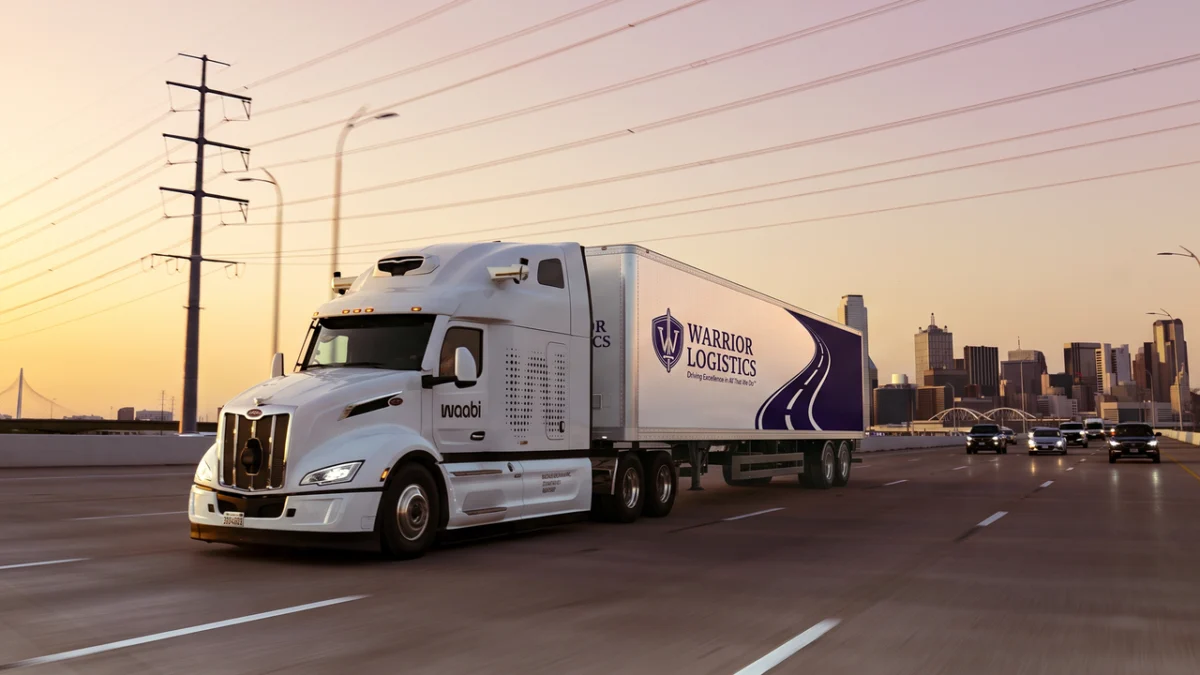
DALLAS — In a major development for the autonomous freight industry, artificial intelligence developer Waabi and Coppell, Texas-based carrier Warrior Logistics have officially announced a commercial partnership. The alliance brings Waabi Driver-powered autonomous trucks into Warrior’s active network, handling routine, recurring customer freight along the crucial commercial corridor between Dallas and Houston.
The partnership, which quietly began operations earlier this year, marks a significant step forward in the integration of self-driving technology into traditional freight networks. As supply chain pressures mount and driver shortages persist, the collaboration showcases how established asset-based carriers and cutting-edge tech developers can join forces to optimize fleet capacity, improve delivery metrics, and reshape the future of American logistics.
Main Facts: The Alliance and Operational Scope
Under the terms of the commercial agreement, Warrior Logistics—an asset-based carrier founded in 2015 that operates a private fleet of more than 200 trucks—has integrated a fleet of Waabi-powered autonomous trucks into its day-to-day operations. These vehicles are being deployed to haul routine, recurring shipments for a diverse roster of clients, including food and beverage providers, consumer packaged goods companies, and other core customers.
While both companies have opted to keep the exact financial terms, the size of the deployed Waabi fleet, and the precise volume of hauled loads confidential, the operational results to date have been thoroughly documented. According to data released by Waabi, routes completed by the autonomous trucks since the start of the partnership have achieved a flawless 100% on-time pickup and delivery record, alongside a pristine safety record featuring zero incidents.
The trucks operate primarily along Interstate 45, connecting the major metropolitan hubs of Dallas and Houston—a vital, high-density trade artery in the Lone Star State. This lane has proven to be an ideal testing and scaling ground for Waabi’s autonomous software stack, which relies on advanced artificial intelligence to navigate complex highway dynamics, unpredictable weather, and demanding traffic environments.
Chronology: From First Revenue Loads to Commercial Scaling
To understand the significance of the Warrior Logistics partnership, it is helpful to examine the rapid timeline of Waabi’s commercial deployment in Texas:
- September 2023: Waabi successfully moves its first commercial revenue loads on Interstate 45 between Dallas and Houston, coinciding with the announcement of a landmark 10-year strategic partnership with Uber Freight.
- January 2024: Waabi outlines its long-term roadmap, emphasizing its commitment to door-to-door autonomy while noting that safety drivers will remain in the cab until fully redundant vehicle platforms are certified and ready from original equipment manufacturers (OEMs).
- July 2024: In a major technical milestone, Waabi demonstrates the adaptability of its software by taking an AI driver trained exclusively on a Peterbilt 579 and successfully deploying it on a Volvo VNL Autonomous truck without requiring any new data or retraining.
- Earlier in 2025: Warrior Logistics and Waabi quietly initiate commercial operations on the Dallas-Houston corridor, integrating autonomous trucks into Warrior’s regular shipping routes.
- October 2025 (9 Days Prior to Warrior Announcement): Waabi and Volvo Autonomous Solutions officially begin hauling commercial freight for logistics provider Warp, utilizing Volvo VNL Autonomous trucks powered by the Waabi Driver for direct-to-facility deliveries.
- Mid-October 2025: Waabi and Warrior Logistics publicly announce their commercial partnership, confirming explosive growth on the Dallas-Houston route.
Supporting Data and Market Momentum
The numbers surrounding Waabi’s operations point to a broader trend of rapid commercialization within the autonomous trucking sector.
According to company metrics, commercial load volume on Waabi’s signature Dallas-Houston route has surged by more than 80% over the course of the year. Although Waabi did not disclose its exact baseline figures, the triple-digit percentage growth signals a transition from experimental pilot programs to sustained, high-volume commercial utilization.
The partnership also acts as a force multiplier for Warrior Logistics. Operating a fleet of over 200 trucks, Warrior is leveraging Waabi’s autonomous units to bridge capacity gaps. By letting self-driving trucks handle predictable, repetitive highway legs, Warrior can maximize the productivity of its broader asset base without overworking its human workforce.
Furthermore, Waabi’s leadership has reiterated its commitment to taking the final step toward truly driverless operations. While safety operators currently sit behind the wheel to monitor systems—especially during complex interchanges and terminal approaches—Waabi COO Lior Ron confirmed that the company remains "fully on track for driverless next year, with Volvo as the first OEM platform."
Official Responses and Strategic Vision
Leadership from both companies have emphasized that the partnership is built on mutual trust, technological innovation, and a collaborative approach to fleet integration.
Scott McFarlane, CEO of Warrior Logistics, highlighted why his company chose to partner with Waabi in a crowded marketplace of autonomous developers. McFarlane pointed to three key pillars: a leadership team he deeply trusts, technology that he describes as "truly innovative," and a co-development model that allowed Warrior’s operations team to witness firsthand the safety and reliability of the Waabi Driver.
"Our customers want more capacity on our core lanes, and they want it to be consistent," McFarlane said. "Our partnership with Waabi gives us the flexibility to deliver that. Waabi Driver-powered trucks complement our professional drivers, build density on our power lanes, and add capacity on the routes that are less desirable for our drivers."
McFarlane envisions a symbiotic operational ecosystem where autonomous trucks and professional drivers work side by side. Rather than viewing technology as a replacement for human labor, Warrior is utilizing it to alleviate driver fatigue on grueling, monotonous stretches of highway.
Lior Ron, COO of Waabi, echoed these sentiments, praising Warrior’s active involvement in refining the technology.
"Warrior has helped shape our technology over the course of our partnership, and the impact we’re seeing across their operations shows how we can help carriers take on more freight, serve more customers, and grow their business," Ron stated.
Looking ahead, the two companies have outlined plans to jointly evaluate, select, and develop new autonomous lanes across Warrior Logistics’ broader network over the coming year.
Industry Implications: Hybrid Fleets and the Path to Driverless
The Waabi-Warrior Logistics partnership carries significant implications for the broader logistics and transportation industries:
1. The Rise of the Hybrid Fleet
For years, the narrative surrounding autonomous trucks has often been framed as a zero-sum game between human drivers and machines. Partnerships like the one between Waabi and Warrior dismantle this myth. By deploying autonomous trucks on repetitive, high-density lanes—such as Dallas-Houston—carriers can free up human drivers for more complex, localized drayage and routes that require human problem-solving and customer interaction.
2. Easing Capacity Constraints and Service Consistency
Shippers in the food, beverage, and consumer goods sectors demand absolute reliability. With Waabi-powered trucks achieving 100% on-time pickups and deliveries in their early runs, asset-based carriers now have a viable tool to guarantee service levels, even amid fluctuating market conditions and chronic labor shortages in long-haul trucking.
3. OEM Partnerships and the Driverless Horizon
Waabi’s strategic positioning with hardware giants like Volvo Autonomous Solutions—coupled with its software’s demonstrated ability to generalize across different truck models—places the company at the forefront of the commercial autonomous race. With planned driverless deployments targeted for the upcoming year, the logistics industry is rapidly approaching a watershed moment where commercial, driverless Class 8 trucks will transition from a futuristic vision into an everyday highway reality.
As Waabi and Warrior Logistics expand their footprint across Texas, the lessons learned on Interstate 45 will likely serve as a blueprint for nationwide autonomous freight scaling in the years to come.