By Industry News Desk
Published: August 2026
Main Facts: A Unified Automation Shield for Next-Generation Data Centers
As the global push toward artificial intelligence (AI) and machine learning (ML) accelerates, the infrastructure supporting these high-density workloads is facing unprecedented operational strain. To address this critical industry bottleneck, global technology and engineering leader Emerson has officially launched the DeltaV Automation Platform for Data Centers.
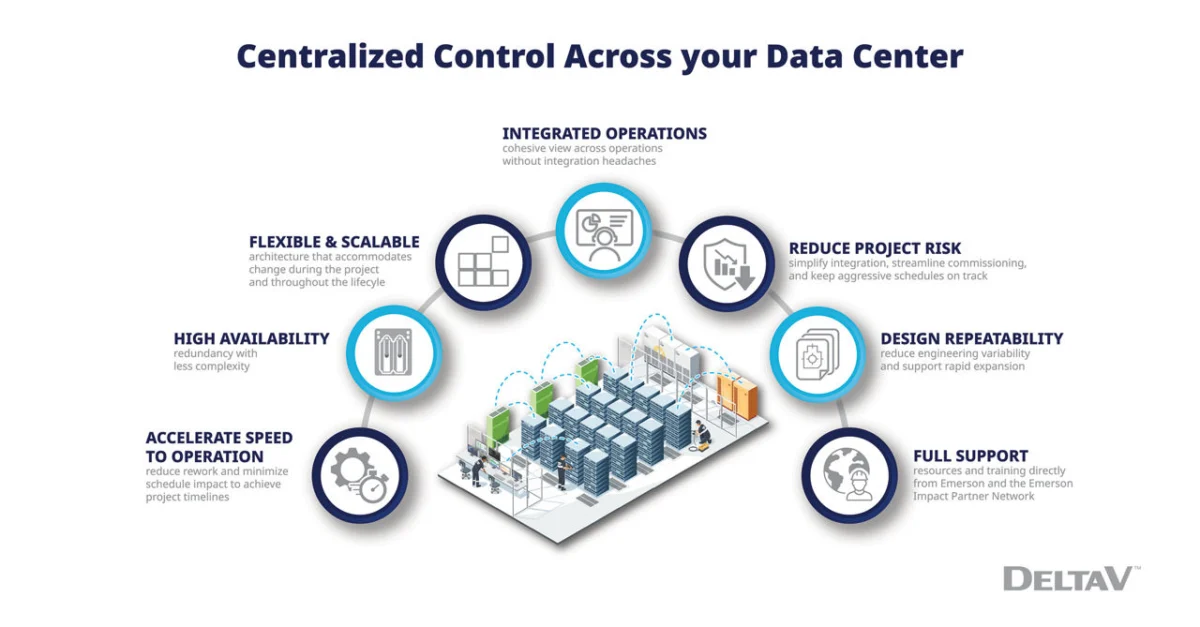
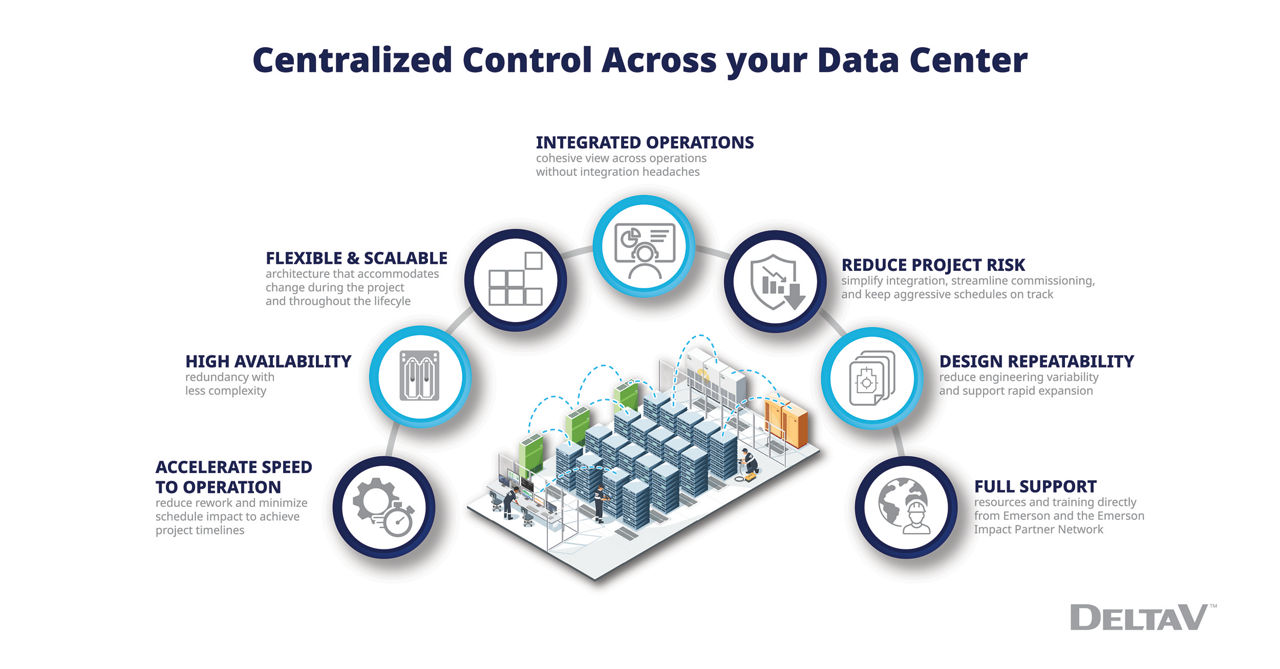
This comprehensive automation portfolio is purpose-built to monitor, manage, and optimize the mission-critical infrastructure required by modern, AI-driven data facilities. By seamlessly integrating thermal, mechanical, and electrical subsystems within a single, highly scalable automation framework, the platform offers a departure from traditional, fragmented control models.
The core facts of the Emerson DeltaV Data Center platform include:
- Holistic Integration: Bridges the gap between electrical power distribution, mechanical cooling units, and environmental control subsystems.
- Core Technology: Leverages Emerson’s industry-proven DeltaV Distributed Control System (DCS) working in tandem with advanced DeltaV Programmable Logic Controllers (PLCs).
- AI-Enhanced Workflows: Incorporates context-specific artificial intelligence tools designed to streamline engineering workflows, execute advanced process control (APC), and interface effortlessly with external AI optimization models.
- Lifecycle Efficiency: Aims to compress deployment schedules, reduce overall engineering effort, simplify system integration, and ensure long-term consistency across the commissioning, operational, and maintenance phases of a facility’s life cycle.
Chronology: The Evolution of Data Center Demands and Emerson’s Response
The rapid evolution of data center architecture over the past decade provides essential context for the introduction of Emerson’s new platform.
Phase 1: The Cloud and Hyperscale Era (2010–2020)
For years, data center design was dominated by cloud computing, streaming services, and enterprise storage. While facilities grew in physical footprint—evolving into massive hyperscale warehouses—the heat loads and power densities per rack remained relatively predictable, typically ranging from 5 to 10 kilowatts (kW) per rack. Subsystems for power and cooling were often procured from multiple vendors and managed via siloed building management systems (BMS) or disparate point solutions.
Phase 2: The Generative AI Explosion (2022–2025)
The public rollout of generative AI models shifted the paradigm overnight. High-performance compute (HPC) clusters, powered by advanced Graphics Processing Units (GPUs) and Tensor Processing Units (TPUs), sent rack power densities skyrocketing to 40kW, 60kW, and even upwards of 100kW per rack.
This extreme concentration of computing power generated unprecedented thermal loads, rendering traditional air-cooling methodologies insufficient and forcing the rapid adoption of liquid cooling. Simultaneously, the sheer volume of power required to run these clusters strained electrical grids, necessitating tighter coordination between backup generators, uninterruptible power supplies (UPS), and primary power feeds.
Phase 3: The Integration Imperative (2026 and Beyond)
Recognizing that manual coordination and legacy software could no longer keep pace with accelerated construction timelines, Emerson developed the DeltaV Automation Platform for Data Centers. By consolidating disparate control systems into a unified architecture from the initial design phase, Emerson aims to solve the synchronization crises currently plaguing mission-critical construction projects worldwide.
Supporting Data: The Logistics and Engineering Crisis of AI Infrastructure
The urgency behind Emerson’s product launch is underscored by data from across the engineering, construction, and power sectors. The AI boom has triggered a massive wave of capital expenditure, but it has also exposed critical vulnerabilities in supply chains and project execution.
Compressed Schedules vs. Complex Engineering
Industry data indicates that data center developers are under immense pressure to bring facilities online in record time—often cutting standard project lifelines from 36 months down to 18–24 months. However, this compression clashes directly with the growing complexity of the infrastructure itself. Modern AI facilities require intricate coordination among:
- Supply chain vendors supplying long-lead electrical switchgear and chillers.
- Multidisciplinary engineering teams designing redundant power paths.
- Electrical and mechanical contractors working on tight job sites.
- Commissioning agents tasked with verifying system reliability before go-live.
The Cost of Siloed Systems
Historically, data centers relied on separate point solutions for electrical power monitoring systems (EPMS), building management systems (BMS), and specialized cooling controls. According to industrial automation studies, relying on disparate point solutions increases engineering hours during integration by up to 30%. Furthermore, manual data handoffs between electrical and mechanical subsystems frequently introduce vulnerabilities that can lead to catastrophic downtime or inefficient energy usage—a critical issue given that cooling and power infrastructure can account for over 40% of a data center’s total operational expenditure.
By unifying these elements under the DeltaV umbrella, Emerson’s platform targets these exact friction points, promising reduced engineering hours and a streamlined path from blueprint to full-scale commercial operation.
Official Responses and Technological Architecture
While the broader engineering community has long recognized the need for convergence between process control and data center management, Emerson’s deployment of context-specific AI tools within its DCS and PLC ecosystem marks a significant step forward.
Inside the DeltaV Architecture
The platform’s strength lies in the synergy between its core components:
- DeltaV Distributed Control System (DCS): Acts as the central nervous system for the data center, providing high availability, robust security, and enterprise-grade reliability traditionally reserved for mission-critical chemical plants and power generation facilities.
- DeltaV Programmable Logic Controllers (PLCs): Seamlessly connect to the DCS to handle localized, high-speed subsystem control, such as managing individual chiller loops, computer room air handlers (CRAHs), and direct-to-chip liquid cooling distribution units (CDUs).
- Embedded AI Tools: The newly integrated AI capabilities are not generic; they are context-specific. They assist engineers by automating routine configuration tasks, predicting maintenance anomalies before they cause failures, and continuously analyzing thermal and electrical loads to optimize power usage effectiveness (PUE).
Industry Perspective
Though specific customer deployment names are rolling out in waves alongside major hyperscale developers, industry analysts note that process control giants like Emerson are uniquely positioned to capture market share in this domain. Unlike traditional IT management software, companies rooted in industrial automation bring decades of expertise in managing continuous, high-stakes environments where failure is simply not an option.
Implications: Shaping the Future of Autonomous Data Centers
The introduction of the DeltaV Automation Platform for Data Centers carries profound implications for the future of industrial automation, energy grids, and the broader digital economy.
1. Paving the Way for Fully Autonomous Operations
The ultimate roadmap for modern data facilities is full autonomy—the ability of a facility to self-optimize, reroute power during micro-outages, and dynamically adjust cooling flows based on real-time AI compute loads without human intervention. By integrating advanced process control with AI optimization models at the controller level, Emerson is laying the foundational hardware and software infrastructure required to make lights-out, autonomous data centers a reality.
2. Easing Grid Stresses and Sustainability Targets
Data centers are under intense scrutiny regarding their environmental impact and strain on local electrical grids. By tightly integrating electrical and mechanical systems through a high-precision automation platform, operators can achieve hyper-accurate tracking of energy consumption. This optimization directly supports corporate sustainability goals, minimizes carbon footprints, and prevents localized grid destabilization through smarter load-shedding and energy storage utilization.
3. Redefining Project Delivery Standards
For engineering and construction firms, the availability of scalable, pre-engineered automation architectures changes the bidding and execution landscape. Projects that once required custom software development and extensive on-site troubleshooting can now rely on standardized, pre-validated integration frameworks. This shift is expected to become a competitive differentiator for developers racing to capture market share in the booming AI landscape.
Conclusion
As artificial intelligence continues to push the boundaries of computing power, the physical infrastructure supporting it must evolve in lockstep. Emerson’s DeltaV Automation Platform for Data Centers represents a pivotal shift from fragmented, manual subsystem management to a unified, intelligent, and scalable control paradigm. By bridging the gap between electrical, mechanical, and process control domains—and embedding AI directly into the engineering workflow—Emerson is equipping the data center industry to meet the immense challenges of the AI era head-on.
For more information on Emerson’s industrial automation portfolios and data center solutions, visit emerson.com.