





GLEN COVE, N.Y. — In a significant development for the industrial automation sector, Standard Bots has officially unveiled a suite of three artificial intelligence capabilities designed to fundamentally transform how manufacturers program, direct, and utilize robotic systems on the shop floor. Entitled Agent, Locate, and Inspect, this new proprietary software ecosystem is integrated directly into the Standard Bots AI platform.
The launch arrives at a critical juncture for global manufacturing. As factories face persistent labor shortages, volatile supply chains, and an increasing demand for high-mix, low-volume production, the traditional bottlenecks of industrial automation—namely complex coding, expensive systems integration, and rigid deployment models—have become increasingly untenable. By democratizing access to advanced robotics through natural language processing and computer vision, Standard Bots aims to make robotic deployment as intuitive as interacting with a consumer smartphone.
Main Facts: The Core Components of the Standard Bots AI Suite
The newly introduced platform comprises three distinct yet interconnected pillars, each engineered to address a specific, long-standing friction point in manufacturing and assembly lines:
- Agent (Natural Language Programming): The Agent capability allows factory operators to describe a desired task using standard, everyday conversational language. Rather than navigating complex control panels or writing lines of code, an operator can simply prompt the system with requests such as building a machine-tending routine. The software then engages in an interactive dialogue, asking clarifying questions about the specific application parameters before autonomously generating the robot program alongside the operator.
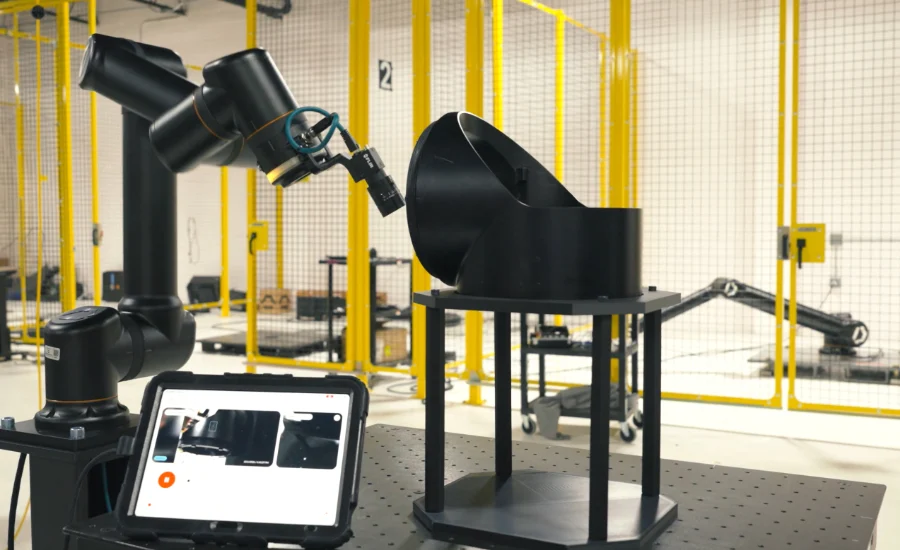
- Locate (Visual Part Tracking): Leveraging the robot’s onboard video feed, Locate identifies and tracks parts dynamically. Instead of manually plotting and defining coordinates across multiple rigid waypoints—a tedious process that traditionally requires specialized engineering hours—operators can simply tap an object on a video screen or describe it via text input. Standard Bots reports that this capability alone can slash programming time by up to 90%, effectively eliminating grid-based waypoint establishment.
- Inspect (Automated Vision Quality Control): Developed through a strategic partnership with computer vision leader Roboflow, Inspect seamlessly weaves automated quality control into routine robot tasks. The system utilizes custom vision models trained directly on a manufacturer’s proprietary parts to catch surface-level defects, structural inconsistencies, or manufacturing flaws (such as scratches or casting imperfections). Crucially, manufacturers are not restricted to pre-packaged software; they can upload and run their own custom inspection models directly on the Standard Bots platform.
Chronology: The Evolution of Industrial Robotics and the Shift Toward AI
To understand the magnitude of Standard Bots’ latest release, it is helpful to examine the historical trajectory of industrial automation and how the industry arrived at this turning point.
The Era of Hard Automation (1960s–1990s)
When industrial robots first entered the mainstream automotive and manufacturing sectors in the mid-20th century, they were marvels of engineering built for massive, repetitive scale. However, these machines were essentially "dumb" mechanical arms. They required extensive custom engineering, hard-coded logic via proprietary programming languages (such as RAPID or KRL), and fixed physical environments. Changing a robot’s task meant shutting down the line for days or weeks while specialized integrators re-calibrated sensors and re-taught waypoints.
The Rise of Collaborative Robots, or Cobots (2000s–2010s)
The introduction of collaborative robots (cobots) in the early 2000s marked a major milestone. Designed to work safely alongside humans without the need for massive safety cages, cobots lowered the physical barrier to entry. However, programming them remained largely the domain of robotics engineers. While "teach pendants" and hand-guiding made physical path-recording easier, setting up complex logic, high-mix sorting, and vision integration still demanded considerable technical expertise.
The AI and Natural Language Revolution (Present Day)
With the exponential growth of generative AI, large language models (LLMs), and advanced machine vision over the past several years, the industrial automation landscape has begun experiencing a paradigm shift. Standard Bots’ integration of natural language prompting and dynamic computer vision represents the bleeding edge of this transition. By abstracting the underlying code behind conversational interfaces and self-updating vision models, the industry is moving from programming robots to teaching them in real time.
Supporting Data and Technical Architecture
The operational metrics released by Standard Bots highlight the profound efficiency gains made possible by the new AI platform. According to company data, the Locate feature’s ability to eradicate manual waypoint grids reduces initial programming and setup time by an estimated 90%.
This efficiency is especially vital for high-mix, low-volume (HMLV) manufacturing environments. In traditional high-mix settings, where product specifications change frequently throughout the day, the downtime associated with re-programming robots often outweighs the benefits of automation. By allowing operators to visually tap or textually describe a new part layout in seconds rather than hours, changeover times plummet.
Furthermore, the integration of Inspect via the Roboflow partnership bridges a historical gap between mechanical manipulation and quality assurance (QA). Traditionally, machine vision and robotic handling were handled by two separate, highly customized systems requiring complex middleware and expensive hardware integration. By unifying motion control, part location, and defect detection within a single native platform, manufacturers reduce hardware footprint, latency, and points of potential failure.
Standard Bots’ open approach to model architecture is another critical technical differentiator. While the company is actively developing its own proprietary foundation models tailored specifically to industrial applications, it intentionally designed the platform to accept third-party and custom models. This flexibility ensures that manufacturers who have already invested in proprietary AI training datasets can deploy them without starting from scratch.

Official Responses and Industry Perspective
The high-cost, high-friction reality of legacy industrial automation has long been a frustration for small- and medium-sized manufacturers (SMMs). Leif Jentoft, Head of Applied AI at Standard Bots, pulled no punches when describing the pain points the new platform is designed to eliminate.
"You used to have to hire an integrator; it costs a million dollars. You spend months dialing it in. And when something breaks in the middle of the night, you can’t fix it yourself," said Jentoft.
"It’s like a literal black box on your own shop floor. With Standard Bots AI, you don’t have to program every position or keep track of where you are in a routine. You simply show your robot what you want it to do, and it will adapt to higher-mix tasks with simpler, more reliable programs."
Jentoft’s comments resonate deeply within the broader manufacturing community, where skilled labor shortages have left many facilities struggling to fill specialized programming roles. By shifting the burden of logic creation from human programmers to AI agents, facilities can empower existing floor workers—regardless of their coding background—to oversee and modify robotic routines.
Implications for the Future of Manufacturing
The launch of the Agent, Locate, and Inspect capabilities points toward several profound implications for the future of industrial manufacturing and the robotics industry at large:
1. Democratization of Automation for Small and Medium Enterprises (SMEs)
Historically, complex robotics solutions were financially and operationally out of reach for smaller job shops and localized manufacturers. By reducing the reliance on expensive external system integrators and slashing deployment times, platforms like Standard Bots lower the total cost of ownership (TCO) for automation. This leveling of the playing field allows smaller operations to compete more effectively against global conglomerates.
2. Redefining the Role of the Shop Floor Worker
As natural language interfaces and visual tracking streamline operations, the job description of the manufacturing floor worker is evolving. The need to memorize complex syntax or manually calibrate physical coordinates is giving way to supervisory roles where human workers act more like mentors or trainers to the robotic systems. Operators guide the robot through conversational prompts and visual cues, focusing their human ingenuity on problem-solving, process optimization, and quality oversight.
3. Accelerated Adoption of High-Mix, Low-Volume Production
Consumer demand increasingly favors mass customization over mass production. Manufacturers must frequently pivot between different product variations, SKUs, and batch sizes. Rigid legacy automation penalized high-mix operations due to continuous downtime for reprogramming. With AI platforms capable of recognizing new parts instantly via a video feed or natural language update, the economic penalties of high-mix manufacturing evaporate, enabling true agile manufacturing.
4. A Shift Toward Open Ecosystems
By allowing manufacturers to integrate their own custom vision and AI models, Standard Bots is signaling a departure from closed, proprietary hardware-software ecosystems. This openness encourages collaborative innovation, allowing factories to leverage specialized third-party algorithms for unique manufacturing challenges without being locked into a single vendor’s software catalog.
Conclusion
Standard Bots’ introduction of Agent, Locate, and Inspect marks an important milestone in the ongoing evolution of industrial automation. By combining conversational AI, real-time computer vision, and flexible model integration, the company has addressed some of the most stubborn barriers to robotic adoption. As manufacturers continue to navigate labor shortages and market volatility, solutions that replace rigid, expensive programming with intuitive human-robot collaboration will undoubtedly shape the factories of tomorrow.