



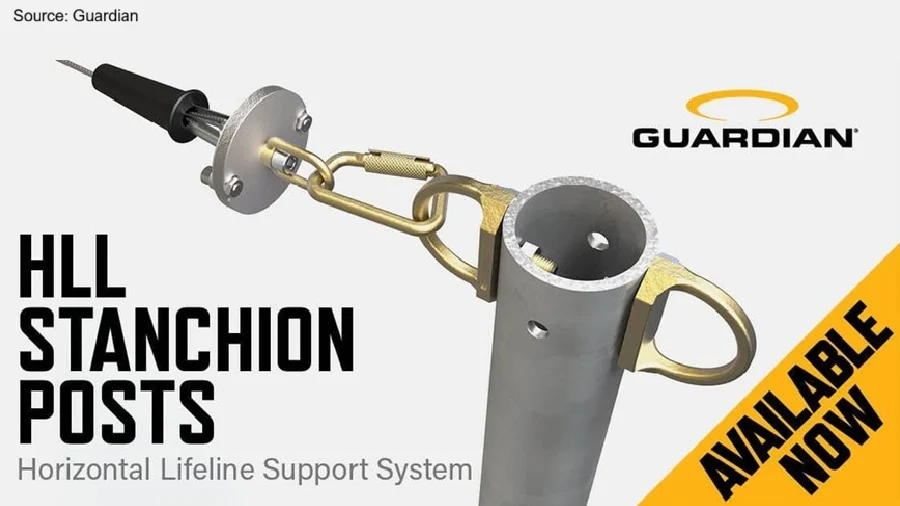
AUSTIN, TX — In an industry where fall-related injuries and fatalities remain a persistent challenge, height safety equipment leader Guardian has announced the official commercial launch of its new Horizontal Lifeline (HLL) Stanchion Post System. Engineered to deliver a durable, reusable, and highly versatile overhead fall protection solution, the new system aims to redefine how contractors, safety managers, and workers at height approach dynamic jobsite safety. By elevating attachment points above the worker, the HLL Stanchion Post minimizes fall clearance requirements while maximizing jobsite coverage, striking a critical balance between uncompromising safety compliance and operational productivity.
The rollout of the HLL Stanchion Post System comes at a crucial time for the construction, industrial, and maintenance sectors, where regulatory scrutiny regarding fall protection continues to intensify. By combining advanced engineering, rugged material construction, and seamless installation processes, Guardian’s latest offering addresses longstanding industry pain points related to complex safety setups, equipment wear-and-tear, and restricted worker mobility.
Main Facts: Engineering the Future of Overhead Fall Protection
At its core, the Guardian HLL Stanchion Post System is designed to create reliable overhead horizontal lifelines across varied and challenging workspaces. Constructed from a robust hybrid of high-grade aluminum and steel, the stanchion post merges structural strength with a lightweight profile optimized for efficient transport, rapid assembly, and repeated deployment across multiple jobsites.
The primary engineering achievement of the system lies in its 102-inch overhead support post. By raising the anchorage and attachment point well above the user, the system significantly reduces the "free-fall distance" and overall "fall clearance" required during a slip or fall event. This is a vital safety parameter in environments where lower-level hazards or restricted vertical clearances previously limited the feasibility of traditional lifeline setups.
Key technical specifications and features of the Guardian HLL Stanchion Post System include:
- Elevated Support: A 102-inch overhead support post designed to elevate attachment points above the worker.
- Configurable D-Rings: Available in three distinct variations—featuring 4 integrated D-rings, 2 integrated D-rings, or a configuration without D-rings—allowing safety managers to tailor the setup to specific application demands.
- Superior Materials: Heavy-duty aluminum and steel construction engineered to withstand harsh industrial and weathering conditions.
- Reusability: Built for longevity, enabling contractors to re-deploy the system across numerous projects, thereby lowering the total cost of ownership.
- Long-Span Capability: Capable of supporting HLL system configurations that span up to 60 feet without the need for intermediate support posts, minimizing structural interference on the work floor.
- Pre-Assembled Options: Features a pre-assembled cable HLL option complete with an integrated turnbuckle tensioner to streamline setup and tensioning.
- System Compatibility: Fully compatible with the Guardian HTL Rope HLL System, offering added adaptability for temporary safety configurations.
Guardian is making the Stanchion Post available both as an individual component and as part of pre-packaged, turnkey HLL system kits designed for immediate deployment. These include the HLL Stanchion Kit (pairing two 4 D-ring posts with a 60-foot Absorbinator HLL System) and the Retractable HLL Stanchion Kit (pairing two 4 D-ring posts with a 60-foot Retractable HLL System).
Chronology: The Development and Evolution of Guardian’s Height Safety Portfolio
The journey toward the release of the HLL Stanchion Post System reflects Guardian’s ongoing commitment to listening to field feedback and iterating on its existing product lines. While the formal announcement was made public today, the roots of the product trace back several years through an evolutionary cycle of research, engineering, and field testing.
Phase 1: Identifying Industry Gaps (2021–2022)
As modern construction projects grew more complex and architectural designs featured increasingly intricate, open-span structures, safety engineers noted a deficit in flexible overhead anchor points. Traditional tie-off points often restricted movement or required permanent installations that were cost-prohibitive for temporary commercial and industrial jobsites. Guardian’s product development teams began consulting with ironworkers, scaffold builders, and general contractors to map out the ideal characteristics of a portable, high-span overhead lifeline system.
Phase 2: Prototyping and Material Testing (2022–2023)
Engineering teams prioritized a hybrid material approach. Pure steel was deemed too heavy for frequent repositioning by ground crews, while pure aluminum lacked the rugged impact resistance required in heavy industrial applications. The resulting fusion of aluminum and steel provided the necessary strength-to-weight ratio. Simultaneously, the team engineered the 102-inch height profile and developed the modular D-ring configurations to accommodate diverse tie-off preferences.
Phase 3: Field Trials and Compatibility Integration (2023–2024)
Before commercial production, prototype stanchions underwent rigorous real-world testing across select commercial construction sites in North America. Feedback from these trials prompted refinements to the pre-assembled cable options and ensured seamless cross-compatibility with existing Guardian infrastructure, such as the Absorbinator and HTL Rope systems.
Phase 4: Commercial Launch and Distribution (Q4 2024)
With testing complete and manufacturing pipelines secured, Guardian officially introduced the HLL Stanchion Post System to the global market, rolling it out through its authorized distribution network alongside comprehensive technical documentation and data sheets.
Supporting Data: The Economics and Ergonomics of Fall Protection
To fully appreciate the impact of Guardian’s new system, one must examine the broader landscape of occupational safety data, productivity metrics, and ergonomic engineering in high-risk trades.
Fall Clearance and Safety Physics
In fall protection engineering, "fall clearance" is the minimum distance a worker needs beneath them to safely arrest a fall without striking a lower level or obstacle. It is calculated using a formula that accounts for free-fall distance, energy absorber deceleration distance, worker height, and a safety factor.
By utilizing a 102-inch overhead stanchion post, the anchor point is placed significantly higher than standard waist- or foot-level tie-offs. This effectively shortens the initial free-fall distance, allowing the energy-absorbing lanyard or retractable lifeline to engage sooner. Consequently, the total fall clearance requirement is reduced—a critical safety enhancement when working in spaces with restricted vertical clearances.
Economic Viability and Reusability
For contractors, safety equipment represents a substantial capital expenditure. Single-use or disposable safety anchors drive up operational costs. By emphasizing a durable, modular, and reusable design crafted from corrosion-resistant aluminum and steel, Guardian has engineered the Stanchion Post to withstand repeated tear-downs, transport, and re-installations. This durability translates directly into a lower total cost of ownership (TCO) for contractors managing multiple simultaneous job sites.
Productivity Through Mobility
Historically, rigid tie-off systems created "anchor drag" or restricted a worker’s lateral range of motion, forcing frequent unhooking and re-hooking—a dangerous practice known as "tied-off compromise." The 60-foot uninhibited span capability of the HLL Stanchion Post System allows workers to move freely across large work zones without constantly changing anchorage points. According to industry ergonomic studies, minimizing movement restrictions not only improves safety compliance (as workers are less tempted to bypass cumbersome equipment) but also boosts overall labor productivity by up to 15% in linear installation tasks.
Official Responses: Industry Leadership Weighs In
Guardian’s leadership team emphasized that the development of the HLL Stanchion Post System was driven by a philosophy of practical innovation—designing equipment that solves real-world challenges faced by laborers on the ground.
“Our goal is to continue simplifying height safety by developing solutions that are practical for the people installing and using them every day,” said David Viele, Senior Product Manager at Guardian.
Viele elaborated on how the system transforms jobsite logistics:
“The HLL Stanchion Post gives contractors greater flexibility in how they configure fall protection across a jobsite while providing an overhead solution that supports worker mobility and productivity. We wanted to eliminate the friction between safety compliance and getting the job done efficiently.”
Industry analysts and safety consultants have echoed these sentiments, noting that equipment manufacturers are increasingly shifting away from one-size-fits-all models toward modular, adaptable ecosystems. By allowing safety managers to choose between 4 D-ring, 2 D-ring, or bare configurations, and by ensuring backward compatibility with trusted products like the Absorbinator and HTL Rope HLL systems, Guardian has positioned the product as an adaptable ecosystem rather than an isolated tool.
Implications: What This Means for Contractors, Safety Managers, and the Industry
The introduction of the Guardian HLL Stanchion Post System carries significant implications across several key stakeholders in the construction and industrial maintenance sectors.
1. For General Contractors and Project Managers
Project managers are perpetually tasked with balancing stringent OSHA (Occupational Safety and Health Administration) and international safety compliances with tight project deadlines and budget constraints. The modularity of the Stanchion Post System simplifies procurement. Instead of sourcing disparate components from multiple vendors, contractors can utilize pre-packaged kits like the HLL Stanchion Kit or Retractable HLL Stanchion Kit. Furthermore, the ability to span up to 60 feet without intermediate posts means fewer structural obstructions on the deck, easing the flow of materials and personnel.
2. For Safety Directors and Competent Persons
Safety officers bear the legal and moral responsibility of hazard identification and system design on jobsites. The clear technical documentation, engineered aluminum-steel durability, and predictable performance metrics of the Stanchion Post System make risk assessments more straightforward. The reduction in fall clearance requirements broadens the range of environments where overhead protection can be safely deployed, closing safety gaps in complex architectural structures.
3. For Workers at Height
Ultimately, the end-user stands to benefit the most. Equipment that is cumbersome, heavy, or restricts movement is frequently misused or neglected. By providing an overhead lifeline that enhances mobility, reduces the psychological burden of complex rigging, and ensures reliable fall arrest, Guardian helps foster a culture of safety compliance driven by ease of use rather than fear of penalty.
4. Market Competitiveness
Guardian’s latest launch underscores a broader trend within the height safety market: the race toward intelligent modularity. As competitors strive to offer more versatile solutions, Guardian’s deep integration with its existing proprietary systems (such as the Absorbinator and HTL lines) creates a sticky ecosystem effect, encouraging loyal customers to expand their safety inventory within a unified brand standard.
Conclusion and Availability
The Guardian HLL Stanchion Post System represents a notable step forward in the ongoing evolution of jobsite height safety. By merging elevated overhead protection, impressive 60-foot span capabilities, rugged aluminum-steel construction, and versatile D-ring configurations, Guardian has delivered a tool that addresses both the physical safety of workers and the logistical demands of modern contractors.
The Guardian HLL Stanchion System, along with its associated kits and individual components, is available immediately through Guardian’s authorized global distribution network. Contractors, safety directors, and industry professionals seeking detailed technical specifications can download the official technical data sheet directly by visiting the manufacturer’s official web portal at guardianfall.com.