





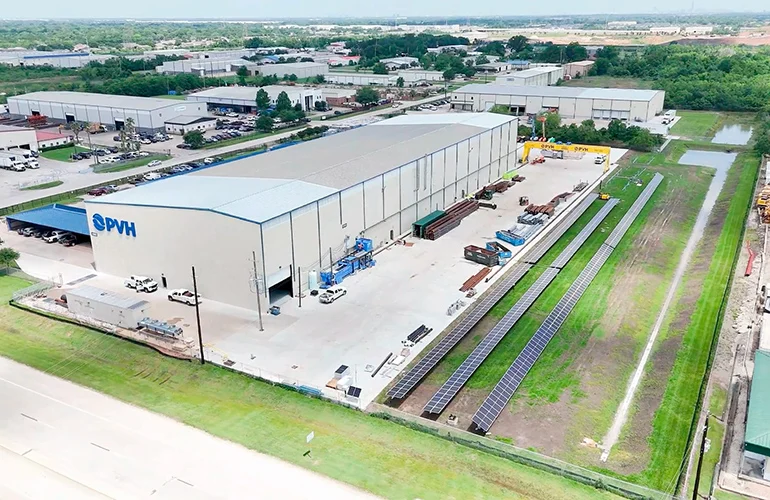
HOUSTON, Texas — In a decisive move to meet the surging national demand for renewable energy infrastructure, PV Hardware USA (PVH), a leading global provider of solar tracking and foundation solutions, has announced a significant expansion of its flagship manufacturing facility in Houston, Texas. The strategic growth initiative is designed to bolster domestic production capacity, streamline project deployment, and alleviate mounting operational pressures faced by utility-scale solar developers across the United States.
The expansion adds approximately 34,200 square feet of advanced manufacturing space to the existing footprint, boosting the company’s total Houston operational capacity by an impressive 42%. Originally inaugurated in 2024 with a 50,000-square-foot facility, this latest investment underscores PVH USA’s long-term commitment to American manufacturing, localized supply chains, and the accelerated transition toward a low-carbon economy.
By scaling up its domestic production capabilities, PVH USA aims to bridge the gap between burgeoning clean energy demand and the logistical hurdles traditionally associated with large-scale solar construction.
Chronology of Growth: From Inception to Domestic Scaling
The trajectory of PVH USA’s presence in the United States reflects the broader maturation and localization of the American solar supply chain.
- Early 2024: Recognizing the acute need for regionally manufactured solar tracking components—particularly in the wake of shifting federal policies, trade dynamics, and post-pandemic supply chain vulnerabilities—PVH opened its inaugural dedicated solar tracker factory in Houston, spanning 50,000 square feet.
- Mid-to-Late 2024: As utility-scale solar pipelines expanded across North America, the Houston plant experienced immediate, high-volume demand. Engineering, Procurement, and Construction (EPC) firms increasingly sought reliable, domestically sourced trackers to satisfy strict project timelines and domestic content requirements.
- The Current Expansion: Prompted by continuous order backlogs and customer requests for deeper integration, PVH initiated the 34,200-square-foot facility expansion. This phase integrates advanced material handling workflows, increased pre-assembly capabilities, and optimized factory layouts to maximize throughput.
- Future Outlook: With the expanded facility now fully integrated into PVH’s operational network, the company is positioned to service an escalating share of the North American utility-scale solar market while continuously refining its factory-floor efficiencies.
Supporting Data and Operational Metrics
The rationale behind PVH USA’s manufacturing expansion is rooted in hard data, particularly concerning the reduction of on-site labor burdens, waste minimization, and supply chain optimization.
Dismantling Field Complexity
Traditionally, the construction of utility-scale solar farms has relied heavily on manual, on-site assembly of disparate components. A typical solar tracker row requires the handling and fastening of roughly 188 loose parts upon arrival at a project site. This decentralized approach introduces numerous variables, including weather disruptions, skilled labor shortages, inventory tracking challenges, and safety risks.
By shifting the bulk of the assembly process into a controlled factory environment, PVH USA has fundamentally altered this equation:
- Component Reduction: Pre-assembling trackers and foundations at the Houston facility has enabled PVH USA to slash the number of loose components handled on project sites by an extraordinary 70%.
- Capacity Surge: The 34,200-square-foot addition increases local storage and production throughput capacity by 42%, allowing the company to service concurrent utility-scale projects with greater agility.
- Material Circularity: Steel constitutes more than 98% of the total weight of a PVH solar tracker. Because the manufacturing and pre-assembly processes are centralized in Houston, scrap generation on the job site is drastically reduced. Furthermore, the steel-intensive trackers remain 100% recyclable at the end of their multi-decade operational lifespans.
Logistics and Carbon Accounting
Beyond labor and installation metrics, localizing production in Texas carries significant environmental and economic benefits. By manufacturing closer to major solar markets in the American Southwest, West, and Midwest, PVH USA sharply curtails the carbon emissions traditionally generated by international maritime shipping and long-haul overland logistics. This localized model ensures compliance with emerging regulatory frameworks that reward domestic content sourcing and low-carbon footprints.
Official Responses and Executive Insights
Leadership at PVH USA views the Houston expansion not merely as a real estate investment, but as a paradigm shift in how solar technology is delivered to the field.
Alfonso Queipo, CEO of PVH USA, emphasized that the expansion is a direct response to evolving market demands.

"We are investing in additional domestic manufacturing capacity because our customers are asking us to do more," said Alfonso Queipo, CEO of PVH USA. "But this is not simply about manufacturing more products. It is about finding ways to make solar installation more efficient. Pre-assembly has become an important part of that strategy because it allows us to move complexity out of the field and into an environment where we have greater control over quality, productivity, and consistency. This expansion gives us the capacity to bring that approach to more customers and more projects while maintaining the standards they expect from PVH USA."
The operational headaches confronting solar developers—particularly EPC firms operating under tight financial and time constraints—were further detailed by Rodolfo Bitar, Vice President of Business Development for PVH USA.
"Solar EPCs face mounting pressure regarding labor availability, strict timelines, and total project costs," noted Rodolfo Bitar. "Traditionally, manufacturers pushed the assembly burden onto the job site. We ask a different question: what work can be done more efficiently before the equipment ever leaves the factory? By managing the assembly of 188 loose parts per row in our controlled manufacturing environment, we remove field complexity and make installation highly predictable."
Industry Implications: The Future of U.S. Solar Construction
The expansion of PVH Hardware’s Houston facility carries wide-ranging implications for the broader American renewable energy sector. As the United States accelerates its clean energy transition under aggressive federal decarbonization targets and investment incentives, the bottleneck has increasingly shifted from project financing to supply chain execution and workforce constraints.
1. Mitigating Labor Shortages
The construction industry, including the renewable energy sector, continues to navigate a persistent skilled labor shortage. By pre-assembling complex solar tracker systems in a factory setting, PVH USA minimizes the specialized labor hours required outdoors in harsh environments. Factory workers utilize standardized assembly lines, specialized tooling, and ergonomic workstations, which not only enhance worker safety and retention but also drastically accelerate the speed at which trackers can be deployed.
2. Enhancing Quality Control and Predictability
Field assembly is inherently susceptible to variables such as inclement weather, uneven terrain, and human error during manual bolting and alignment. Moving assembly indoors ensures that every sub-component undergoes rigorous quality assurance inspections before deployment. For utility-scale developers managing multi-million-dollar portfolios, this predictability translates directly into mitigated financial risk and on-time commissioning.
3. Strengthening Supply Chain Resilience
Global supply chain disruptions over recent years exposed the vulnerabilities of relying heavily on overseas manufacturing hubs for critical clean energy hardware. By anchoring production in Texas, PVH USA shields its clients from international freight volatility, geopolitical trade friction, and customs bottlenecks. This localized resilience is increasingly vital as renewable energy deployment scales exponentially to meet grid electrification demands.
4. Setting a New Benchmark for Sustainability
True sustainability extends beyond the zero-emission electricity generated by completed solar farms; it encompasses the lifecycle footprint of the hardware itself. By reducing onsite waste, optimizing steel recycling pathways, and cutting transportation emissions through localized manufacturing, PVH USA is helping set a higher environmental benchmark for the entire solar tracking sector.
Conclusion
PV Hardware USA’s expanded Houston facility represents a maturation point for domestic solar manufacturing. By marrying high-volume production capacity with an innovative pre-assembly philosophy, PVH is directly addressing the most pressing pain points of modern solar construction: labor scarcity, field complexity, timeline compression, and supply chain vulnerability.
As the American energy landscape continues its rapid evolution, investments of this scale ensure that the infrastructure powering the renewable transition is built efficiently, sustainably, and right at home.