






WASHINGTON — In federal policymaking, the old adage notes that even a stopped clock is right twice a day. The Trump administration’s proposed Fiscal Year 2027 Department of Energy (DOE) budget request contains certain cuts that warrant praise. For years, federal public funding and policy attention have chased speculative clean energy applications—most notably, the forced integration of hydrogen for everyday buses, trucks, building heat, and routine electricity storage—failing repeatedly to overcome the fundamental thermodynamic and economic advantages of direct electrification.
Ending these dead-end initiatives represents overdue administrative hygiene. However, the broader architecture of the FY2027 request reveals a much more alarming strategy: the administration has weaponized a few defensible cuts to camouflage a sweeping, indiscriminate retreat from foundational energy transition technologies. While batteries, electric vehicles, buildings, solar, and wind face near-total starvation, several far weaker technological bets have been treated with surprising leniency.
The resulting fiscal blueprint is not a surgical strategy designed to optimize taxpayer value; it is a blunt ideological instrument that undercuts the exact institutional capabilities the United States requires to navigate the energy transition.
Main Facts
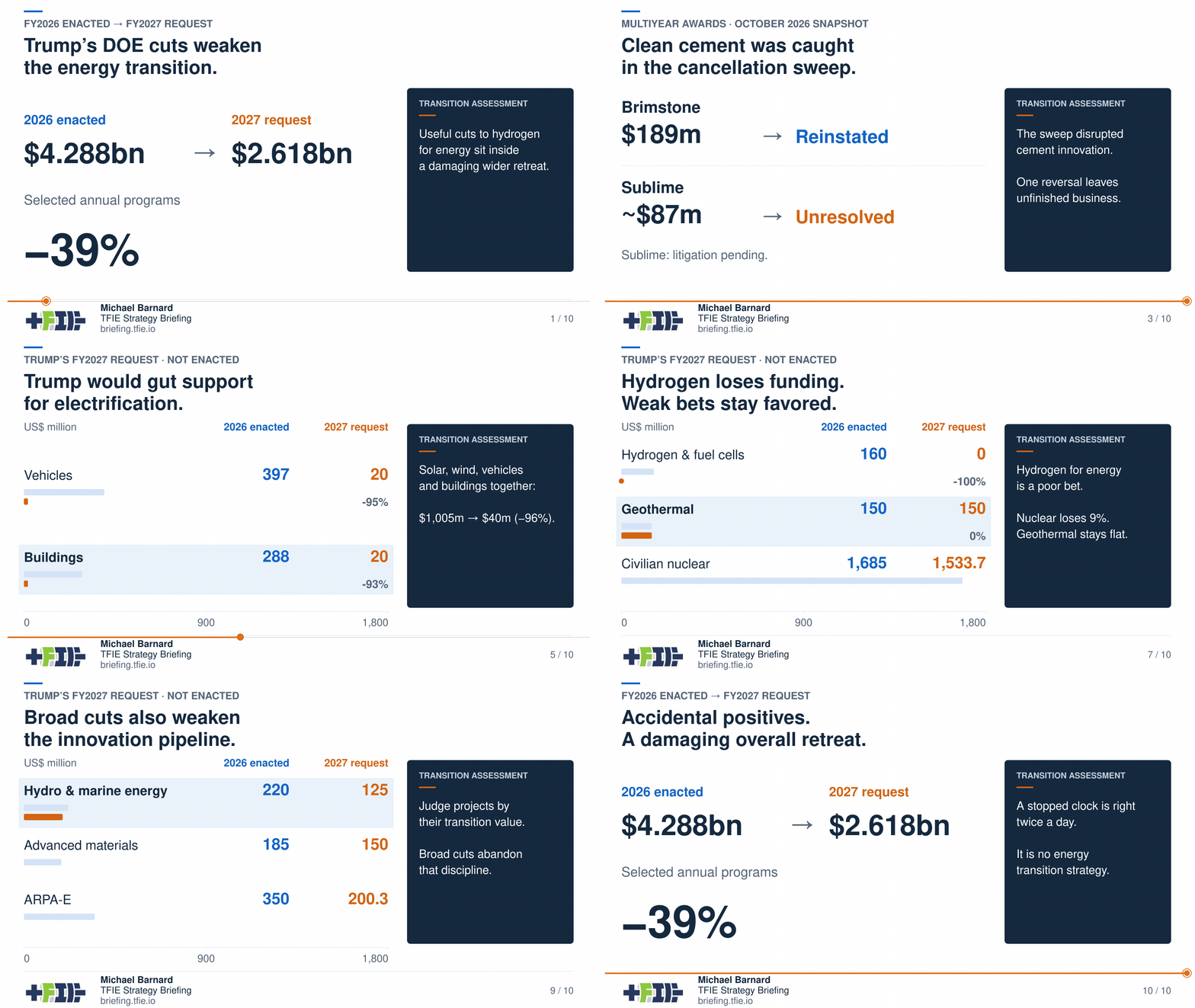
The scale of the proposed contraction is stark. Across 13 selected DOE technology program lines, funding drops from an enacted total of approximately $4.288 billion in FY2026 to $2.618 billion in the FY2027 request—a severe 39% reduction.
Yet the macro figure obscures the ideological bias of the cuts. The administration has disproportionately targeted core commercialized sectors:
- The Core Four: Funding for solar, wind, vehicles, and buildings plummets from a combined $1.005 billion down to a meager $40 million—representing a staggering 96% slash.
- Hydrogen and Fuel Cells: The annual hydrogen and fuel-cell line is zeroed out, dropping from $160 million to $0, alongside proposed clawbacks for unobligated clean-hydrogen funds.
- The Exception List: Conversely, critical-minerals funding surges from $83 million to $364 million. Civilian nuclear experiences a relatively mild 9% dip (from $1.685 billion to $1.534 billion), while geothermal funding holds flat at $150 million.
- ARPA-E: The Advanced Research Projects Agency-Energy sees its overall allocation drop from $350 million to $200.3 million, with direct project funding falling from $310 million to $160.3 million.
While a presidential budget request is merely a proposal submitted to Congress rather than enacted law, it serves as an unmistakable administrative roadmap, signaling precisely which technologies the executive branch believes deserve public backing.

Chronology and Policy Trajectory
To understand how the DOE’s funding priorities reached this juncture, it is necessary to examine the historical evolution of federal energy investments over the past decade.
- Early-to-Mid 2010s (The Post-Recovery Era): Federal R&D primarily focused on scaling down the levelized cost of energy (LCOE) for utility-scale solar and onshore wind, establishing their baseline commercial viability.
- The Bipartisan Infrastructure Law and IRA Era (2021–2024): Federal funding expanded dramatically into deployment, regional hubs (such as the heavily promoted hydrogen hubs), and domestic manufacturing supply chains, occasionally blurring the line between rigorous research and politically expedient industrial policy.
- The 2025–2026 Political Shift: Following the inauguration of the Trump administration, early budget reviews initiated comprehensive audits of climate and clean energy programs.
- The FY2027 Request (Late 2026/Early 2027): The administration formally submitted its FY2027 budget proposal, executing steep contractions in renewable deployment and end-use efficiency programs while carving out selective exemptions for nuclear, critical minerals, and targeted heavy-industry demonstrations.
Supporting Data: Winners and Losers in the FY2027 Request
Analyzing the distribution of the 13 selected DOE technology program lines reveals stark asymmetries in how the administration evaluates technological maturity and public-interest research.
| Technology Program Line | FY2026 Enacted Funding | FY2027 Budget Request | Percentage Change / Trajectory |
|---|---|---|---|
| Solar Energy | $220 million | $0 | -100% (Zeroed out) |
| Wind Energy | $100 million | $0 | -100% (Zeroed out) |
| Vehicle Technologies | $397 million | $20 million | -95% |
| Building Technologies | $288 million | $20 million | -93% |
| Hydrogen & Fuel Cell Tech | $160 million | $0 | -100% (Zeroed out) |
| Critical Minerals | $83 million | $364 million | +338% (Surge) |
| Civilian Nuclear | $1.685 billion | $1.534 billion | -9% (Mild contraction) |
| Geothermal Technologies | $150 million | $150 million | Flat funding |
| ARPA-E (Total Allocation) | $350 million | $200.3 million | -43% |
Distinguishing Research from Deployment
To fairly judge these programs, analysts must avoid dividing technologies into simplistic "favored" or "disfavored" camps. Federal support should operate under strict structural tests based on a project’s lifecycle:
- Early-Stage Research: Must answer a credible scientific or engineering question worth asking.
- Demonstrations: Must resolve specific technical, operating, or commercial uncertainties.
- Deployment: Should accelerate innovations that possess a clear, plausible path to competing on their own merits in the open market.
Commercial success in a specific sector—such as solar photovoltaic generation—does not mean all public-interest research questions have been answered. While private firms naturally fund routine product competition, shared knowledge regarding durability, advanced materials, recycling, and grid integration for variable generation yields broad public benefits that no single corporation can fully capture.
Official Responses and Institutional Perspectives
The administration’s rationale relies heavily on rolling back what it perceives as government overreach into mature commercial markets. Proponents of the budget cuts argue that technologies like solar and wind should now stand entirely on their own feet without federal subsidies skewing market signals.
However, industry analysts, engineering experts, and institutional observers have pushed back sharply against the blunt nature of the cuts. According to specialized assessments from energy policy trackers like the TFIE Strategy Briefing, the administration’s approach fails to differentiate between mature sectors that still require complex systemic integration and speculative technologies that have consistently failed to meet cost-reduction benchmarks.
Furthermore, the handling of multiyear legacy programs illustrates administrative disarray. For instance, while the annual hydrogen program line was zeroed out, several regional hydrogen hubs authorized under previous legislation remain nominally retained following administrative reviews. Yet, on-the-ground reporting—particularly from project sites in Pennsylvania—paints a picture of profound uncertainty, skittish industrial partners, and stagnant momentum. Simultaneously, the FY2027 budget requests clawbacks for unobligated clean-hydrogen funds, creating a chaotic "will they or won’t they" limbo that paralyzes long-term industrial planning.
Contradictions are also evident in the cement sector. Demonstration awards have faced erratic administrative treatment: Brimstone’s large cement demonstration award was reinstated, while Sublime’s status remained caught in limbo. Neither administrative status serves as an objective validation of the underlying science. Brimstone must still prove the commercial economics of a rock refinery dependent on multiple saleable outputs, just as Sublime faces fundamental feedstock and cost questions. True public funding should purchase objective data regarding these technical uncertainties, rather than acting as a political reward or penalty.
Implications for the Energy Transition
The most insidious consequence of the FY2027 budget request is its assault on institutional competence within the federal government. This is most clearly visible in the proposed contraction of ARPA-E.
The foundational design of ARPA-E is explicitly built around intelligent failure. The agency’s purpose is not to curate a portfolio where every single experiment transforms into a profitable commercial enterprise. Rather, public value is generated by funding high-risk, high-reward concepts that private venture capital cannot justify carrying alone. Some experiments must fail; others must reveal that an attractive concept cannot scale; while others still must generate foundational knowledge that private firms eventually commercialize.
Achieving this delicate balance requires highly competent personnel within government agencies who can:
- Distinguish rigorous basic research from premature commercial demonstrations.
- Negotiate stringent operational milestones.
- Inspect ongoing projects and interpret complex scientific evidence.
- Responsibly terminate projects that fail to justify continued public investment.
By hollowing out these internal capabilities through sweeping, indiscriminate political cuts, the administration weakens both sides of the federal oversight mechanism. It paradoxically becomes much harder to intelligently weed out failing projects while simultaneously protecting high-value, high-risk scientific experiments from ideological crossfire.

A Path Forward
A rational energy budget would indeed eliminate weak hydrogen-for-energy subsidies, sunset commercial claims that have long outrun their evidence, and impose rigorous economic reality checks on speculative nuclear and enhanced-geothermal ambitions.
Simultaneously, however, a functional strategy would fiercely protect and expand institutional capacity around direct electrification, building efficiency, industrial decarbonization, advanced batteries, renewable integration, and critical mineral processing that removes genuine industrial bottlenecks.
The administration’s current trajectory achieves neither. A stopped clock may occasionally cancel an obsolete subsidy, but it remains fundamentally incapable of deciding what a modern industrial economy must build next.