



By Industrial Automation News Desk
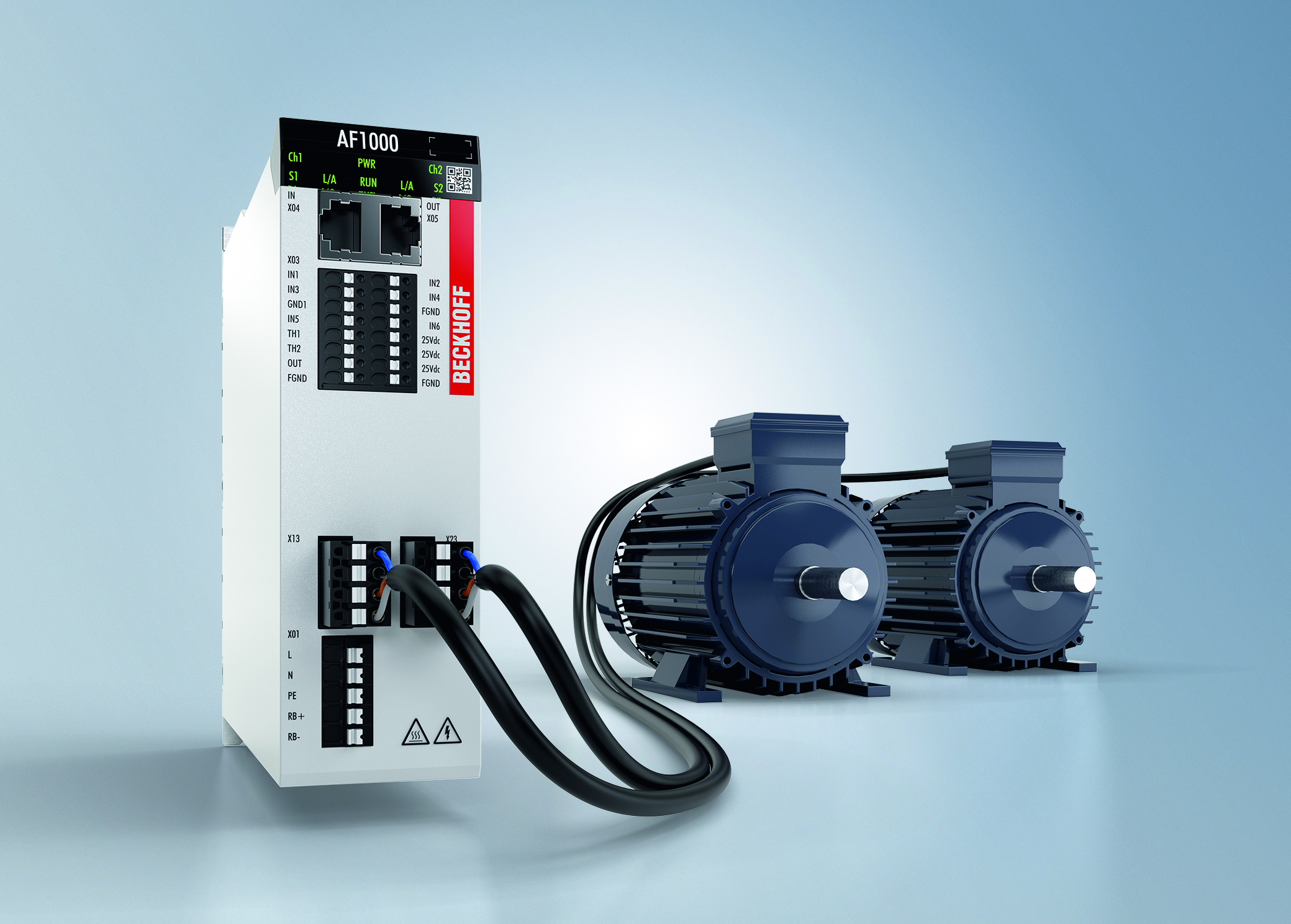
Beckhoff Automation has announced the launch of the AF1000 variable frequency drive (VFD), a strategic addition to its comprehensive motion control product line. Designed specifically to handle standard, less complex motion tasks such as conveyor systems, industrial pumps, and ventilation fans, the AF1000 bridges the gap between high-performance servo applications and cost-sensitive, basic industrial automation.
By integrating seamlessly with Beckhoff’s established TwinCAT automation platform via EtherCAT, the AF1000 brings advanced diagnostic capabilities, streamlined engineering, and robust performance to everyday machine-building challenges.
Main Facts: What is the Beckhoff AF1000?
The AF1000 is an economy-focused variable frequency drive engineered to deliver reliable, efficient motor control without the unnecessary complexity or cost associated with high-end servo systems. Despite its positioning as a solution for basic motion tasks, the drive incorporates sophisticated hardware and software features borrowed from Beckhoff’s higher-end product tiers.
Key hardware specifications of the AF1000 series include:
- Dual Power Supply Options:
- A single-phase 240 V AC version catering to power ranges from 0.37 kW to 1.5 kW.
- A three-phase version supporting up to 480 V AC with power ranges spanning from 0.37 kW to 5.5 kW.
- Compact System Architecture: The units feature integrated control power supplies, robust DC link capacitors, and internal ballast circuits. The internal control voltage is generated directly by the integrated power supply utilizing the DC link, reducing external wiring and saving valuable control cabinet space.
- Axis Configurations: Both power variants are available in flexible single-axis and space-saving two-axis module configurations.
- Motor Compatibility: The drive supports a wide array of motor technologies, including traditional asynchronous motors, synchronous servomotors, and modern reluctance motors. These can be operated entirely without feedback devices, utilizing either standard U/f (voltage-to-frequency) control or advanced vector control methods.
Crucially, the AF1000 relies on the TwinCAT Drive Manager 2 software tool for configuration and commissioning. This unified engineering environment allows system integrators and maintenance personnel to deploy the AF1000 using the exact same workflows, software interfaces, and diagnostic protocols previously reserved for Beckhoff’s high-performance servo drives.
Chronology: The Evolution of Beckhoff’s Drive Portfolio
To understand the strategic significance of the AF1000 launch, it helps to examine how Beckhoff has systematically expanded its drive and motion control offerings over the decades.
1. Early Foundations in PC-Based Control
Beckhoff Automation built its global reputation on PC-based control technology, introducing the TwinCAT (The Windows Control and Automation Technology) software suite in the mid-1990s. TwinCAT effectively transformed standard personal computers into powerful real-time industrial controllers, managing logic, motion control, and visualization within a single software environment.
2. The Rise of EtherCAT (2003)
A major turning point for the company occurred in 2003 with the introduction of EtherCAT (Ethernet for Control Automation Technology). EtherCAT revolutionized industrial networking by offering ultra-fast communication speeds, exceptional synchronization, and flexible topology. As EtherCAT gained widespread global adoption, Beckhoff began developing specialized hardware—including input/output modules, industrial PCs, and eventually, electric drives—optimized specifically for the ultra-fast protocol.
3. Expansion into Servo Drives and Motion Control
As machine builders demanded tighter synchronization and higher dynamic performance, Beckhoff moved deeper into hardware manufacturing. The company introduced advanced servo drives and servomotors, pairing them tightly with TwinCAT NC PTP (Point-to-Point) and NC Robotic software packages. While these high-end solutions excelled in robotics, packaging machinery, and multi-axis CNC machines, they often represented an over-engineered—and thus cost-prohibitive—option for simple operations like moving a conveyor belt or regulating fluid flow in a pump.
4. Introduction of the AF1000 Series (Present Day)
Recognizing a market demand for scalable, cost-effective automation components that do not sacrifice software unity, Beckhoff developed the AF1000. By targeting basic motion tasks, the company has closed the loop in its drive ecosystem, ensuring that machine builders can source everything from basic inverters to high-performance multi-axis servo systems from a single vendor while utilizing a single software platform.
Supporting Data: Technical Performance and System Integration
The technical architecture of the AF1000 reflects a deep understanding of modern control cabinet constraints and engineering workflows. In industrial environments, minimizing cabinet footprint, reducing installation time, and simplifying troubleshooting are paramount.
Hardware Efficiency and Space Saving
In modern machine building, control cabinet real estate is at a premium. The inclusion of an integrated control power supply within the AF1000 means that external transformers or separate control voltage feeds are often unnecessary. By deriving the control voltage straight from the DC link capacitors, Beckhoff has engineered a self-contained unit that streamlines internal panel layouts.
Furthermore, the availability of two-axis module configurations allows OEMs (Original Equipment Manufacturers) to control multiple standard motors with a minimal physical footprint. For instance, a dual-axis module running two separate conveyor lines reduces the required DIN-rail space and cuts down on terminal block wiring compared to using two standalone single-axis inverters.
Software Consistency via TwinCAT Drive Manager 2
One of the most compelling aspects of the AF1000 release is its complete integration into the TwinCAT engineering framework. Engineering overhead is frequently one of the largest hidden costs in machine manufacturing. When technicians must learn entirely different software packages, proprietary programming languages, or separate commissioning utilities for different hardware tiers, the risk of configuration errors increases.
By utilizing TwinCAT Drive Manager 2, Beckhoff ensures that engineers who are already familiar with configuring high-end servo drives can commission an AF1000 inverter with zero a learning curve. The tool provides:
- Intuitive wizards for motor parameterization.
- Real-time tuning and optimization graphs.
- Comprehensive diagnostic and error-logging functions.
- Seamless parameter backup and restoration through the central TwinCAT project tree.
Official Responses and Industry Perspectives
While formal statements from executive leadership highlight the strategic nature of the product launch, industry analysts and automation specialists have been quick to weigh in on what the AF1000 means for the broader motion control landscape.
Industry insiders note that machine builders are increasingly pressured to deliver modular, scalable machines. End-users want the flexibility to upgrade or downgrade machine features without completely redesigning the underlying automation architecture.
A spokesperson close to Beckhoff’s product development team emphasized that the philosophy behind the AF1000 was "uncompromising integration."
"Our customers have long trusted TwinCAT and EtherCAT to deliver world-class performance in complex multi-axis motion applications," the representative noted during initial product briefings. "However, many of those same machines feature auxiliary axes—such as infeed belts, coolant pumps, or cooling fans—that do not require high-end servo dynamics. With the AF1000, we are ensuring that engineers no longer have to step outside the Beckhoff ecosystem or compromise on diagnostic capabilities when automating these essential secondary axes."
Independent automation consultants have echoed these sentiments, pointing out that unifying basic variable frequency drives and high-end servo drives under a single software umbrella significantly reduces the total cost of ownership (TCO) for machine builders over the lifecycle of a product line.
Implications: What the AF1000 Means for Machine Builders and OEMs
The introduction of the Beckhoff AF1000 carries several important implications for the industrial automation sector, spanning system design, supply chain logistics, and maintenance operations.
1. Streamlined Bill of Materials (BOM)
For OEMs, sourcing components from a single trusted vendor simplifies purchasing, reduces administrative overhead, and frequently unlocks volume-based pricing tier advantages. Rather than procuring high-end servo gear from Beckhoff while sourcing basic VFDs from a completely different manufacturer, machine builders can now consolidate their drive purchases. This single-source strategy streamlines the bill of materials and simplifies inventory management for spare parts.
2. Enhanced Diagnostic Transparency
Historically, basic variable frequency drives deployed on conveyor belts or ventilation systems operated as "black boxes." If a basic VFD faulted out, maintenance personnel often had to decipher blinking LED error codes or connect via specialized, legacy serial cables to read diagnostic logs.
Because the AF1000 communicates via EtherCAT and is fully visible within TwinCAT, maintenance teams gain advanced diagnostic functions. Operators can monitor drive temperatures, current draws, operational hours, and fault histories directly from the central HMI (Human-Machine Interface) or supervisory control system. This level of transparency paves the way for predictive maintenance strategies, reducing unexpected machine downtime.
3. Scalable Machine Architectures
Machine builders often develop modular equipment platforms that are sold in various configurations. A base model might feature simple fixed-speed conveyors, while a premium model includes fully synchronized multi-axis robotic handling.
The AF1000 allows OEMs to use the exact same control hardware architecture (Industrial PCs running TwinCAT) and the same fieldbus network (EtherCAT) across their entire machine lineup. Whether a machine requires nanometer-precision servo control or basic open-loop frequency inversion for a fan, the underlying control philosophy remains identical.
4. Future-Proofing Plant Floors
As smart manufacturing and Industry 4.0 initiatives continue to mature, the demand for data at every level of the machine architecture is growing. Even simple actuators like pumps and fans are expected to report their operational health to cloud platforms or on-premise edge servers. By embedding EtherCAT connectivity and advanced diagnostics into an economy-class drive like the AF1000, Beckhoff is helping manufacturers ensure that even their most basic auxiliary systems are fully digitized and ready for the future of industrial automation.
Conclusion
Beckhoff’s introduction of the AF1000 variable frequency drive marks an important evolution in the company’s motion control strategy. By successfully pairing economy-class hardware designed for basic tasks like pumping, ventilation, and material transport with the sophisticated ecosystem of EtherCAT and TwinCAT Drive Manager 2, Beckhoff has delivered a versatile tool for modern machine builders.
As industrial automation continues to demand greater efficiency, reduced engineering overhead, and seamless connectivity, products like the AF1000 prove that high-performance integration is no longer reserved exclusively for high-end servo applications.