In the modern industrial landscape, the standard emergency drill is often reduced to a bureaucratic formality. Facilities across the globe frequently conclude their safety exercises with little more than a sign-in sheet, a recorded evacuation time, and a binary "completed" status. However, safety professionals are increasingly recognizing that this approach—while satisfying basic compliance requirements—is a dangerous illusion.
The true value of an emergency drill lies not in the mere act of participation, but in its capacity to serve as a high-fidelity diagnostic tool. By shifting the focus from administrative checklists to operational performance data, plant managers can expose systemic weak points, communication bottlenecks, and decision-making failures long before they manifest during a catastrophic real-world incident.
Main Facts: The Shift from Compliance to Performance
Compliance with regulatory frameworks, such as those mandated by the Occupational Health and Safety Administration (OSHA), ensures that a facility has a plan. Yet, there is a profound difference between having a plan and having a functioning, validated response.
A successful emergency drill must answer complex questions that go beyond "Did everyone get out?" It must interrogate whether employees recognized the emergency signal, exercised sound judgment under pressure, navigated the facility safely, maintained clear communication channels, accounted for transient populations—such as contractors and visitors—and effectively addressed performance gaps in the aftermath.
If a drill concludes with a completed form but fails to identify why an exit route became congested or why an alarm went unnoticed in a high-noise area, the exercise has failed in its primary purpose: to build resilience.
Chronology: The Anatomy of a High-Impact Drill
To transition from passive compliance to active readiness, facility leaders must structure their drills as a chronological sequence of performance indicators. This lifecycle approach ensures that no phase of the emergency response is left unexamined.
1. Alarm Recognition and Initial Response
The first critical failure point often occurs within the first seconds of an emergency. OSHA’s Employee Alarm System rule stipulates that alarms must be perceivable above ambient noise and light levels. In a real-world setting, however, "perceivable" is subjective. Is the alarm audible over the roar of heavy grinding machinery? Is it visible to a worker wearing hearing protection?
2. Route Selection and Decision-Making
Evacuation time is a deceptive metric. A facility might achieve a four-minute clearance, but that data point masks reality if the majority of staff congregated in a bottlenecked hallway or if individuals failed to choose an alternate route when a primary exit was simulated as "blocked."
3. Accountability and Re-entry Control
The drill is not over when the last person reaches the muster point. True accountability requires the reconciliation of employees, contractors, and visitors against real-time rosters. The process must define how missing-person information is escalated and how re-entry is prohibited until an official "all-clear" is verified.
Supporting Data: Metrics That Matter
To transform drills into actionable intelligence, organizations must adopt a rigorous framework. A useful metric must be quantifiable and actionable, following this template: Expected Action + Observation Point + Acceptable Standard + Correction Owner.

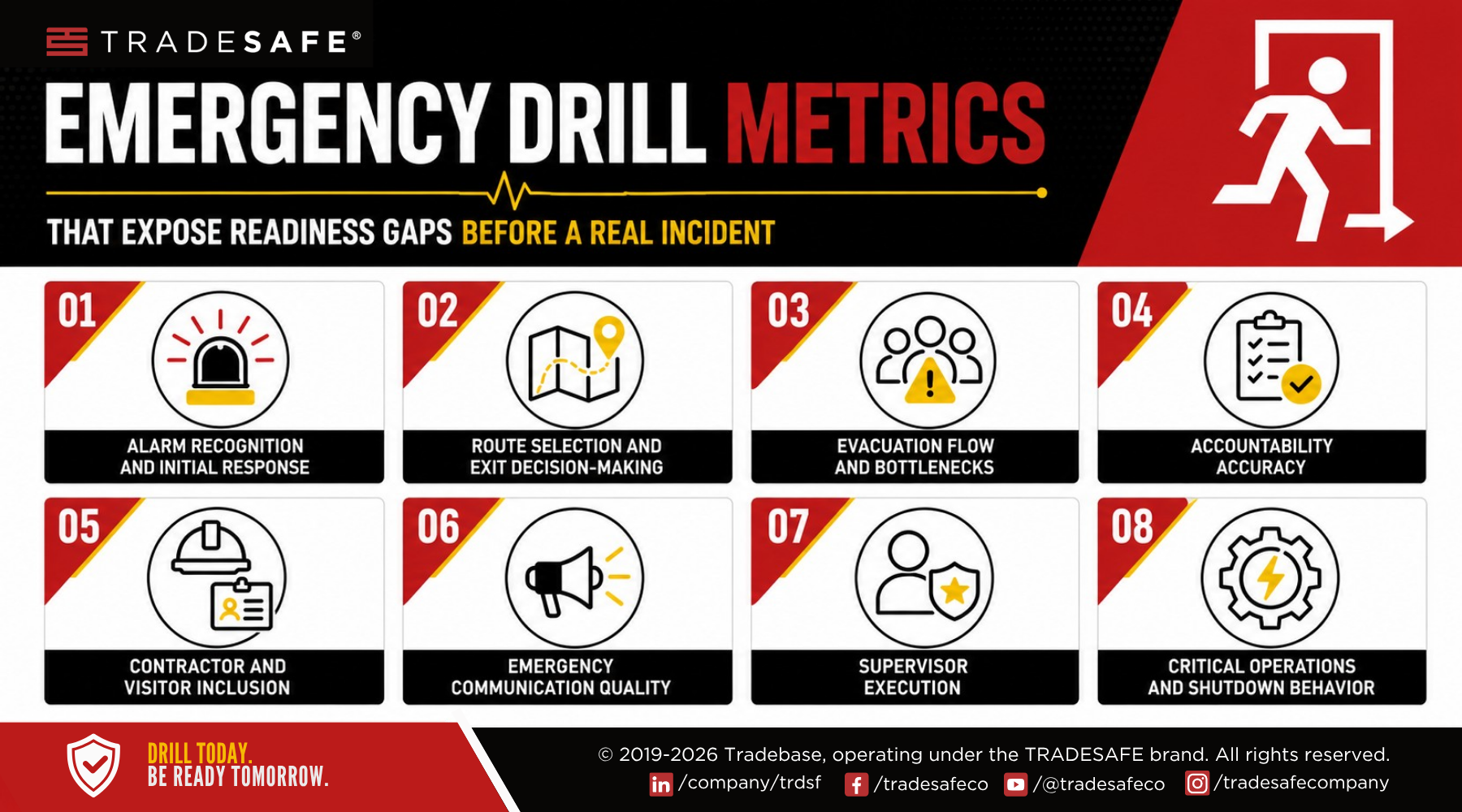
The Eight Critical Drill Metrics
Plant leaders should focus on these eight areas to gain a comprehensive view of operational performance:
- Alarm Perception: Measure the time from activation to the first sign of movement in specific zones. Failure to move within 30 seconds should trigger a root-cause analysis of the alarm system’s reach.
- Route Discipline: Evaluate whether staff utilize secondary routes when primary exits are obstructed.
- Flow and Bottlenecks: Identify physical impediments such as badge readers, turnstiles, or narrow corridors that impede rapid exit.
- Accountability Accuracy: Test the speed and precision with which supervisors account for personnel.
- Contractor/Visitor Inclusion: Ensure that transient populations—who lack the ingrained familiarity of full-time staff—are effectively managed.
- Communication Quality: Determine if instructions are specific, location-based, and consistent across all platforms (PA, radio, text).
- Supervisor Execution: Assess whether leadership provides clear, calm direction, or if hesitation translates into workforce confusion.
- Critical Operations: Verify that "shutdown" procedures (e.g., valve closing) do not compromise personal safety or exceed evacuation time limits.
Official Responses and Regulatory Guidance
The Federal Emergency Management Agency (FEMA) emphasizes the importance of After-Action Reporting (AAR) and Improvement Planning. These processes document not only the strengths of a response but, more importantly, the performance gaps that require immediate corrective action.
Regulatory bodies like OSHA maintain that emergency action plans must be site-specific. By moving beyond generic "check-the-box" drills, companies provide themselves with evidence-based proof that their plans are not merely documents on a shelf, but living protocols that work under the specific physical, environmental, and staffing constraints of their unique facilities.
Implications: Building a Culture of Continuous Improvement
The implications of this shift are significant. When a plant moves away from "passing" a drill to "analyzing" a drill, the culture of safety undergoes a fundamental change.
Ownership and Accountability
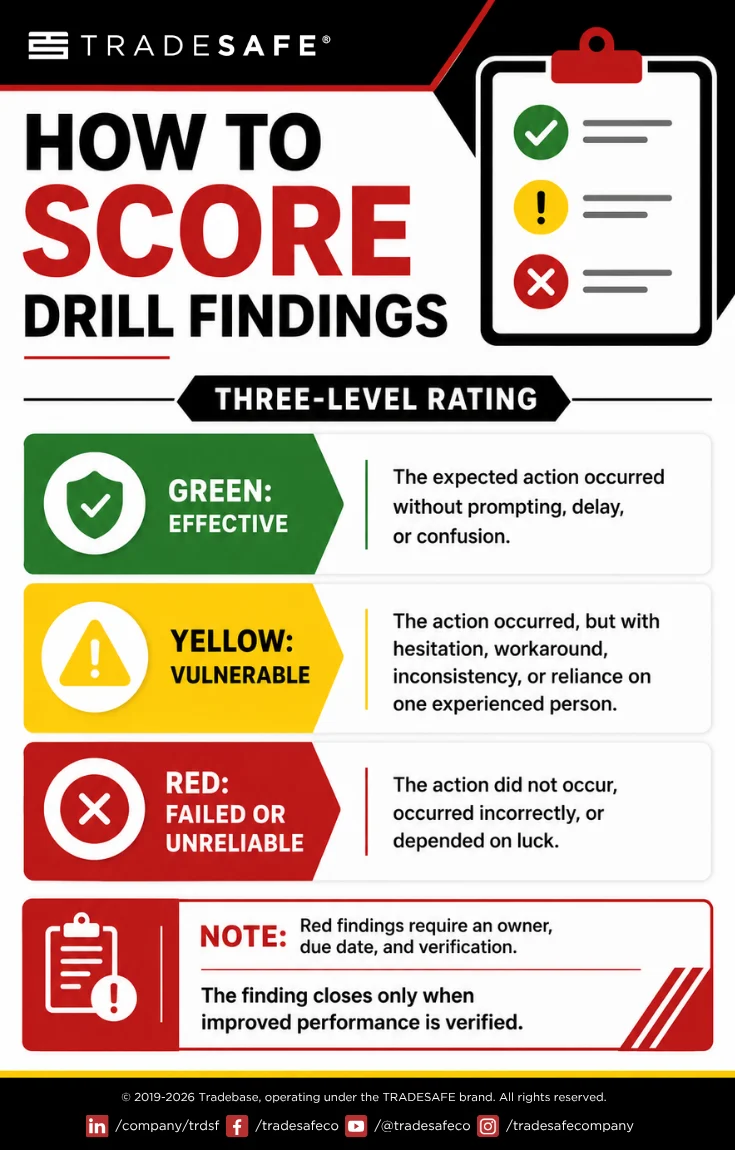
Red-rated findings—those indicating a failure in safety protocols—must be assigned to a specific owner with a hard deadline. It is insufficient to "review the topic with employees." A finding is only considered closed when a follow-up drill or targeted spot check verifies that the performance gap has been bridged.
The True Cost of Failure
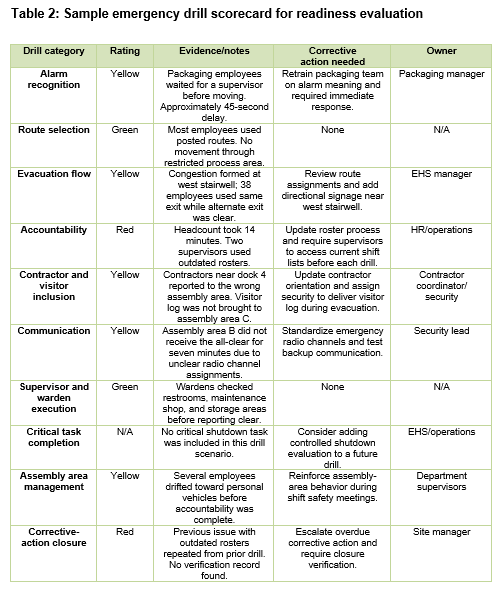
In the event of a real emergency, the cost of an unrehearsed or poorly understood evacuation plan is measured in human lives and catastrophic facility damage. By meticulously testing the emergency action plan against real-world variables—actual shift patterns, real-time noise levels, and authentic visitor counts—leadership can identify exactly where a crisis would become uncontrolled.
Data-Driven Decision Making
Ultimately, an effective drill program functions as a continuous feedback loop. If a supervisor struggles to reconcile a roster, the fix is not a lecture; it is a systemic improvement in how rosters are accessed and maintained. If an alarm is muffled in the maintenance shop, the fix is an infrastructure upgrade.
Conclusion
Emergency drills are not valuable because they satisfy a compliance schedule; they are valuable because they provide a simulation of the "worst day" at the plant. By prioritizing performance data over participation numbers, organizations ensure that their emergency action plans are not just compliant, but capable of saving lives when seconds count.
Every meaningful finding in a drill is a gift—a chance to identify a failure in a controlled environment so that it never occurs in a real one. The goal of every facility manager should be to end every drill with clear evidence of what worked, what failed, who owns the correction, and how that improvement will be verified before the next emergency occurs. By doing so, they convert the drill from a bureaucratic hurdle into the bedrock of organizational resilience.