By the Industrial Technology Editorial Desk
The aerospace and defense (A&D) manufacturing sector stands at a critical technological crossroads. For decades, the industry has relied on isolated pockets of digital innovation, mastering computer-aided design (CAD) and product lifecycle management (PLM) at the single-component level. However, as modern aircraft, defense systems, and space vehicles grow increasingly complex, the friction between design engineering, shop-floor execution, and decades-long field sustainment has become unsustainable.
A recent research initiative released by manufacturing analyst firm Tech-Clarity and sponsored by iBase-t, titled MBE Process Authoring: The Common Thread from Design to Sustainment, sheds light on the next evolution of digital manufacturing: Model-Based Process Authoring (MBPA). Far more than a mere software upgrade, MBPA serves as the foundational connective tissue that translates engineering intent into actionable shop-floor instructions, preserving the digital thread across global supply chains and multi-decade product lifecycles.
Main Facts: The Core of Model-Based Enterprise (MBE)
At its heart, a Model-Based Enterprise (MBE) leverages digital 3D models and associated data as the authoritative source for all activities across a product’s lifecycle. Yet, while MBE has matured significantly at the individual part level—acting largely as an advanced extension of traditional CAD and computer-aided manufacturing (CAM)—scaling this methodology to complex, multi-component assemblies remains a formidable challenge.
According to the Tech-Clarity research, the primary barrier to MBE adoption is not the technical task of transferring information between business, design, and manufacturing systems. Rather, it is the sheer complexity of creating and managing an unbroken digital thread across a sprawling global supply chain, diverse manufacturing environments, and the grueling test of long-term field maintenance.
When A&D manufacturers fail to implement comprehensive MBE frameworks, the human cost is severe. Employees—often the most constrained and valuable resource in an enterprise—are forced to manually re-enter data from enterprise resource planning (ERP) and PLM systems into manufacturing execution systems (MES). This "swivel-chair" data entry drains productivity, introduces human error, and diverts skilled workers from their core mission: building complex, high-reliability products.
Chronology: The Evolution of the Digital Thread
To understand the urgency behind Model-Based Process Authoring, it is helpful to examine the historical trajectory of digital manufacturing in the A&D sector.
Phase 1: The Siloed Era (Late 20th Century)
Historically, design engineering and manufacturing operations operated in distinct silos. Engineers created 2D drawings or early 3D models, which were then "thrown over the wall" to manufacturing engineering. Shop-floor planners interpreted these documents manually, creating static paper-based routing sheets and work instructions. Changes made on the shop floor were rarely reflected accurately back in the master design configuration.

Phase 2: The Rise of CAD/CAM and PLM (2000s–2010s)
The introduction of robust PLM and CAD/CAM systems digitized engineering data, dramatically improving the accuracy of individual parts. However, these systems remained largely disconnected from the shop floor. While engineers could model complex geometries with precision, the instructions for how to build those parts relied on disconnected documents, spreadsheets, and tribal knowledge.
Phase 3: The MBE Frontier and Process Authoring (Present Day)
Today, the industry is transitioning toward the Model-Based Enterprise, where the 3D model drives downstream processes. Within this framework, Model-Based Process Authoring has emerged as the critical link. MBPA bridges the gap between engineering design intent and dynamic manufacturing operations. It provides direct, associative links to key product data, critical-to-quality (CTQ) characteristics, and synchronized Bills of Materials (BOMs) and Bills of Process (BOPs). This ensures that as a product evolves from an engineering concept to a physical assembly and eventually to a maintained field asset, its digital pedigree remains completely intact.
Supporting Data: The Hidden Costs of Disconnection and the MBE Opportunity
The research highlights a stark reality for organizations that delay their MBE journey: they are actively squandering financial and human capital.
- The Resource Drain: Without seamless system connectivity—even at the basic level of engineering change management—engineers and shop-floor workers spend countless hours bridging data gaps manually.
- The Complexity of Assemblies: While single-component MBE is mature, multi-component assemblies require process flexibility capable of navigating strict regulatory environments. Every deviation, substitution, or engineering change must be instantly traceable.
- The Multi-Decade Horizon: A&D products are unique in their longevity. Commercial airliners and defense platforms often remain in service for 30, 40, or even 50 years. The digital thread established during manufacturing must be robust enough to support maintenance, repair, and overhaul (MRO) decades down the line.
MBPA acts as a platform for developing manufacturing-specific instructions tailored to every single instance of a product being built. It establishes the foundational framework for the "as-designed," "as-built," and "as-maintained" conditions of every part and assembly.
Operational Realities: Spanning Departments and Handling Exceptions
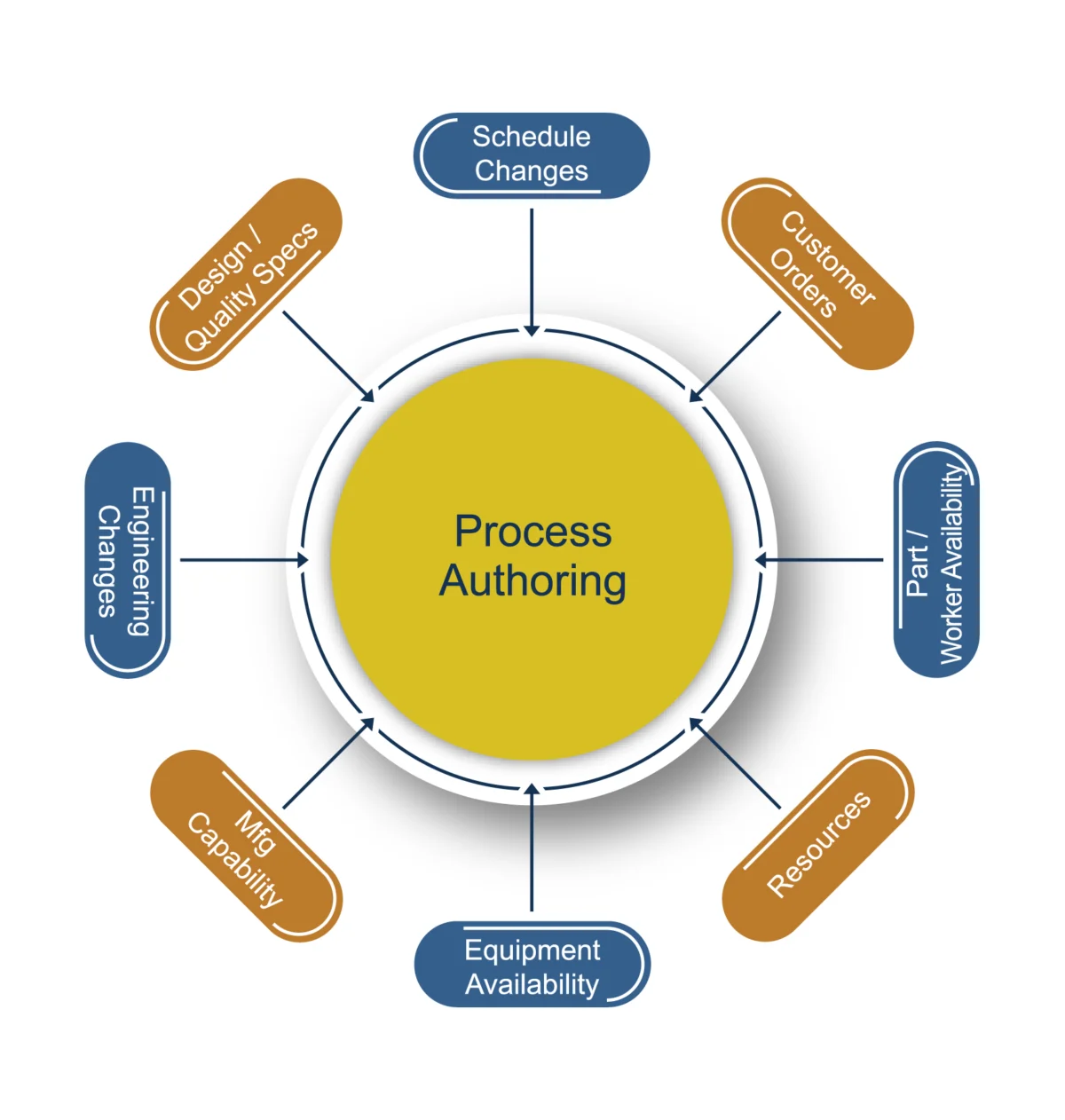
In the high-stakes world of aerospace and defense, manufacturing operations are never static. Day-to-day—and minute-to-minute—operations are subject to a myriad of operational exceptions that can disrupt even the best-laid plans.
Supporting Operations
Process authoring must extend design intent while adapting to current shop-floor capabilities. It must support interactive process documentation that frontline workers can easily navigate, improving both decision-making and operational competency.
Spanning Cross-Functional Departments
Process authoring is not the domain of a single department; it requires continuous input from design engineering, manufacturing engineering, quality assurance, and supply chain management. Each stakeholder group brings unique expertise, priorities, and resource constraints. Furthermore, process instructions are inherently dynamic. When engineering changes occur—particularly those involving flight-critical components—the impact on work-in-progress (WIP) must be evaluated and managed immediately.
Handling Unplanned Exceptions
Manufacturing environments are routinely disrupted by unplanned equipment downtime, sudden shifts in resource availability, and necessary material substitutions. In a true MBE environment, the process must gracefully evolve in response to these events. Crucially, the manufacturing execution system must maintain the digital thread throughout these modifications without a single interruption in data continuity.

Strategic Recommendations for Industry Leaders
To successfully implement Model-Based Process Authoring and realize the full potential of MBE, Tech-Clarity and industry experts outline four key recommendations for A&D manufacturing executives:
1. Keep People at the Forefront
Technology should serve the workforce, not burden it. Manufacturers must start by streamlining tasks for frontline workers, empowering them to spend their time building products rather than wrestling with administrative software.
- Eliminate data re-entry, swivel-chair processes, and clerical bottlenecks.
- Make the tracking of critical-to-quality (CTQ) data, Unique Identification (UID) numbers, and Quality Product Identification (QPID) tracking a seamless, automated part of the manufacturing process rather than an onerous secondary task.
2. Simplify and Challenge Legacy Processes
Organizations must purge the phrase "we’ve always done it this way" from their corporate vocabulary.
- Leverage existing organizational skills and resources to launch targeted continuous improvement projects.
- Ensure that process modernizations are designed to remove friction for the shop-floor workforce rather than simply satisfying IT requirements.
3. Adopt a Federated Data Architecture
No single software vendor or monolithic system can comprehensively manage an entire enterprise, a global supply chain, and a 50-year product lifecycle.
- Focus heavily on the "edges" where systems communicate and cross-functional teams collaborate.
- Prioritize robust data ontologies, Application Programming Interfaces (APIs), and the critical characteristics that form the backbone of the digital thread.
- Employ a comprehensive data model that fully instantiates parts, subassemblies, complete products, and associated shop orders to curate critical MBE data end-to-end.
4. Deploy Built-for-Purpose Technology
Enterprise software decisions must deliberately support people, processes, and data requirements simultaneously.
- Utilize purpose-built tools across the entire value chain, integrated seamlessly through a federated data architecture.
- Link these tools directly to essential digital thread data—including CAD IDs and characteristic IDs defined in the model definition, bill of characteristics, bill of process, and bill of material.
- Ensure information flows smoothly into execution tools capable of maintaining absolute continuity from initial design to final field sustainment.
Implications for the Future of Aerospace and Defense
The adoption of Model-Based Process Authoring represents a fundamental shift in how the aerospace and defense sector thinks about product lifecycles. By weaving a continuous digital thread from the earliest conceptual design sketches all the way to decades-old maintenance depots in the field, manufacturers can unlock unprecedented levels of efficiency, quality, and regulatory compliance.
As global supply chains grow more volatile and regulatory scrutiny intensifies, companies that cling to fragmented, document-heavy processes will find themselves outpaced. Conversely, organizations that embrace MBPA and federated MBE architectures will empower their workforces, eliminate costly data waste, and secure a competitive advantage in the next era of smart manufacturing.
Note: This article is an abbreviated summary of the research ebook, "MBE Process Authoring: The Common Thread from Design to Sustainment." For the complete, unabridged research findings, visit the sponsor, iBase-t.