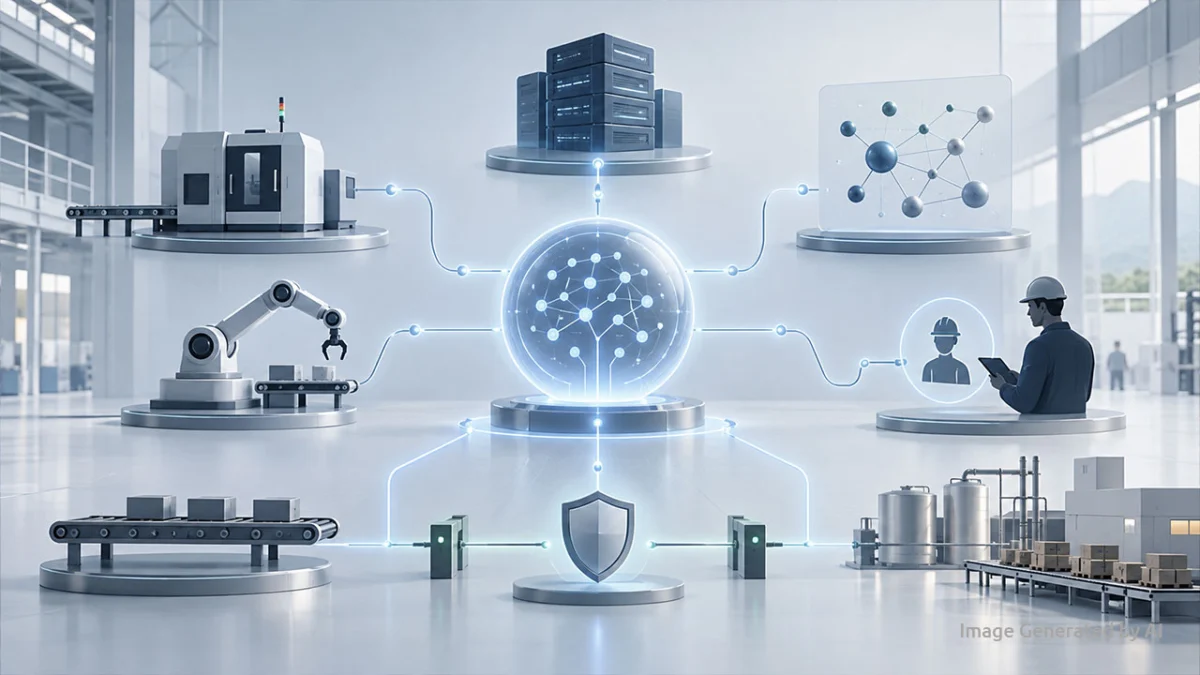
The Industrial AI Summit 2026 served as a pivotal stage for addressing the "last mile" problem of the Fourth Industrial Revolution: moving beyond mere data collection toward truly autonomous, context-aware operations. During the high-impact session titled "From Data Streaming to Autonomous Action," the industry’s brightest minds converged to discuss the architecture of the future factory.
However, the depth of the inquiry—from both the panel of experts and the audience—revealed that the transition to agentic AI is not merely a technical challenge, but a fundamental shift in how manufacturing organizations capture, store, and utilize human expertise. Following the summit, Peter Sorowka, CEO of Cybus, addressed a series of critical questions that remained unanswered during the live broadcast. This report, the first in a three-part series, dissects these insights to provide a roadmap for industrial leaders navigating the AI landscape.
The Core Challenge: Why Data Isn’t Enough
For years, the industrial sector has focused on the "data deluge"—streaming millions of data points from sensors, PLCs, and ERP systems. Yet, as Sorowka noted during his post-summit briefing, data in a vacuum is dangerously misleading.
"Data and context without it give an agent correct values and wrong conclusions," Sorowka warned. "An AI might know the temperature of a machine, but it doesn’t intuitively understand why 82°C is perfectly acceptable on one production line while signaling a critical failure on the next."
This distinction—between raw data and actionable intelligence—forms the foundation of the current industrial AI dilemma. The industry is currently moving away from "black-box" models, where logs are harvested for patterns that no one can audit, toward a more transparent, declarative approach where rules are explicitly defined, reviewable, and subject to human oversight.
Structuring Context: The Hierarchy of Information
A central question posed to the panel was: How do you supply better context to industrial AI? According to Sorowka, the answer lies in segmenting information based on its volatility and purpose.
The Static Layer (The Ontology)
Static context, which includes inventory, machine specifications, process flows, and asset relationships, should be treated as the "single source of truth." Sorowka advocates for supplying this via a unified namespace, supported by clear data ontologies and knowledge graphs. This layer is universal; it doesn’t change based on a specific use case, making it the bedrock upon which all other AI applications should be built.
The Dynamic Layer (Use-Case Specific)
Beyond the static model, AI agents require context that is specific to the task at hand—maintenance manuals, incident reports, technical PDFs, or even photographic evidence of a wear-and-tear issue. Managing this requires a structured approach. While it doesn’t need to be overly complex—a well-organized SharePoint or Confluence repository often suffices—the key is the accessibility of this data to the agentic system.
The Role of MCP Servers in Plant Intelligence
One of the most exciting developments discussed at the summit was the use of the Model Context Protocol (MCP). By deploying an MCP server, organizations can effectively "plug" an LLM into their plant floor data.
When asked if an MCP server loaded with machine drawings could help an LLM understand a plant, Sorowka offered a tempered, pragmatic perspective: "It will definitely help, but be aware that those drawings are often outdated, and may disagree with the ‘plant as-built’."
This underscores the ongoing necessity of human-in-the-loop (HITL) systems. The most robust AI configurations are those where the MCP server exposes a declared model of assets and signals, allowing the LLM to provide answers that are not only accurate but fully traceable. When an AI can cite exactly where a value or a conclusion originated, it builds the trust required for operators to hand over control to an agent.
Chronology of Transformation: From Human-Supplied to Agent-Acquired
The evolution of an industrial AI agent is characterized by a transition from manual input to automated knowledge retrieval. Sorowka outlines a distinct timeline for this evolution:
- The Commissioning Phase (The Human Source): This is the most critical window. When a machine is first wired and installed, the person performing the commissioning possesses the "tacit" knowledge—the nuance of why a valve is set to a certain pressure or how a machine interacts with the line. Capturing this context here is vital.
- The Transition (The Agent Reads): Once the context is defined and digitized, the agent shifts from asking the human to reading the model. This saves countless man-hours and prevents the bottleneck of human reliance for routine operational decisions.
- The Change Management Phase (The Human Loop): When a new line is added or an interlock is changed, the human must re-enter the loop to update the system. The goal is to keep the human in the loop for change, but out of the loop for retrieval.
Tacit Knowledge: The Asset of the Future
Perhaps the most philosophical, yet practical, question raised was whether data, context, and tacit knowledge represent the true foundation for industrial AI. Sorowka’s answer was a definitive "Yes."
He argues that the usable form of knowledge must be concrete: interlocks, defined limits, and the specific conditions that must be met before an action is authorized. By writing these down as declared rules, the organization ensures that the AI’s logic remains transparent. If an operator sees that the system is about to shut down a line, they can instantly see the "why" behind the decision. If the system is merely harvesting knowledge from logs without an audit trail, the organization loses the ability to correct the AI when it drifts into erroneous behavior.
Implications: Who Owns the Knowledge?
The final, and perhaps most controversial, topic addressed was the "Knowledge-Ownership Split." The original inquiry drew a parallel to Frederick Taylor’s "scientific management" (the stopwatch method), where workers’ tacit expertise was harvested, formalized, and effectively "owned" by the organization, often to the detriment of the worker’s autonomy.
Industrial AI represents a massive scaling of this phenomenon. As Sorowka noted: "The mechanism is the same: tacit know-how becomes an asset the organization owns. Two things are different this time—capture is continuous rather than a study, and the system also acts on what it learned."
This presents a design choice for leadership. Companies can either build systems that treat knowledge as a black box (the modern "digital stopwatch") or they can design systems where the operator remains the author. By treating knowledge as declared rules with a named owner, the human remains in control, capable of auditing and correcting the machine.
Conversely, there is the counter-argument that formalizing this know-how is the only way to preserve it. As experienced baby-boomer engineers retire in droves, the formalization of their knowledge into an AI agent may be the only thing preventing a catastrophic loss of institutional memory.
Conclusion: The Path Forward
The Industrial AI Summit 2026 made it clear: the technology is no longer the primary hurdle. The bottleneck is the architecture of trust and the formalization of human expertise. As manufacturers look to scale their AI initiatives, the focus must shift toward:
- Standardization: Implementing unified namespaces and ontologies as the bedrock of the shop floor.
- Transparency: Prioritizing declared, auditable rules over opaque log-harvesting.
- Empowerment: Designing AI systems that act as an extension of the operator’s intent, rather than a replacement for their agency.
As the industry moves from data streaming to autonomous action, the organizations that will thrive are those that successfully balance the efficiency of AI with the irreplaceable, nuanced judgment of the human workforce.
This report is part one of a three-part series based on audience questions from the "From Data Streaming to Autonomous Action" session at the Industrial AI Summit 2026. Stay tuned for further insights on the future of autonomous manufacturing.
Session Contributors:
- Peter Sorowka, CEO of Cybus
- Kudzai Manditereza, HiveMQ
- David Puron, Barbara
- Jonathan Alexander, Albemarle
- Hamish Mackenzie, IIoT World
Sponsored by Cybus, Barbara, and HiveMQ.