By William G. Wong | Senior Content Director, Electronic Design
The landscape of artificial intelligence is undergoing a profound decentralization. While heavy-duty AI tasks have historically been relegated to expansive cloud server farms bristling with multiple GPUs, the rapid maturation of edge computing hardware is shifting the paradigm. Developers, enterprises, and power users are increasingly looking for ways to execute powerful machine-learning workloads locally, ensuring greater data privacy, reduced latency, and absolute independence from cloud infrastructure.
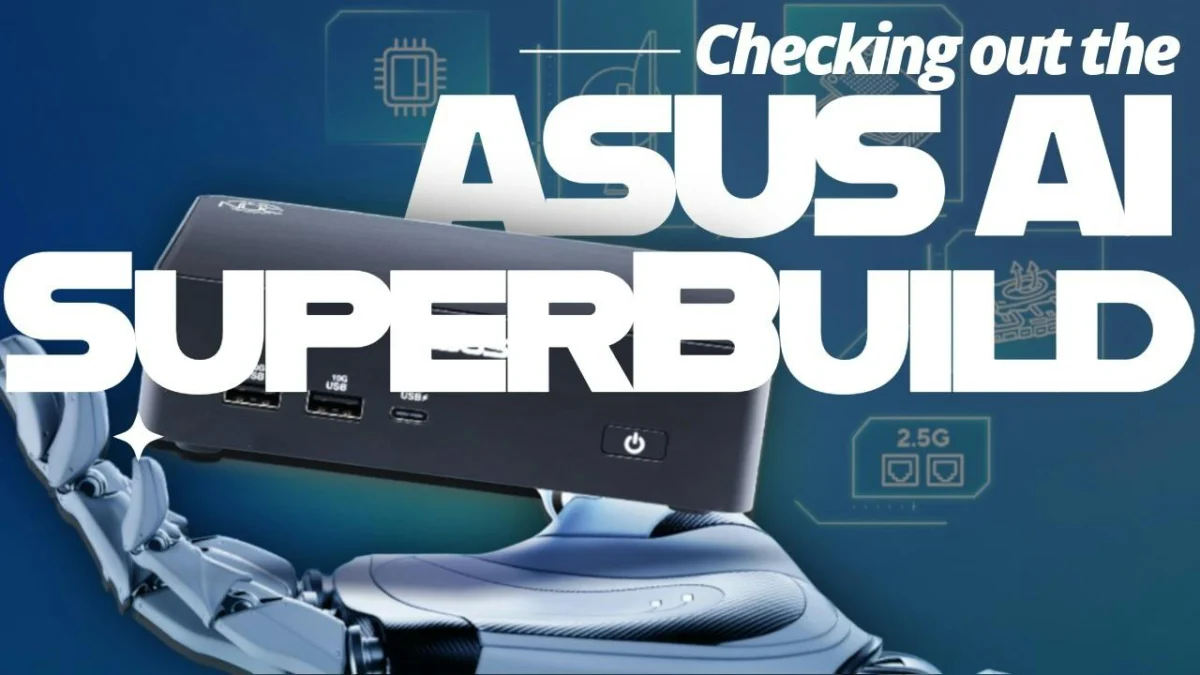
To evaluate the current state of local edge AI, we put the ASUS NUC 16 Pro mini-PC through its paces. Equipped with Intel’s Core Ultra X9 series 3 processor and integrated AI acceleration, this compact machine serves as a compelling testbed for local large language models (LLMs) and agentic workflows. By leveraging Intel’s AI SuperBuild software suite, developers can experiment with cutting-edge edge AI capabilities with minimal friction.

Main Facts: Hardware and Software Synergy
The core viability of local artificial intelligence hinges on the harmony between specialized silicon and intuitive software. The ASUS NUC 16 Pro bridges this gap by combining robust desktop-class processing power in a compact mini-PC form factor with advanced software deployment tools.
At the heart of the system is Intel’s Core Ultra X9 series 3 processor. This multi-tiered 16-core CPU architecture features:
- 4 Performance Cores (P-cores): Designed to handle heavy, single-threaded computational loads and complex logic.
- 8 Efficient Cores (E-cores): Optimized for multi-tasking and background workloads.
- 4 Low-Power Cores (LP E-cores): Tailored for maximum power savings during idle states or light computing tasks.
- Intel Arc B390 GPU: Delivers a staggering 122 INT8 TOPS (Tera Operations Per Second) for graphics and accelerated parallel processing.
- Dedicated Neural Processing Unit (NPU): Delivers 50 INT8 TOPS specifically engineered for power-efficient neural network execution in the background.
To fully exploit this hardware without requiring a PhD in machine learning, ASUS provides the AI SuperBuild software (powered by Intel). This platform targets developers, engineers, and tech enthusiasts eager to deploy local LLMs and agentic workflows out-of-the-box. The utility provides a streamlined chat interface and a model downloader capable of pulling open-source foundation models—such as the Qwen3 series—directly onto local storage for offline execution.

Chronology: Evaluating the Setup and Deployment Process
Deploying complex AI systems has traditionally been a frustrating exercise in dependency management, environment configuration, and hardware compatibility checks. The workflow tested on the ASUS NUC 16 Pro demonstrates how far the industry has come in simplifying this pipeline.
Step 1: Hardware Integration and Baseline Testing
Initial evaluation of the ASUS NUC 16 Pro focused on its physical footprint and thermal management during sustained loads. Because mini-PCs must dissipate heat within tight spatial constraints, running continuous inference tasks can often trigger thermal throttling. During baseline assessments, the NUC 16 Pro maintained stable clock speeds, efficiently routing standard compute tasks to the P-cores while offloading matrix multiplication to the integrated Arc GPU and NPU.
Step 2: Deploying Intel’s AI SuperBuild
Installing the AI SuperBuild environment eliminated the tedious process of compiling custom Python runtimes or configuring llama.cpp wrappers manually. The software provides an intuitive interface that catalogs compatible open-source LLMs. During testing, the Qwen3 model family was downloaded directly through the utility, configured, and initialized for local inference within minutes.

Step 3: Integrating Agentic AI via the Model Context Protocol (MCP)
Beyond static text generation, the evaluation explored the system’s ability to handle agentic AI—systems capable of taking autonomous actions using external tools and data sources. Utilizing the Model Context Protocol (MCP) marketplace embedded within the SuperBuild software, various device drivers and service interfaces were added. These MCPs acted as local bridges, allowing the LLM to interact with local file systems, execute search queries, and manage data without routing queries through external cloud servers.
Supporting Data: Performance Metrics and Platform Comparison
To understand where the ASUS NUC 16 Pro fits into the broader computing ecosystem, it is helpful to analyze its computational throughput relative to other edge and cloud paradigms.
| Metric / Feature | ASUS NUC 16 Pro (Core Ultra X9) | Traditional Cloud Infrastructure | Ultra-Low-Power Edge Boards |
|---|---|---|---|
| Primary Processor | 16-Core Intel Core Ultra X9 Series 3 | Multi-Socket Xeon / EPYC | ARM Cortex / Specialized Microcontrollers |
| Graphics / Accelerator | Arc B390 GPU (122 INT8 TOPS) | Enterprise GPGPUs (e.g., NVIDIA H100/B200) | Integrated NPU / Low-Power Accelerators |
| Dedicated NPU | 50 INT8 TOPS (High Efficiency) | Variable / Often absent on CPU nodes | 10 to 30 INT8 TOPS |
| Primary Deployment Tool | AI SuperBuild / MCP Marketplace | Custom Docker / Kubernetes Clusters | Specialized Runtimes (e.g., ZeroClaw) |
| Primary Advantage | Data privacy, offline operation, low latency | Massive parameter handling, unlimited scale | Minimal footprint, ultra-low power draw |
Alternative AI Ecosystems for Developers and Non-Programmers
While the AI SuperBuild caters primarily to developers looking for lower-level control, the broader software market has evolved to support non-programmers:

- OpenClaw: An alternative platform tailored for non-technical users seeking out-of-the-box agentic AI capabilities, featuring its own MCP marketplace for task automation.
- ZeroClaw: Designed for minimal runtime footprints, targeting extremely resource-constrained edge hardware.
- Commercial Cloud Titans (Claude, Perplexity, ChatGPT): While offering unmatched parameter sizes and contextual awareness, these platforms demand continuous cloud connectivity and introduce subscription costs alongside data privacy considerations.
Official Responses and Industry Perspectives
The push toward local, edge-based artificial intelligence is backed by major silicon manufacturers and hardware OEMs alike. Industry stakeholders emphasize that the future of AI will not be exclusively cloud-dependent; rather, a hybrid model is emerging where routine tasks, sensitive data processing, and offline operations are handled locally.
Intel engineering representatives have repeatedly highlighted the integration of NPUs into client processors as a watershed moment for consumer and enterprise computing. By offloading sustained neural network computations to a dedicated, low-power architectural block, modern processors like the Core Ultra X9 preserve battery life in mobile devices and reduce thermal dissipation in compact form factors like the NUC.
Similarly, ASUS product positioning stresses that form factor innovation must match computational shifts. As artificial intelligence transitions from an experimental novelty into an everyday utility, users require hardware that is reliable, quiet, and powerful enough to run models locally without necessitating a dedicated server rack in their workspace or home office.

Implications: The Promise and Pitfalls of Local Intelligence
While running LLMs and autonomous agents locally on hardware like the ASUS NUC 16 Pro unlocks remarkable capabilities, developers and enterprise architects must weigh both the profound advantages and the inherent limitations of edge deployment.
The Advantages of Local Processing
- Uncompromising Data Privacy: Because inference occurs entirely on the local machine, sensitive corporate documents, personal communications, and proprietary codebases never traverse external networks or third-party cloud servers.
- Offline Resiliency: Local agentic workflows do not depend on internet connectivity. Systems can execute searches, organize local files, and run automated routines even during network outages or within air-gapped secure environments.
- Reduced Latency: Eliminating round-trip network transmission times to remote data centers results in snappier responses for interactive tools and real-time automation scripts.
Cautions, Security, and Limitations
- Raw Computational Ceiling: Despite the impressive 122 INT8 TOPS delivered by the Arc B390 GPU and the 50 INT8 TOPS from the NPU, a mini-PC processor cannot match the multi-terabyte memory bandwidth and massive parallel processing power of cloud-based server arrays. Extremely large frontier models with hundreds of billions of parameters remain outside the practical scope of local client hardware.
- Security and Access Vectors: Running AI models locally brings data closer to the application layer, but it also introduces new security considerations. If an LLM-driven agent equipped with MCP capabilities is granted broad access to local file systems or cloud-linked APIs, unintended data leakage or unauthorized command execution can occur if proper guardrails are not enforced. Users must exercise caution regarding which local directories and external services are exposed to active agents.
Final Thoughts
My hands-on evaluation of the ASUS NUC 16 Pro running Intel’s AI SuperBuild software proved that practical, local agentic AI is no longer a futuristic concept—it is a functional reality available today. Whether the goal is executing offline searches, automating repetitive local chores, or experimenting with emerging Model Context Protocols, hardware platforms like the NUC 16 Pro provide a robust sandbox for developers and tech enthusiasts alike.