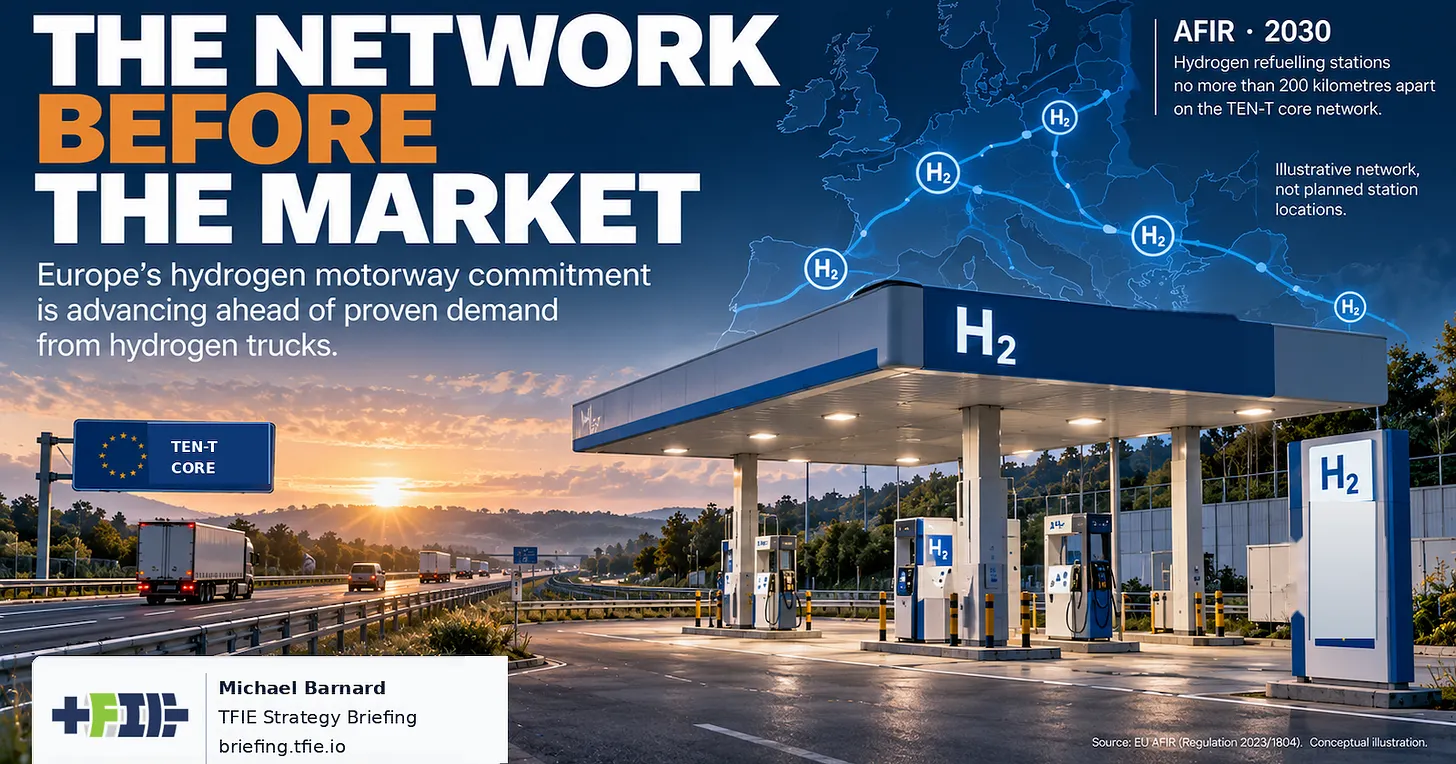
As Europe aggressively builds out its hydrogen-refuelling network ahead of actual commercial truck demand, policymakers are facing a high-stakes infrastructure puzzle. Under the European Union’s Alternative Fuels Infrastructure Regulation (AFIR), hydrogen stations are mandated along major motorway corridors at intervals of no more than 200 kilometers by 2030, alongside comprehensive coverage at designated urban nodes. A recent European assessment estimates that executing this AFIR-compliant network will require roughly €2.1 billion in capital investment.
However, the foundational logic of this policy is under intense scrutiny. While the chicken-and-egg dilemma of clean transport is well documented—truck operators hesitate to purchase hydrogen vehicles without a reliable cross-border refuelling network, and investors refuse to build stations without guaranteed customers—pushing supply far ahead of demand carries staggering financial risks. Europe is not the first global jurisdiction to attempt breaking this deadlock. South Korea has already run a much more mature, large-scale version of this exact experiment, and its sobering station economics serve as an urgent warning for European regulators.
Main Facts
The core tension in Europe’s green transition strategy lies in the race between regulatory infrastructure mandates and actual market adoption. Under AFIR guidelines, member states must ensure hydrogen refuelling stations dot major European freight corridors by the end of the decade. Yet, heavy-duty vehicle (HDV) manufacturers and fleet operators have been slow to embrace hydrogen on a mass scale, deterred by high vehicle purchase prices, high fuel costs, and competing zero-emission technologies.
Key facts shaping this debate include:
- The AFIR Mandate: By 2030, hydrogen stations must be established at maximum intervals of 200 km along core trans-European transport networks (TEN-T), supported by additional urban nodes.
- Capital Exposure: Delivering a fully compliant network across the EU is projected to cost approximately €2.1 billion in upfront capital investments.
- The Competing Technology: Rapid advancements in battery-electric trucks and high-power megawatt-scale freight charging are aggressively capturing the zero-emission commercial transport market, shrinking the potential addressable demand for hydrogen.
- The Economic Disconnect: South Korea’s empirical data reveals that aggressive state-backed infrastructure buildouts do not automatically translate into organic, self-sustaining commercial utilization.
Chronology of the Hydrogen Infrastructure Push
To understand how Europe arrived at its current regulatory crossroads, it is vital to examine the timeline of government-led interventions in both Asia and Europe.
1. The Genesis of Coordinated Policy (2018–2020)
Recognizing the decarbonization imperative for heavy-duty freight, governments began formulating industrial strategies centered on hydrogen. South Korea established an ambitious national roadmap aiming for hundreds of refuelling stations and hundreds of thousands of hydrogen vehicles by 2030, backed heavily by direct state subsidies. Concurrently, European policymakers began drafting the architecture of the Green Deal, laying the groundwork for binding infrastructure targets.
2. The Formulation of AFIR (2021–2023)
The European Union introduced the Alternative Fuels Infrastructure Regulation to legally compel member states into building out alternative fuel networks. Recognizing that private capital would not independently assume the risk of early-stage hydrogen station deployment, the regulation bypassed standard market signals, setting strict geographic and spatial mandates for hydrogen dispensers along motorways regardless of immediate local demand.
3. South Korea’s Milestone Reality Check (2024–2026)
As South Korea raced toward its 2030 targets, structural imbalances between supply and demand became impossible to ignore.

- By August 2026, South Korea had installed 493 hydrogen refuelling units, successfully achieving 74.7% of its target of at least 660 stations by 2030.
- In stark contrast, hydrogen vehicle registrations lagged severely behind at 49,220 units—representing a mere 16.4% of the government’s 300,000-vehicle target.
4. The Current European Crossroads (Late 2026)
With AFIR implementation underway, European policymakers are reviewing the financial viability of their €2.1 billion rollout. Analysts are actively comparing the unfolding European trajectory against South Korea’s heavily subsidized operational model to determine whether minor adjustments or a fundamental overhaul of the mandate is required.
Supporting Data and Financial Realities
The core argument against unyielding geographic infrastructure mandates lies in the hard economic data emerging from advanced testing grounds. South Korea’s heavy intervention provides a clear window into what happens when infrastructure outpaces market demand.
Subsidies and Operating Losses
The financial evidence from South Korea’s network is startlingly clear. Out of 258 commercially active stations assessed in the first half of 2026:
- 208 stations (80.6%) required direct government financial support to stay afloat amid mounting operating losses.
- Several newly constructed stations had already ceased operations entirely, citing poor business prospects and unmanageable financial deficits.
While these support programs feature strict eligibility limits—meaning not every surviving station is inherently unprofitable—the sheer scale of ongoing public life support challenges the foundational thesis that early infrastructure naturally matures into a self-sustaining commercial ecosystem.
The Bus Exception: Captive Fleets vs. Motorway Stations
Proponents of hydrogen often point to isolated success stories, such as the Jeonju Pyeonghwa station in South Korea, which reported reaching an operating break-even point in 2024. However, a deeper look reveals why this success cannot be easily replicated across a motorway network:
- Captive Demand: Jeonju Pyeonghwa primarily services a concentrated, predictable fleet of hydrogen buses. Buses return on fixed schedules, consume massive quantities of fuel daily, and allow operators to design infrastructure precisely around known volumetric demand.
- The Catch: The station’s infrastructure was heavily subsidized, accounting transparency regarding long-term capital expenditure (capex) amortization remains opaque, and the hydrogen dispensed is predominantly fossil-derived.
Motorway stations built purely to satisfy geographic spacing requirements under AFIR face the exact opposite reality. They rely on stochastic, long-haul freight traffic that has yet to adopt hydrogen vehicles at scale, leaving utilization rates dangerously low.
The Provenance and Cost Dilemma
Fuel economics introduce another layer of profound vulnerability. South Korea’s hydrogen-refuelling market was largely built around inexpensive fossil-derived and petrochemical by-product hydrogen. While this lower-cost fuel cushioned initial station economics, it severely undermined the climate and environmental case for the transition.
Transitioning to green, renewable hydrogen significantly improves lifecycle carbon emissions, but it drives fuel costs up dramatically—long before factoring in the additional expenses of transport, high-pressure compression, and dispensing. Europe faces this exact tension. The European hydrogen sector remains overwhelmingly conventional, and renewable hydrogen commands a massive price premium. Consequently, a newly built European hydrogen station may successfully satisfy a bureaucratic infrastructure mandate while failing to offer commercially attractive fuel prices or delivering the deep emissions reductions that originally justified the policy.

Official Responses and Stakeholder Perspectives
Reactions to the mounting costs and sluggish vehicle adoption rates are deeply divided among policymakers, industrial conglomerates, and clean energy analysts.
Proponents of Strict Mandates
EU regulators and traditional energy incumbents maintain that strict infrastructure targets are non-negotiable. From their perspective, waiting for private fleet operators to organically purchase hydrogen trucks before building stations guarantees eternal gridlock. Proponents argue that the €2.1 billion capital expenditure is a necessary seed investment to jump-start a strategic clean-tech industrial base, pointing to long-term decarbonization goals for heavy transport that batteries alone may struggle to service across extreme long-haul routes.
Skeptics and Market Analysts
Independent energy analysts and clean-tech strategy groups caution that continuing to fund geographically mandated stations without verified local demand risks creating a sprawling network of expensive public white elephants. Critics argue that public funds would be far better spent targeting specific, high-density industrial freight clusters and captive fleets rather than scattering capital blindly across European motorways. Furthermore, automotive industry voices point out that rapid breakthroughs in battery-electric freight trucks—supported by the massive deployment of megawatt-scale charging corridors—are neutralizing the unique selling propositions once claimed by hydrogen.
Strategic Implications for Europe
Europe does not need to dismantle its existing, high-utilization hydrogen infrastructure, nor should it halt projects that possess genuine, committed fleet demand. However, it must fundamentally rethink the assumption that geographic network coverage should continue expanding automatically regardless of market feedback.
To avoid repeating South Korea’s costly mistakes, the ongoing AFIR review process should integrate rigorous economic and environmental tests for all future station approvals:
- Throughput Verification: New stations should be subjected to mandatory evaluations regarding expected daily kilograms sold, tied directly to letters of intent from local or regional fleet operators.
- Total Cost Transparency: Projects must account for full capex amortization and long-term operating costs without assuming indefinite state subsidies.
- Price and Provenance Audits: Regulators must scrutinize whether the hydrogen dispensed is genuinely renewable and whether the retail price point can realistically compete with diesel and emerging battery-electric alternatives.
- Technology Competitiveness: Network planners must evaluate hydrogen investments against the rapid evolution of competing zero-emission technologies, particularly high-power battery-electric freight systems, over the lifetime of the assets.
South Korea’s multi-year experiment has provided Europe with a priceless empirical warning: building infrastructure does not automatically manufacture a commercial market. By acknowledging these economic realities before completing its mandated network, Europe has a unique window to transition from rigid bureaucratic targets to a smarter, demand-driven strategy that safeguards public capital and ensures long-term climate success.