





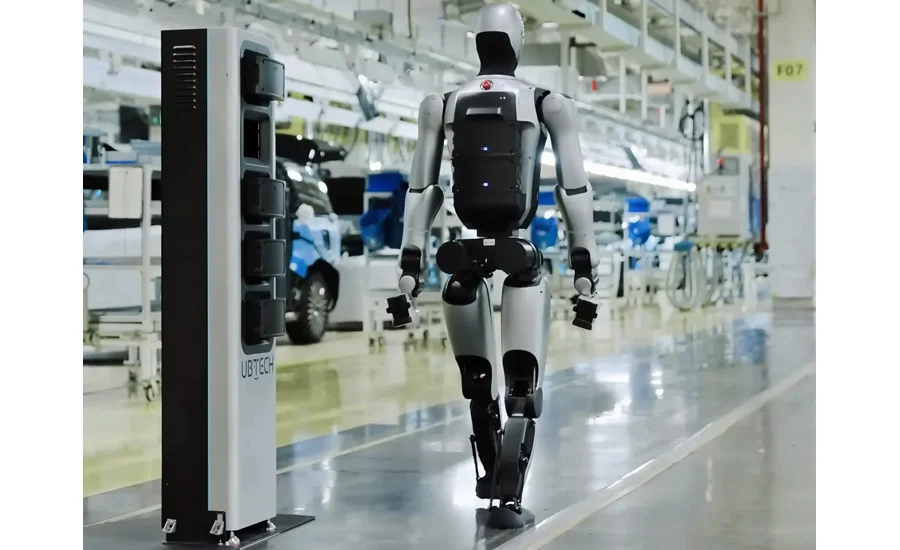
CHANGCHUN, China — In a significant step toward the future of fully automated automotive manufacturing, FAW-Volkswagen Automobile Co. Ltd. is scaling up its integration of cutting-edge humanoid robotics. The joint venture, established between Chinese state-owned automaker FAW Group and German automotive giant Volkswagen Group, is expanding its ongoing trial run of humanoid robots developed by Shenzhen-based Ubtech Robotics.
Having initially deployed Ubtech’s Walker S Lite humanoid robots for precision vehicle inspection tasks, the automaker is now setting its sights on a far more complex and dynamic operational environment: factory floor logistics. The expanded collaboration signals a broader industry-wide push to transition humanoid robots from novelty demonstrations into indispensable, heavy-duty production assets.
Main Facts: The Next Frontier in Automotive Automation
The centerpiece of the expanded partnership is a strategic cooperation agreement signed earlier this month between FAW-Volkswagen and Ubtech Robotics. The pact centers on the joint development, testing, and deployment of physical artificial intelligence (AI) applications tailored specifically for automotive assembly environments.
- The Technology: The trials utilize Ubtech’s advanced humanoid robotics platforms, notably the Walker S Lite series, which are equipped with sophisticated arrays of high-resolution cameras, LiDAR, and environmental sensors.
- The Evolution of Use Cases: While the initial phase focused on static and semi-static quality control—such as inspecting vehicle components, identifying assembly defects, and interfacing with plant quality systems—the new phase tests humanoids in material handling and internal logistics.
- Infrastructure Compatibility: A primary driver for deploying humanoids in logistics is their anthropomorphic form factor. Because factories are built around human dimensions, humanoid robots can operate workstations, navigate standard aisles, and utilize existing flow racks without requiring costly facility overhauls.
- Unconfirmed Parameters: As of press time, neither FAW-Volkswagen nor Ubtech has disclosed the precise number of robots slated for the expanded trial, the specific manufacturing facilities hosting the new logistics demonstrations, or a definitive timeline for full commercial deployment.
Chronology: From Quality Control to Logistics Integration
The integration of Ubtech’s humanoid technology into FAW-Volkswagen’s manufacturing ecosystem has progressed rapidly, reflecting the automotive sector’s urgency in adopting physical AI solutions.
Phase 1: Initial Deployment and Inspection Trials
In the early stages of the collaboration, FAW-Volkswagen introduced Ubtech’s Walker S Lite humanoid robots into controlled manufacturing environments. These initial trials were strictly observational and analytical. Stationed along the assembly lines, the robots utilized their onboard vision systems to perform rigorous vehicle inspections. They were trained to scan vehicle bodies, verify the correct installation of components, and flag surface-level defects or assembly deviations. Crucially, these trials allowed engineers to evaluate how well humanoid hardware could integrate with existing factory digital infrastructures and manufacturing execution systems (MES).
Phase 2: Strategic Agreement and Scope Expansion
Building on the relative success of the inspection trials, leadership from both FAW-Volkswagen and Ubtech recognized the potential to tackle more demanding factory workflows. Earlier this month, the two companies formalized their relationship by signing a comprehensive strategic cooperation agreement. This milestone shifted the partnership’s focus from isolated quality-assurance tasks to holistic manufacturing support, paving the way for testing robots in dynamic material-flow scenarios.
Phase 3: Current Logistics Testing and Future Outlook
The current phase involves deploying humanoids into the labyrinthine world of plant logistics. Unlike fixed-position industrial robotic arms or even traditional Automated Guided Vehicles (AGVs)—which often require dedicated magnetic strips, optical tracks, or heavily modified floor layouts—the new trials evaluate the humanoids’ ability to make real-time decisions while transporting parts, managing inventory, and coordinating with human workers in chaotic, high-traffic environments.
Supporting Data: The Logistics Challenge and Infrastructure Advantages
Automotive manufacturing logistics is notoriously complex. Moving thousands of discrete parts, fasteners, and sub-assemblies to the exact point of use on an assembly line requires absolute precision.
Navigating the Dynamic Factory Floor
Introducing humanoid robots into logistics introduces a completely different matrix of engineering challenges compared to stationary inspection:
- Dynamic Navigation: Robots must continuously map and adapt to changing environments, avoiding obstacles such as forklifts, human operators, and shifting pallet placements.
- Material Handling: Humanoids must demonstrate fine-motor dexterity and grip control to pick, lift, and place varied components—ranging from heavy metal stampings to delicate wiring harnesses—without dropping or damaging them.
- Collaborative Synchronization: The robots need to operate seamlessly alongside traditional material-handling equipment, including Automated Guided Vehicles (AGVs), Autonomous Mobile Robots (AMRs), and overhead conveyor systems, without causing production bottlenecks.
The Economic Case for Humanoid Form Factors
Despite these hurdles, manufacturers see a compelling economic justification for humanoid designs over traditional automation. Historically, automating a brownfield manufacturing plant for advanced robotics required extensive capital expenditure to redesign material flow paths, install custom gantry systems, or replace human-centric workstations.
Humanoid robots, however, offer a unique "plug-and-play" advantage within human spaces:
- Zero Infrastructure Redesign: Because humanoids walk on two legs and possess articulated arms and hands, they can utilize existing infrastructure originally designed for human workers.
- Ergonomic Adaptability: They can interact with standard industrial furniture, pull standard carts, and access multi-tier flow racks without requiring specialized, robot-only tooling.
- Flexibility: Unlike single-purpose automation machinery that becomes obsolete when a vehicle model changes, software-driven humanoid robots can be reprogrammed to handle entirely new tasks as production lines evolve.
Official Responses and Industry Perspectives
Representatives from both FAW-Volkswagen and Ubtech have framed the expanded partnership as a milestone for intelligent manufacturing.
Industry analysts note that Chinese automakers, operating in one of the most competitive and technologically aggressive automotive markets in the world, are uniquely positioned to spearhead the adoption of physical AI. With high labor costs rising in urban manufacturing hubs and the Chinese government heavily promoting "New Productive Forces" and advanced automation, domestic automakers are eager to pioneer factory floor robotics.
"The integration of humanoid robotics into logistics is no longer a theoretical exercise confined to research laboratories," notes an industry manufacturing strategist. "Automakers are under intense pressure to squeeze every ounce of efficiency out of their supply chains. If humanoids can prove their reliability in moving parts through active assembly plants, we are looking at a paradigm shift in industrial engineering."
Ubtech, which has steadily positioned itself as a global leader in commercial humanoid robotics, views partnerships with legacy automotive giants like Volkswagen and FAW as crucial validation of its hardware and software stacks. The real-world data gathered from FAW-Volkswagen’s sprawling manufacturing complexes will provide invaluable feedback for refining Ubtech’s neural networks, motion-planning algorithms, and power-management systems.
Implications: What This Means for the Future of Manufacturing
The escalation of FAW-Volkswagen’s trials carries profound implications for the global automotive industry and the broader manufacturing sector.
1. Acceleration of "Lights-Out" and Collaborative Manufacturing
While fully automated "lights-out" factories have existed for years in highly specialized sectors, final-assembly automotive plants have stubbornly resisted complete automation due to the sheer dexterity required to assemble complex vehicles. Humanoid robots bridge this gap. By handling both quality inspection and parts logistics, humanoids serve as the connective tissue between traditional human-led craftsmanship and rigid automated machinery.
2. Shifting Workforce Dynamics
As physical AI moves deeper into factory logistics, the role of the human manufacturing worker will inevitably evolve. Rather than performing monotonous, physically taxing material-handling tasks—such as pushing heavy carts or lifting bins of heavy components—workers will increasingly transition to supervisory, maintenance, and programming roles. This shift addresses both labor shortages in the manufacturing sector and long-term ergonomic concerns regarding repetitive strain injuries.
3. Global Competitive Pressures
As Tier-1 joint ventures like FAW-Volkswagen successfully field-test humanoid robots in high-volume production settings, global competitors in Europe, North America, Japan, and South Korea will face mounting pressure to accelerate their own robotics programs. The race to commercialize versatile, cost-effective physical AI is rapidly becoming a defining competitive metric for international automotive dominance.
Conclusion
The expansion of FAW-Volkswagen and Ubtech’s partnership marks a pivotal chapter in the evolution of industrial automation. By moving beyond simple inspection tasks and stepping into the complex, chaotic world of factory logistics, humanoid robots are proving their mettle where it matters most: on the active assembly line. As these trials progress and the underlying AI matures, the vision of humanoid robots working shoulder-to-shoulder with human operators is rapidly transforming from science fiction into an indispensable industrial reality.