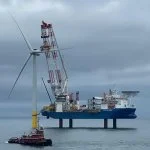
WASHINGTON, D.C. — In a sweeping move that has sent shockwaves through the renewable energy sector and state utility commissions, the U.S. Department of the Interior has issued an immediate, indefinite pause on all leases for large-scale offshore wind projects currently under construction across the United States.
The decision, which follows the release of classified reports from the Department of Defense, marks a significant shift in federal energy policy under the Trump administration. Officials cite "emerging national security risks" as the primary catalyst for the stoppage, specifically pointing to the intersection of modern military radar capabilities and the physical infrastructure of offshore wind farms.
The Core Conflict: Radar Interference and "Clutter"
At the heart of the administration’s decision is a technical concern regarding how offshore wind turbines interact with defense surveillance systems. According to documents provided by the Department of the Interior, the massive scale of modern offshore wind turbines—which can stand hundreds of feet tall—creates significant "radar clutter."
The Department of the Interior alleges that the rhythmic movement of turbine blades, combined with the reflective surfaces of the steel towers, creates a radar signature that mimics or obscures legitimate aerial targets. In a formal statement, Secretary of the Interior Doug Burgum emphasized that the government’s mandate to protect the populace necessitates this pause.
"The prime duty of the United States government is to protect the American people," Secretary Burgum stated. "Today’s action addresses emerging national security risks, including the rapid evolution of the relevant adversary technologies, and the vulnerabilities created by large-scale offshore wind projects with proximity near our East Coast population centers. The Trump administration will always prioritize the security of the American people."
Chronology of a Regulatory Collision
The rapid escalation of this issue follows years of careful development and inter-agency coordination. The following timeline outlines the development of the current impasse:
- 2014–2019: Early pilot programs, including the Coastal Virginia Offshore Wind (CVOW) pilot turbines, are commissioned. Initial assessments by federal and military entities suggest minimal impact on radar or maritime operations.
- 2020–2022: Large-scale commercial offshore wind projects receive federal approval. Regional utility regulators, such as the Virginia State Corporation Commission, conduct rigorous cost-benefit analyses, clearing the way for multi-billion dollar investments.
- 2023–2024: Construction on major projects begins, with developers investing heavily in supply chains, specialized maritime vessels, and subsea cabling.
- Early 2025: The Department of Defense concludes a classified review of critical infrastructure vulnerabilities in the face of evolving adversary technologies, such as advanced long-range stealth and drone swarms.
- Current Date: The Department of the Interior issues an immediate stay on all active construction leases, citing the findings of the recent classified DoD reports.
Supporting Data: The Scale of the Disruption
The projects currently caught in this regulatory freeze represent a significant portion of the U.S. transition toward a diversified energy portfolio. While the Interior Department has not released the specific list of all affected sites, industry analysts estimate that billions of dollars in capital expenditure are now effectively frozen.
The impact is not merely financial; it is grid-dependent. As the nation experiences a historic surge in electricity demand—driven largely by the proliferation of artificial intelligence, high-performance computing, and the massive expansion of regional data centers—the loss of these wind assets threatens to create a supply-demand gap.
For many states, particularly along the Atlantic seaboard, these wind projects were slated to become the backbone of "all-of-the-above" energy strategies, designed to supplement baseload power from natural gas and nuclear facilities.
The Industry Pushback: Dominion Energy’s Stance
The response from the private sector has been swift and contentious. Dominion Energy, the primary developer behind the Coastal Virginia Offshore Wind (CVOW) project, has challenged the federal government’s characterization of their site as a security liability.
In a comprehensive rebuttal, Dominion Energy emphasized that the CVOW project is not just a power source, but a vital component of the nation’s "war-fighting" infrastructure.
The Argument for Essentiality
"The Coastal Virginia Offshore Wind Project is essential for American national security and meeting Virginia’s dramatically growing energy needs," the company stated. "This growth is driven by the need to provide reliable power to many of America’s most important war-fighting installations, the world’s largest warship manufacturer, and the largest concentration of data centers on the planet."
Dominion points out that their project has undergone over a decade of rigorous federal oversight. They argue that the proximity—27 to 44 miles offshore—renders the projects invisible from the coast and minimizes any potential visual interference. Furthermore, the company highlights the historical success of their pilot turbines: "The project’s two pilot turbines have been operating for five years without causing any impacts to national security."
Economic and Strategic Consequences
Dominion Energy warns that the suspension of the project will have cascading effects:
- Grid Reliability: Threatening the power supply to critical AI assets and military installations.
- Energy Inflation: Potential cost overruns and loss of economies of scale.
- Job Market Instability: Thousands of construction and maritime jobs are now in jeopardy.
"Virginia’s grid needs the addition of electrons, not subtraction," the company’s statement read. "These electrons will power the data centers that will win the AI race, support our war fighters, and build the nuclear warships needed to maintain our maritime supremacy."
Implications for the Future of U.S. Energy
The standoff between the Trump administration and offshore wind developers highlights a growing tension between domestic energy independence and military surveillance requirements.
Technological Hurdles
The Department of the Interior’s focus on "radar clutter" suggests that the government is concerned about how stationary or slow-moving structures interact with modern "look-down" radar systems. As adversary nations develop smaller, lower-flying, and stealthier airborne threats, the military’s requirement for a "clean" radar environment is becoming increasingly stringent.
Regulatory Uncertainty
For investors, the pause introduces a new, "black swan" level of risk. If federal agencies can retroactively freeze leases based on classified security findings, the financial modeling for future renewable projects will become significantly more expensive, if not impossible to secure.
The Path Forward
The administration has yet to outline a pathway for resolution. It remains unclear whether the government intends to demand technical modifications to existing turbines (such as radar-absorbent coatings or modified blade geometry) or if they are seeking a complete termination of specific projects located in sensitive corridors.
As legal teams for major energy firms begin to analyze the executive authority behind the Department of the Interior’s directive, the political landscape remains polarized. Supporters of the move argue that national security must supersede commercial interests in an era of heightened global tension. Conversely, proponents of the wind projects argue that energy security is national security, and that a stable, domestic power grid is the foundation upon which American military superiority rests.
For now, the turbines remain silent, and the maritime vessels that were scheduled to begin the next phase of construction are sitting idle, waiting for a resolution that will likely be decided in the high-stakes arena of federal courtrooms and the corridors of the Pentagon.
Key Questions for Future Review:
- Can technical mitigation strategies be deployed to satisfy the Department of Defense without dismantling existing infrastructure?
- Will the Department of the Interior provide a mechanism for developers to seek compensation for the state-mandated work stoppages?
- What will be the impact on state-level energy goals for states like Virginia, New Jersey, and New York, all of which relied on offshore wind to meet statutory carbon-reduction targets?
As the situation develops, stakeholders across the energy and defense sectors are watching closely to see if this is a temporary pause for site-specific adjustments or the beginning of a wholesale rollback of the U.S. offshore wind industry.