Sponsored by InfluxData
For decades, the data historian has served as the heartbeat of automotive manufacturing. From the precision of robotic weld cells in the body shop to the high-stakes environment of the final assembly line, these systems have reliably captured signals from PLCs, test stands, and automated machinery. However, as the automotive industry accelerates toward Industry 4.0, the sheer volume and velocity of data generated by modern smart factories are pushing traditional historian architectures to their breaking point.
The limitations are clear: restrictive per-tag licensing models turn every new sensor installation into a complex budgetary negotiation, while proprietary architectures create data silos that stifle cross-plant transparency. Perhaps most critically, the batch-export workflows common in legacy systems act as a bottleneck, stalling the real-time analytics necessary for predictive maintenance and immediate quality intervention. For automotive leaders, the dilemma is acute: how do you modernize infrastructure that is foundational to operations without risking a single minute of downtime?
The Dilemma: To Rip-and-Replace or to Augment?
In the automotive sector, the cost of operational disruption is catastrophic. A single line stoppage can cascade within hours, resulting in missed takt times, heavy Just-in-Time (JIT) penalties, and, in worst-case scenarios, the shutdown of downstream Original Equipment Manufacturer (OEM) assembly plants.
Consequently, the "rip-and-replace" approach—the traditional IT solution to legacy debt—is rarely a viable strategy in a mission-critical automotive environment. The risk of interrupting a validated, IATF 16949-certified production line is simply too high. This reality has forced a shift in strategy among OT and IT architects: instead of discarding the historian, the industry is moving toward an augmentation strategy. By layering high-performance, time-series capabilities alongside existing infrastructure, manufacturers can unlock modern data potential while keeping the legacy foundation intact.
A new 22-page guide from InfluxData outlines this transition, providing a blueprint for how automotive manufacturers can introduce modern data capabilities in parallel with their existing systems. This approach allows production to continue uninterrupted while new, AI-ready data streams come online.
Chronology of a Data Evolution
The shift from legacy historians to modern time-series platforms follows a clear progression in the manufacturing lifecycle:
- The Era of Silos (1990s–2010s): Manufacturing data was captured primarily for local monitoring. Historians were centralized within specific plant departments, and cross-plant visibility was non-existent.
- The Connectivity Explosion (2015–2020): The rise of IIoT brought thousands of new sensors online. The cost of licensing these tags through traditional historians began to outpace the value of the data being collected, leading to "data starvation" where only critical parameters were monitored.
- The Real-Time Requirement (2020–Present): The push for predictive maintenance, digital twins, and machine learning models required granular, high-frequency data. Legacy systems, built for long-term archival rather than real-time stream processing, struggled to provide the latency required for proactive intervention.
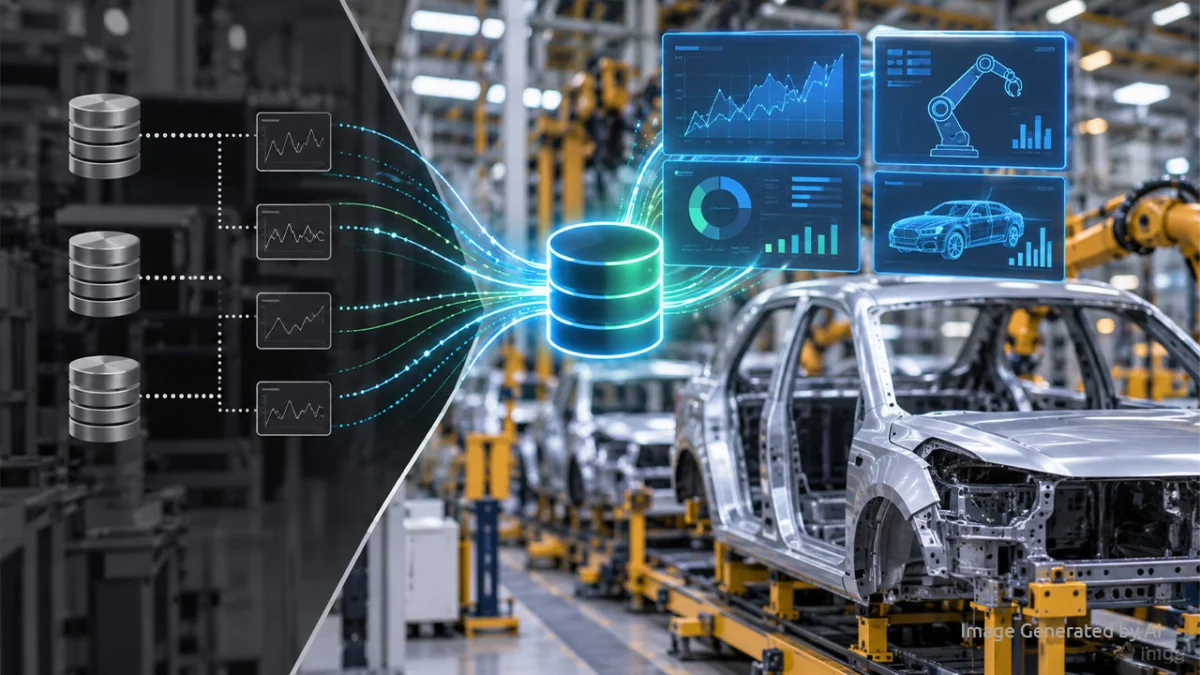
- The Augmentation Phase (Today): Manufacturers are now adopting "Sidecar" architectures. By using open-source collectors like Telegraf to mirror traffic from PLCs, companies are feeding both their legacy historian and a modern, cloud-native time-series database (TSDB) simultaneously, creating a bridge to the future without dismantling the past.
Supporting Data: Mapping the Automotive Architecture
To understand the scope of the challenge, one must look at the specific data flows within a modern automotive plant. The InfluxData guide provides a granular breakdown of the critical telemetry points that define modern production:
- Stamping Presses: Monitoring tonnage, die temperatures, and vibration signatures is essential for preventing tool breakage and ensuring dimensional consistency.
- Body Shop: High-frequency tracking of KUKA and FANUC robotic joint data and spot weld current is required to detect early signs of mechanical fatigue or weld degradation.
- Paint Shop: Managing E-Coat tank levels, oven temperatures, and HVAC environmental controls requires precise, long-term trend analysis to maintain finish quality.
- Final Assembly: Integration with Atlas Copco DC torque tools, AGV routing data, and end-of-line (EOL) dynamometer testing provides the final proof of vehicle quality.
The challenge, historically, has been that each of these areas often uses different communication protocols (OPC-UA, MQTT, Modbus, etc.). InfluxData’s approach utilizes Telegraf, an open-source collector with hundreds of plugins, to normalize these disparate streams into a unified format before ingestion. This eliminates the need for expensive, vendor-locked middleware.
Integration: A Symbiotic Ecosystem
Modernization is not about isolation; it is about integration. The current manufacturing stack relies on a complex web of platforms that must communicate seamlessly. InfluxDB serves as a persistence layer that integrates with industry-standard tools:
- PTC ThingWorx: InfluxDB acts as the high-speed data engine for ThingWorx, allowing for advanced persistence of IoT data.
- Kepware: By streaming OPC data directly into InfluxDB 3, legacy weld and stamping assets can be brought into a modern queryable layer without requiring a full PLC upgrade.
- Rockwell Automation: FactoryTalk Optix and View SE can pipe Allen-Bradley PLC data directly into the time-series engine, ensuring that operational data is available for cross-plant analytics.
- Litmus Edge: This serves as the orchestration layer, handling tag mapping and ensuring that asset context is standardized across multiple geographical sites.
Perhaps the most revolutionary addition is the InfluxDB MCP Server, which bridges the gap between raw time-series data and Generative AI. By connecting production data to AI tools via natural language, engineers can now query complex metrics—such as "Show me the vibration trends for Stamping Line 4 over the last week"—without needing to write complex SQL queries or navigate opaque schema structures.
Real-World Case Studies: Proof of Scale
The efficacy of the augmentation model is evidenced by the success of several industry leaders who have already made the transition:
Toyo Tires
Facing the need for global scale, Toyo Tires began with a pilot of 100 machines at a single plant in Serbia. The goal was to implement real-time anomaly detection and quality analysis. By leveraging the flexibility of a time-series architecture, they successfully scaled to over 1,000 machines across multiple international locations. Critically, the system now maintains 20 years of data retention, ensuring the company remains fully compliant with rigorous automotive audit standards.
Gotion
As a top-10 global EV battery manufacturer, Gotion required a platform capable of handling the high-volume data inherent in cell production. They chose InfluxDB specifically for its superior data compression capabilities and a query language that was intuitive for their data science teams. This has allowed Gotion to rapidly iterate on machine learning models that optimize battery chemistry and assembly speed.
American Axle & Manufacturing (AAM)
Operating nearly 85 facilities across 18 countries, AAM required an enterprise-wide infrastructure that could unify data across disparate sites. By deploying a combination of InfluxDB, Telegraf, and Grafana, AAM has created a centralized visibility layer that allows them to perform cross-plant benchmarking, effectively identifying best practices and operational inefficiencies at a global scale.
Implications for the Future of Manufacturing
The shift toward augmented data infrastructure carries significant implications for the automotive workforce and the bottom line.
Empowering the Workforce
By moving away from manual, spreadsheet-heavy data collection, plant engineers and launch managers are freed from the drudgery of data retrieval. Instead, they are empowered to act as data consumers. When AI tools can interpret plant-level telemetry in natural language, the barrier to entry for advanced analytics is lowered, allowing frontline personnel to make data-driven decisions that improve OEE (Overall Equipment Effectiveness) in real time.
Future-Proofing Quality
For quality leaders, the transition to modern infrastructure means the end of "blind spots." With unified data layers, warranty investigations can be traced back to the specific production parameters of a single vehicle component. If a defect is identified, the ability to correlate the incident with historical machine data across global facilities becomes a massive competitive advantage.
Strategic Infrastructure
The message to IT/OT architects is clear: the historian is not dead, but it is no longer sufficient on its own. The future belongs to those who can build "bilingual" systems—infrastructure that respects the stability and reliability of the legacy historian while embracing the agility and power of the modern data stack.
For those currently evaluating their digital transformation roadmap, the path forward is not a disruptive rip-and-replace, but a thoughtful, parallel evolution. By augmenting the historian, automotive manufacturers can protect their production lines today while building the data foundation required for the autonomous, AI-driven factories of tomorrow.
Are you ready to modernize your production data? Download the full 22-page guide from InfluxData to explore the architecture, integration patterns, and deployment strategies tailored specifically for the automotive industry. Access the Guide Here.