






Introduction and Main Facts
The landscape of Environmental, Health, and Safety (EHS) professions continues to evolve rapidly, driven by heightened regulatory scrutiny, corporate sustainability mandates, and an overarching organizational focus on workplace well-being. To capture the current state of financial compensation, professional benefits, and credentialing within this vital sector, the annual collaborative research initiative has officially released its findings.
In partnership with the Board of Certified Safety Professionals (BCSP), the newly published 2026 Salary Survey compiles comprehensive data from nearly 6,700 active EHS professionals across the United States. This robust data set offers a granular look into what safety practitioners earn, how various certifications impact earning potential, and how compensation packages compare against broader national economic benchmarks.

The core finding of the 2026 report is clear: EHS professionals continue to command salaries significantly higher than the typical U.S. worker. As organizations across industries recognize that safety culture directly impacts operational resilience and financial bottom lines, specialized expertise in hazard mitigation and environmental compliance is being heavily rewarded.
Chronology of the EHS Salary Survey
The annual EHS salary assessment has matured into one of the most anticipated and relied-upon benchmarking tools in the safety industry. Understanding its development highlights why this year’s data holds such weight for career planning and corporate compensation strategies.

- Early Foundations: For decades, compensation data in the safety sector was fragmented, relying on generic labor statistics that failed to capture the unique interplay of technical certifications, specialized degrees, and industry-specific hazards.
- The BCSP Partnership Era: To bridge this information gap, industry publishers joined forces with the Board of Certified Safety Professionals. This alliance transformed a simple questionnaire into an exhaustive, highly targeted demographic and financial study.
- The 2026 Deployment: Throughout the data-collection phase leading up to the publication of the 2026 report, outreach efforts engaged tens of thousands of safety practitioners. Nearly 6,700 validated responses were ultimately processed, establishing a statistically significant sample size that reflects modern post-pandemic and automated workplace dynamics.
- Publication and Dissemination: Released in late 2026, the survey results were made publicly available through specialized safety channels, offering visual infographics, deep-dive data tables, and professional development integration—including recertification point opportunities for BCSP credential holders.
Supporting Data: What the Numbers Tell Us
While the visual report graphs provide an extensive breakdown across regions, industries, and experience tiers, several primary themes emerge from the 2026 data:
1. The Power of Credentials
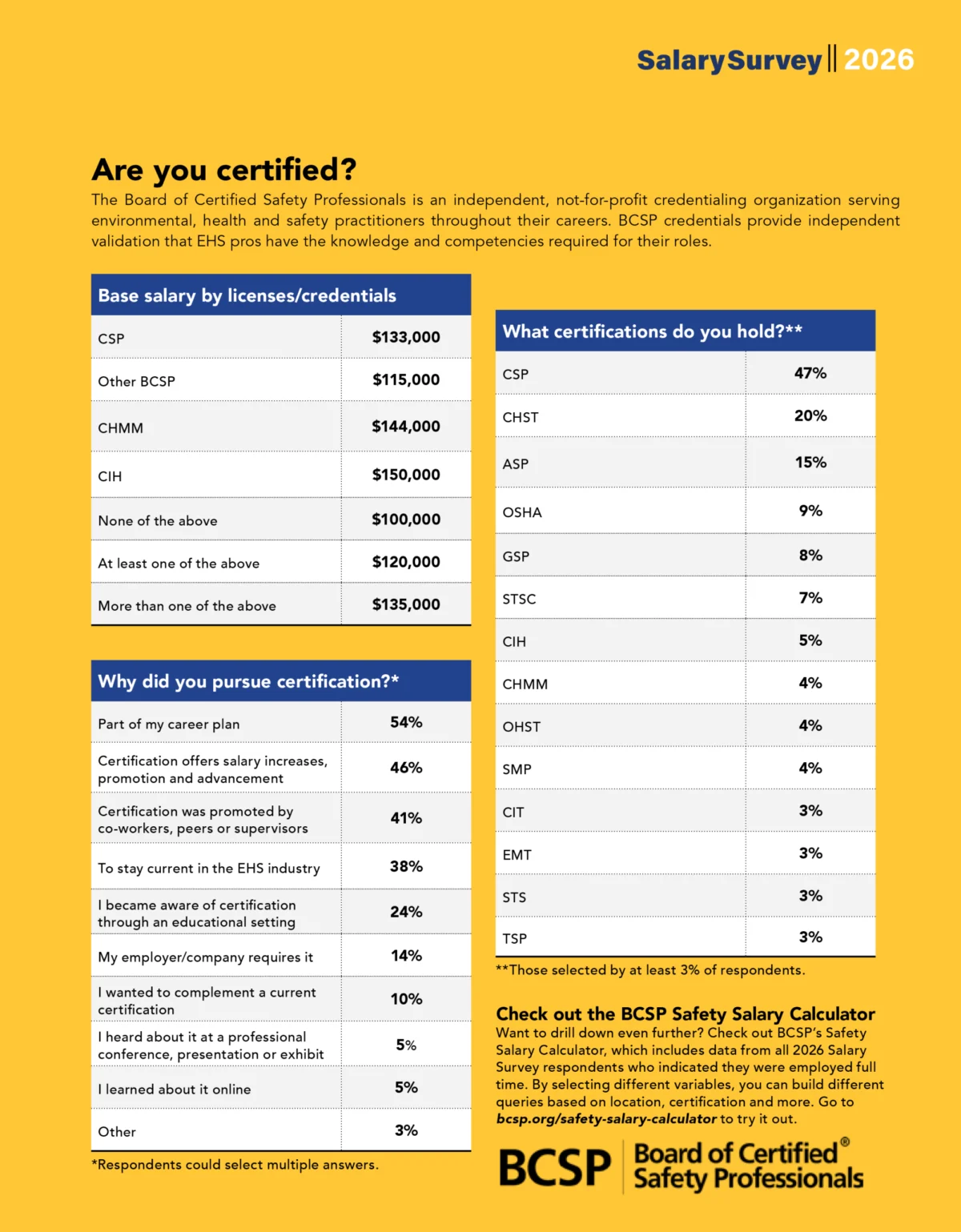
Certifications remain a primary driver of high compensation in the EHS space. Professionals holding recognized designations—such as the Certified Safety Professional (CSP), Certified Industrial Hygienist (CIH), or Occupational Health and Safety Technologist (OHST)—consistently report earning averages well above their uncertified peers. Employers view these credentials as third-party validation of critical risk-management capabilities, translating directly into higher base pay and accelerated career progression.

2. Experience and Industry Sectors
Unsurprisingly, tenure plays a pivotal role in salary scaling. Entry-level practitioners typically secure comfortable starting wages relative to general market benchmarks, but mid-to-late-career professionals managing enterprise-level safety programs routinely reach upper-tier executive compensation brackets. Furthermore, high-hazard sectors—such as oil and gas, heavy construction, chemical manufacturing, and aerospace—continue to outpace service-oriented or low-hazard industries in direct financial compensation.
3. Comprehensive Benefits Beyond Base Pay
The survey also examined total compensation packages, revealing that EHS professionals frequently enjoy robust health benefits, retirement matching, performance-based bonuses, and continuing education stipends. In an era where talent retention is a primary corporate concern, competitive fringe benefits remain a cornerstone of EHS employment agreements.

Official Responses and Industry Perspectives
The release of the 2026 Salary Survey has generated widespread discussion among industry leaders, educators, and professional organizations.
Leadership from the Board of Certified Safety Professionals emphasized that the data underscores the tangible value of professional dedication. A spokesperson noted that when practitioners invest time and resources into maintaining rigorous certifications, they are not only safeguarding workers and the environment but also securing substantial personal return on investment through superior earning power.

Meanwhile, educational partners—such as Columbia Southern University (CSU), a prominent sponsor of the 2026 survey—have pointed to the data as validation for academic programs tailored to occupational safety and health. Administrators note that prospective students increasingly look at salary surveys to justify the pursuit of specialized degrees and certifications. By aligning academic curricula with real-world industry demands, educational institutions help bridge the talent gap in high-demand technical fields.
Industry analysts further observe that as regulatory bodies introduce stricter compliance standards and emerging technologies—such as artificial intelligence in hazard monitoring and advanced ergonomic analytics—the demand for highly skilled EHS leaders will only intensify, likely pushing compensation baselines even higher in subsequent survey cycles.

Implications for EHS Professionals and Employers
The findings of the 2026 Salary Survey carry profound implications for both individual career planning and corporate human resource strategies.
For Practicing and Prospective EHS Professionals:
- Strategic Upskilling: Professionals looking to maximize their earning potential should prioritize obtaining advanced certifications recognized by the BCSP. The data clearly demonstrates that structural credentialing is one of the most reliable pathways to salary advancement.
- Negotiation Leverage: Armed with up-to-date regional and sector-specific data, EHS workers can utilize the survey results during annual performance reviews or job transitions to benchmark their compensation fairly against market standards.
- Continuous Professional Development: Engaging in ongoing education not only sharpens technical competencies but also fulfills recertification requirements, keeping practitioners at the top of their game.
For Employers and Human Resources Leaders:
- Competitive Recruiting: Because EHS professionals are in high demand and command higher-than-average wages, companies offering substandard compensation packages will struggle to attract and retain top-tier talent.
- Investing in Safety Culture: Organizations must view EHS expenditures not merely as regulatory overhead, but as strategic investments. Properly compensated, highly qualified safety professionals help prevent catastrophic workplace incidents, reduce costly downtime, and foster a more productive corporate culture.
- Total Rewards Strategy: Beyond base salaries, employers should evaluate their total rewards offerings—including professional development support, mental health resources, and flexible working arrangements—to remain competitive in a tight labor market.
Conclusion
The 2026 Salary Survey, presented jointly through the ongoing partnership between safety publishers and the Board of Certified Safety Professionals, paints a picture of a robust, highly valued profession. By synthesizing the experiences of nearly 6,700 practitioners, the report serves as an indispensable compass for navigating career trajectories and organizational compensation frameworks alike. As the workplace continues to shift in complexity, the financial and professional standing of the EHS community remains exceptionally strong, affirming that protecting people and the planet is both a noble calling and a professionally rewarding career.