By Global Logistics Desk
North American cross-border supply chains are bracing for prolonged strain. Despite lingering softness in broader freight demand, logistics executives and industry analysts warn that truck capacity between the United States, Mexico, and Canada will remain severely constrained deep into 2027.
According to leadership at major logistics provider TRAFFIX, a convergence of tightening government regulations, escalating operating costs, acute driver shortages, and restrictive macroeconomic conditions is preventing the market from expanding. Unlike previous cycles where elevated freight rates quickly triggered a wave of new market entrants and equipment purchases, today’s high-interest-rate environment has effectively locked the door on fleet growth, setting the stage for structurally higher freight rates for the foreseeable future.
Main Facts: The Current State of North American Logistics
The overarching narrative of the North American cross-border landscape is one of structural constraint meeting unyielding operational friction. While overall cargo volumes across the continent have experienced periods of sluggishness, available truck capacity has failed to keep pace, leaving shippers with a dwindling margin of error.
Key drivers of this ongoing capacity squeeze include:
- The Financing Wall: Prevailing interest rates of 8% to 9% have made equipment financing and fleet expansion cost-prohibitive for small-to-midsize carriers and prospective owner-operators.
- Regulatory and Visa Clampdowns: Sweeping changes to commercial driver documentation—most notably the revocation of tens of thousands of B-1 visas for Mexican truckers—have dramatically reduced the pool of legally authorized cross-border drivers.
- Geographic Trade Imbalances: Chronic imbalances in north-south and south-north freight flows, particularly along the Canadian border, are stranding equipment and rendering certain regional lanes economically unviable for carriers.
- The Spot Market Resurgence: As operational costs eclipse outdated contract rates, primary carriers are increasingly handing back freight commitments, driving a massive surge in spot-market utilization.
TRAFFIX executives note that these pressures are fundamentally different from the pandemic-era logistics crunch. Back then, federal stimulus funds and low-interest loans fueled an explosion of new trucking formations. Today, the capital markets are closed to speculative logistics investments, cementing a prolonged "higher-for-longer" rate environment.
Chronology: How the Crisis Unfolded
To understand how North American logistics arrived at this bottleneck, it is necessary to trace the compounding regulatory, economic, and operational events leading up to the current market structure:
- The Pandemic-Era Boom (2020–2022): Surging e-commerce demand and federal stimulus cash flooded the trucking market. Freight rates skyrocketed, inspiring thousands of new owner-operators to secure cheap loans, buy tractors, and enter the spot market.
- The Post-Pandemic Correction (2023–2024): As consumer spending normalized and supply chains cleared, freight demand softened dramatically. Spot rates collapsed, leaving overleveraged, newly minted carriers struggling to service high-interest equipment debt as diesel prices and insurance premiums climbed.
- The Regulatory Squeeze (Late 2024–2025): Governments on both the northern and southern borders began rolling out stricter enforcement actions. The U.S. government intensified its scrutiny of foreign commercial drivers operating under domestic cabotage rules, leading to the gradual reduction and revocation of thousands of B-1 visas for Mexican drivers.
- Border Infrastructure Bottlenecks (September 2026): Critical disruptions materialized at key southern crossings. Restrictions on southbound empty-truck crossings at Texas ports of entry like Eagle Pass and Brownsville stranded nearly 700 tractors on the U.S. side of the border in mid-September, causing commercial crossings to plummet by up to 70% and forcing expensive equipment repositioning.
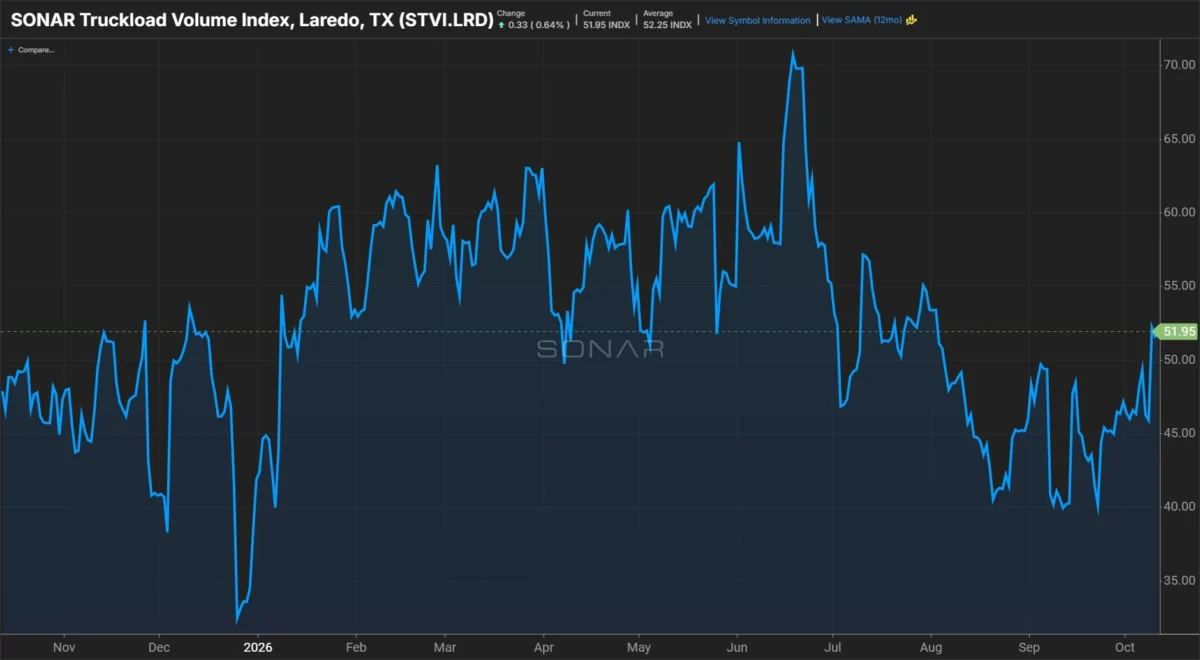
- Fourth-Quarter Surge and Index Readings (October 2026): TRAFFIX released its October North American Cross-Border Index, registering 57 for Canada and 54 for Mexico, signaling entrenched market tightness. Simultaneously, FreightWaves SONAR data for Laredo, Texas, showed outbound tender volumes spiking from 39.95 to 51.95, confirming that cross-border demand was accelerating precisely as usable capacity reached a multi-year low.
Supporting Data: Metrics Paint a Picture of Tightness
Industry barometers and regional data feeds underscore the severity of the cross-border capacity crunch.
TRAFFIX North American Cross-Border Index
The TRAFFIX index tracks four core components—transportation costs, capacity, demand, and trade policy—utilizing more than 10 distinct economic and trade indicators. Readings above 50 denote tightening conditions.
- Canada Corridor: Registered at 57 in October (down marginally from September), indicating persistent cost pressures and capacity ceilings.
- Mexico Corridor: Registered at 54 in October, highlighting the chronic friction of regulatory headwinds and driver scarcity.
The Laredo Micro-Market Surge
As the premier commercial gateway for U.S.-Mexico trade, the Laredo market serves as a primary bellwether for continental freight health. According to FreightWaves SONAR data as of October 11:
- The Outbound Tender Volume Index (STVI.LRD) climbed sharply from 39.95 in mid-September to 51.95.
- The SONAR Weighted Rejection Index (SWRI) flipped from -0.74 to +0.65 within a single week, offering mathematical proof that local capacity was actively tightening and carriers were increasingly turning down contracted loads.
Visa Revocations and Border Disruption Metrics
- Industry associations, including Mexico’s CANACAR, and reports from firms like C.H. Robinson indicate that U.S. authorities have pulled visas from approximately 20,000 to 25,000 Mexican freight drivers.
- During the mid-September border restrictions at Eagle Pass and Brownsville, daily commercial traffic tumbled from roughly 1,000 crossings to between 300 and 400 per day.
Official Responses and Regional Analysis
Leadership voices across the logistics sector have spoken out on the compounding factors choking cross-border fluidity.
The Macroeconomic View: Alex Fuller (TRAFFIX)
Alex Fuller, vice president of commercial intelligence at TRAFFIX, points directly to the financing environment as the primary culprit preventing market correction.
"We’re only four or five years later and we’re not seeing that [capacity expansion]," Fuller noted in an interview. "And it’s like, OK, well, what’s different? Two factors stand out: tighter regulations governing who can operate commercial trucks and the increased cost of purchasing equipment… Financing costs can reach 8% to 9%, making it much more difficult for drivers to enter the industry or established carriers to expand their fleets. Because of that, rates are going to stay higher for longer."
The Southern Gateway: Patricio Gutierrez on Mexico’s Woes
Patricio Gutierrez, TRAFFIX’s Manzanillo-based carrier sales manager, emphasized that Mexico’s structural labor deficit is worsening under the weight of U.S. immigration policy and border friction.
"I think that the main issue here is a lack of qualified drivers," Gutierrez said, calling out the tightening limits on B-1 visa holders. Furthermore, an aging workforce compounds the problem. Many established Mexican drivers are in their 50s and 60s, while younger generations shun the profession due to persistent highway security concerns and low starting compensation. "The shortage of drivers in Mexico is a real problem."
The Northern Corridor: Lance Halliday on Canadian Imbalances
Up north, Lance Halliday, TRAFFIX’s Toronto-based regional director of carrier sales, highlighted a deeply disruptive trade imbalance. While Canadian exports to the U.S. remain relatively steady, southbound-to-northbound return loads are scarce.
This imbalance has turned certain U.S. destination markets into operational nightmares for Canadian carriers.
"Florida is a no-go zone," Halliday stated bluntly. "Guys just won’t go because they’re getting stuck down there for days" waiting for a profitable backhaul. Consequently, carriers are rejecting inbound U.S. commitments unless compensated with dramatic rate premiums—surging 25% to 35% on specific lanes over a span of weeks.
Implications for Shippers and the Broader Economy
The long-term outlook carries significant financial and operational consequences for supply chain leaders:
- Erosion of Contract Integrity: With operating expenses outstripping legacy contract pricing, primary carriers are increasingly defaulting on volume commitments. Shippers are being forced down their routing guides, driving an unprecedented reliance on higher-cost spot-market transactions.
- Persistent Margin Compression: Shippers can no longer bank on a cyclical freight recession to drive down logistics spend. Elevated baseline transportation costs will likely force enterprises to pass expenses down to consumers, influencing retail pricing dynamics through 2027.
- Strategic Nearshoring Reassessments: Companies that built nearshoring strategies around frictionless, low-cost cross-border trucking from Mexico and Canada must now factor in recurring border delays, visa restrictions, and premium carrier pricing into their total cost of landed goods.
- The Need for Advanced Visibility Tools: As capacity remains fluidly constrained, logistics departments will increasingly rely on real-time market intelligence platforms—such as FreightWaves SONAR and proprietary cross-border indexes—to anticipate micro-market shocks in gateways like Laredo before tender rejections spike.
Ultimately, the North American trucking sector has transitioned from a cyclical market driven by temporary supply-and-demand swings into an era defined by structural, regulatory, and macroeconomic bottlenecks. For shippers navigating this landscape through 2027, agility, digital visibility, and collaborative carrier partnerships will form the absolute baseline for survival.