Introduction: The Velocity Paradox in American Energy Planning
Power system planners—comprising electric utilities, regional grid operators, and state and federal regulators—are currently caught in a high-stakes race against time. The unprecedented proliferation of energy-hungry artificial intelligence data centers, coupled with the electrification of transportation and industrial processes, has created a massive surge in demand. Yet, while administrative bodies push for immediate action to bring large loads online, analysts and industry stakeholders warn that planners are systematically overlooking short-term engineering solutions that could drastically increase grid capacity.
While long-term structural reforms are slowly being negotiated, funded, and implemented, structural bottlenecks—such as persistent shortages of skilled labor, critical high-voltage grid equipment, and prolonged regulatory review cycles—are threatening to derail the nation’s energy transition. Driven by strict federal orders and executive priorities, grid operators are scrambling to re-engineer their interconnection queues. However, experts argue that without a broader embrace of grid-enhancing technologies (GETs) and advanced conductors, the grid will struggle to meet the velocity demanded by the digital infrastructure boom.
Main Facts: The Anatomy of the Power Shortage
The modern power grid faces a unprecedented convergence of supply chain constraints and hyper-growth demand. At the epicenter of this crisis are AI data centers, which require continuous, high-capacity power supplies that traditional local distribution networks and legacy transmission lines were never designed to support.
At the federal level, regulatory agencies are exerting immense pressure on system operators. On June 18, the Federal Energy Regulatory Commission (FERC) issued sweeping "show cause" orders directed at six major regional transmission organizations and independent system operators. These orders demanded that operators submit concrete plans to accelerate the interconnection of large loads. However, all six requested extensions, citing the extreme difficulty of integrating massive new blocks of demand without compromising grid reliability or shifting unfair infrastructure costs onto ordinary residential and commercial ratepayers.
Simultaneously, the White House has leaned heavily on technology companies and utilities to help secure American dominance in the global artificial intelligence sector. This push is tethered to a voluntary Ratepayer Protection Pledge, which requires hyperscalers—the massive cloud computing companies driving data center construction—to directly shoulder the costs of the dedicated infrastructure required to serve them. Executive actions from the White House have further declared national infrastructure planning an urgent priority.
Despite these political directives, market and regulatory frameworks remain bogged down. Large-load interconnections are frequently frozen while legislative bodies debate sweeping permitting reform bills in Congress. Meanwhile, state and local governments are adopting fractured approaches: some regions are rolling out aggressive incentives to attract high-tech developments, while others are implementing strict vetting mandates, outright moratoria, and indefinite pauses on new data center interconnections.

Chronology: From Order 1920 to the Modern Interconnection Crisis
To understand how the electricity sector reached this critical juncture, it is helpful to trace the regulatory and operational milestones that have shaped grid planning over recent years:
- 2024: FERC issues Order 1920, a landmark rule designed to overhaul long-term regional transmission planning. The order establishes a robust framework for managing the uncertainties of traditional generation retirements and the integration of variable renewable energy resources.
- 2025 (Early to Mid): The surge in large-load demand from AI data centers accelerates dramatically. Grid operators experience an unprecedented logjam in their interconnection queues. FERC publishes its 2025 State of the Market report, revealing that transmission investments are still primarily driven by aging asset renewal and baseline reliability rather than proactive load growth.
- July 2025: MISO secures FERC approval for its Expedited Resource Addition Study (ERAS), implementing shorter 90-day study periods to streamline resource additions. The Energy Systems Integration Group (ESIG) and the Brattle Group release a pivotal joint report titled "Transmission Planning with Large Loads," arguing for a complete paradigm shift toward scenario-based, least-regrets planning.
- December 2025: FERC issues a wave of show cause orders directing regional grid operators to create specialized pathways for co-located loads.
- January 2026: FERC officially approves the Southwest Power Pool’s (SPP) groundbreaking framework for High Impact Large Loads (HILL) and Conditional High Impact Large Loads (CHILL), offering a glimpse of flexible, curtailment-based grid integration.
- June 2026: The Public Utility Commission of Texas approves ERCOT’s "Batch Zero" review process, merging large-load queue analysis with the grid’s six-year transmission planning horizon. Meanwhile, FERC’s Order 1920 compliance filings begin rolling in across the country, though industry analysts note that a true "rethink" of utility planning remains incomplete.
- August 2026: FERC grants PJM Interconnection an extension until November 16, 2026, to comply with federal directives on large loads. The ClearPath organization publishes "Amping Up the Grid," highlighting the massive, untapped potential of advanced conductors.
Supporting Data & Regional Responses
Given the protracted timelines required to build brand-new transmission lines and generation facilities, industry leaders are increasingly looking toward maximizing the utilization of the existing grid. Yet, data shows that most capital expenditure by utilities continues to lag behind real-time load growth.
Regional grid operators are responding to this challenge with varying degrees of innovation, frequently using load flexibility as a currency to trade for speed-to-power.
The Southwest Power Pool (SPP)
SPP has emerged as a national model for holistic grid planning. Although its Consolidated Planning Process—which merges the traditionally segregated interconnection and transmission planning tracks—was conceptualized before large loads dominated the sector, it has won high praise from federal regulators. Furthermore, SPP introduced the High Impact Large Load (HILL) and Conditional High Impact Large Load (CHILL) frameworks. Under the CHILL structure, industrial users agree to allow grid operators to curtail their power consumption during periods of transmission inadequacy, mirroring the "connect and manage" philosophy utilized by ERCOT for independent power producers. SPP is also advancing the Price Adaptive Load Service (PALS), which pushes this concept further by allowing flexible loads to connect without dedicated generation matching, accepting higher curtailment risks in exchange for rapid access to the grid.
PJM Interconnection
As the regional operator projected to absorb up to 70% of future U.S. data center development, PJM is facing intense pressure from state governors, local legislators, and FERC. In response to federal show cause directives, PJM proposed the Interim Resource Adequacy Service (IRAS). Similar to Texas models, the IRAS framework permits large loads to interconnect without waiting for new network capacity, provided they possess the capability to drop their load or switch to on-site resources when the system experiences resource adequacy shortfalls.
ERCOT (Electric Reliability Council of Texas)
Operating outside of FERC’s direct jurisdictional purview, ERCOT instituted "Batch Zero"—a comprehensive, system-wide analysis of all large loads currently sitting in its interconnection queue. By merging Batch Zero with its annual six-year transmission plan, ERCOT sought to streamline evaluations. Through tracks like the Withdrawal-Limited Private Use Network (WLPUN)—which allows data centers to pair with on-site generation to minimize transmission draw—and the Provisional Controllable Load Resource (PCLR) track, ERCOT has attempted to fast-track interconnections. However, these initiatives are currently experiencing temporary pauses following orders from Texas Governor Greg Abbott to audit the state’s sprawling interconnection queue.
MISO (Midcontinent Independent System Operator)
Rather than designing an entirely new planning architecture from scratch, MISO has opted to rework its existing administrative processes. Through the Expedited Resource Addition Study (ERAS) and newly minted Expedited Project Review processes, MISO is reviewing proposed transmission infrastructure every two months. Furthermore, MISO stakeholders are actively debating a proposed Zero-injection Generator Interconnection Agreement to simplify approvals for large loads that feature co-located, behind-the-meter generation assets.
Official Responses and Expert Insights
The disconnect between long-term regulatory frameworks and short-term operational realities has drawn sharp criticism from industry experts and policy strategists who argue that advanced technologies are being left out of the conversation.
Zachary Zimmerman, Director of Research and Policy at Grid Strategies, notes that while regulatory milestones like FERC Order 1920 point the industry in the right direction, a fundamental psychological shift has yet to take hold. "The elements of Order 1920 showed the way, and large loads add the exclamation point on the need for new planning processes," Zimmerman stated. "But there has not been a complete rethink of utility planning yet."
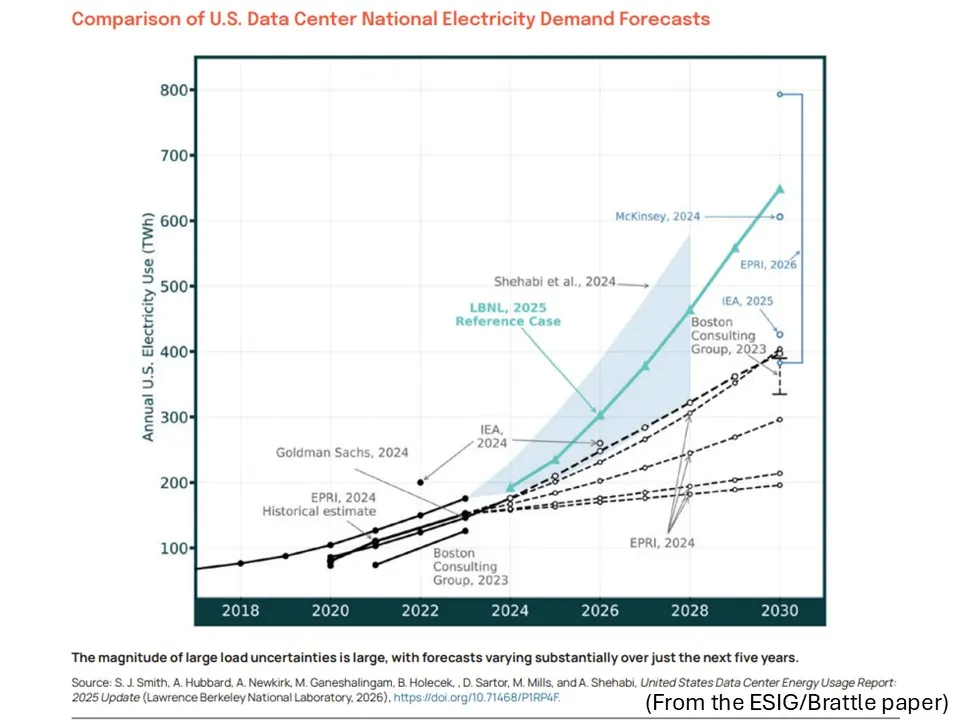
Johannes Pfeifenberger, a principal with The Brattle Group and co-author of the ESIG-Brattle report, emphasizes that modern planning frameworks must account for extreme forecasting uncertainty. This requires implementing "fast and cost-effective near-term options that address speed to power"—such as advanced carbon core conductors embedded with fiber sensing and real-time analytics—while long-term transmission lines are slowly permitted and constructed.
This sentiment is echoed by Theodore Paradise, Chief Policy and Grid Strategy Officer for advanced powerline manufacturer CTC Global. Paradise argues that while policymakers finally recognize the legitimacy of explosive new load forecasts, they continue to starve the market of urgently needed short-term interventions.
According to Paradise, citing data from a recent ClearPath policy report, advanced transmission technologies and high-capacity conductors can be manufactured, procured, and deployed in 36 months or less. In many cases, replacing traditional aluminum-conductor steel-reinforced (ACSR) lines with advanced composite conductors can double the carrying capacity of an existing right-of-way at a fraction of the cost of building new towers.
"Policymakers now realize the new large load forecasts are real, but they are still not enabling the urgently needed short-term solutions," Paradise said. He advocates for mandatory requirements compelling regional planners to evaluate advanced conductors at the earliest stages of the planning process, warning that treating them as an afterthought strips them of their system-wide optimization value. Notably, at least six state legislatures have passed binding laws since 2024 requiring regulated utilities to formally consider advanced transmission technologies in their capital expenditure filings.
Implications: Navigating the Road Ahead
The inability to quickly and efficiently interconnect large loads carries profound economic and geopolitical implications. If the United States intends to "win the AI race" while simultaneously expanding domestic manufacturing and electrifying the broader economy, the electricity sector must evolve past its traditional, project-by-project upgrade mentality.
- Economic Pressures on Ratepayers: Without strict enforcement of ratepayer protection pledges and innovative co-location models, the astronomical cost of upgrading regional transmission grids to serve localized tech hubs risks falling squarely on residential and small-business utility customers.
- Technological Integration: Grid operators can no longer afford to treat grid-enhancing technologies (GETs) and advanced conductors as niche experiments. As noted by James Okullo, former MISO manager and current system planning director at ESIG, major utilities—such as AEP in Texas, PPL in Pennsylvania, and Southern California Edison—have already validated the reliability of these technologies. Standardizing power flow simulations and asset management practices for advanced conductors is no longer optional; it is an operational imperative.
- Regulatory Reform and Agility: The tension between federal acceleration mandates (such as FERC’s show cause orders) and state-level friction (such as data center moratoria and queue audits) highlights the desperate need for cohesive, multi-jurisdictional alignment.
Ultimately, the future of the American power grid depends on a dual-track strategy. While long-term regional planning under frameworks like Order 1920 must proceed to build the backbone of tomorrow’s grid, power system planners must immediately embrace flexible load agreements, advanced conductors, and grid-enhancing technologies. Only by bridging the gap between immediate operational velocity and prudent long-term structural design can the industry successfully power the technological demands of the 21st century without compromising system reliability or economic equity.