





FRAMINGHAM, MA — In the world of commercial facility management, few infrastructure upgrades are as daunting as the replacement of a massive rooftop unit (RTU). When that unit weighs over 32,000 pounds and serves a sprawling 162,000-square-foot office complex, the margin for error is non-existent. Over the weekend of September 11th through September 13th, the team at Building Automation Systems (BAS) successfully executed a high-stakes surgical replacement of a massive 172-ton Seasons 4 cooling system, completing the entire operation with zero disruption to building tenants.
This project serves as a masterclass in logistics, engineering foresight, and inter-company collaboration, demonstrating how modern HVAC design-build firms are tackling the challenges of aging infrastructure in the New England region.
The Main Facts: A Heavyweight Undertaking
The installation involved the removal of an existing climate control unit and the deployment of a new, state-of-the-art Seasons 4 RTU. The specifications of the new hardware are indicative of the building’s significant cooling demands.
- Cooling Capacity: 172 tons of DX (Direct Expansion) cooling.
- Mechanical Power: 8 high-efficiency scroll compressors.
- Total Weight: 32,300 lbs.
- Timeline: 48 hours (Friday night to Sunday).
- Project Scope: 162,000 sq. ft. of climate-controlled commercial office space.
The procurement and logistics for this unit were managed in partnership with Noble Associates, Inc., a prominent manufacturer’s representative. The project was not merely a "swap out" of hardware; it was a comprehensive integration project that required meticulous planning to ensure the new unit would interface seamlessly with the building’s existing electrical and structural architecture.
Chronology: A 48-Hour Operation
The success of the Framingham project hinged on a rigid, pre-planned timeline that minimized the risk of downtime for the office building’s tenants.
Phase 1: Preparation and Logistics (Pre-September 11)
Months before the first bolt was turned, BAS engineers conducted extensive site surveys. The critical challenge was ensuring the new Seasons 4 unit would fit onto the existing roof curb. By assessing the building loads and existing structural supports, BAS and Seasons 4 engineers engineered the unit to utilize the current footprint, which prevented the need for expensive and time-consuming structural roof modifications.
Phase 2: Deployment (Friday Night, Sept 11)
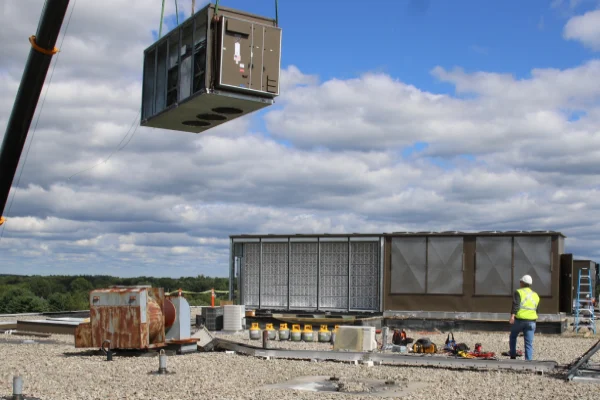
The logistical maneuver began Friday evening as the old unit was decommissioned and disconnected. The heavy-duty cranes were positioned to lift the 32,300-pound beast, a process that requires precise wind-speed monitoring and site coordination. By late Friday, the legacy unit had been extracted, clearing the staging area for the new arrival.
Phase 3: Installation and Integration (Saturday, Sept 12)
Saturday was defined by the physical setting of the unit. Because the design accounted for the exact placement of existing power feeds and control wiring, the BAS team was able to bypass the "field engineering" that usually plagues such projects. By aligning the electrical and communication conduits with the new unit’s internal layout, the team eliminated the need for complex, on-site re-wiring.
Phase 4: Commissioning (Sunday, Sept 13)
The final day was dedicated to the digital and mechanical "handshake." BAS programmers worked in tandem with Seasons 4 to integrate custom RTU sequences into the building’s existing Building Management System (BMS). By Sunday evening, the system was fully operational, balanced, and verified for peak efficiency.
Supporting Data: The Engineering Behind the Efficiency
The technical requirements of a 162,000-square-foot facility are immense. A 172-ton system is not a standard "off-the-shelf" solution; it is a custom-engineered asset.
Load Balancing and Demand Analysis
Before the project began, BAS utilized data-driven assessments of the building’s thermal loads. The primary objective was to right-size the cooling capacity. Over-sizing an RTU leads to "short-cycling," which wastes energy and increases wear on the compressors, while under-sizing leads to poor humidity control and tenant discomfort. The decision to use 8 scroll compressors was deliberate; these compressors allow for "staged" cooling. The unit does not have to run at 100% capacity at all times, but rather modulates its output based on the real-time thermal demand of the building.
Seamless Structural Integration
The "curb-fit" strategy employed by BAS is a significant cost-saver for property managers. Often, a new unit’s ductwork and electrical connections do not match the old unit, forcing contractors to rebuild the roof curb. By collaborating directly with the factory engineers at Seasons 4, BAS ensured the new unit’s connections were a mirror-image of the previous configuration. This effectively saved the client thousands of dollars in electrical and mechanical labor.
Official Responses and Industry Context
"The success of this installation speaks to the importance of the design-build methodology," says a representative from Building Automation Systems. "When the design team, the manufacturer, and the installation technicians are on the same page, the timeline shrinks and the reliability of the system increases. Our goal was to provide the client with a ‘plug-and-play’ experience for a 172-ton machine, and we achieved that by doing the heavy lifting in the design phase rather than in the field."
The involvement of Noble Associates, Inc. was also critical. As the manufacturer’s representative, they facilitated the communication between the facility management team in Framingham and the manufacturing plant at Seasons 4, ensuring that any custom software sequences were pre-loaded or pre-configured before the unit ever reached the job site.
Implications: The Future of HVAC Management in New England
The Framingham project highlights a growing trend in commercial real estate: the shift toward high-speed, low-disruption infrastructure upgrades.
The Tenant Experience
In the modern office environment, tenants expect consistent climate control. Even a 24-hour shutdown of HVAC services can lead to complaints, productivity losses, or lease penalties. By completing this massive upgrade over a single weekend, BAS demonstrated that facility upgrades no longer require significant downtime. This "invisible upgrade" model is becoming the gold standard for property managers in New England.
Energy Efficiency and Sustainability
The transition from an older, likely inefficient RTU to a modern unit equipped with 8 scroll compressors significantly lowers the building’s carbon footprint. Modern units offer better energy consumption monitoring and tighter control over refrigerant cycles, aligning with both local environmental regulations and corporate ESG (Environmental, Social, and Governance) goals.
The Role of Integrated Design-Build
This project serves as a case study for why property owners should favor integrated teams. Because BAS handles both the engineering and the automation/programming, there is no "blame game" when issues arise. If the unit does not communicate with the building’s management system, it is the same company’s responsibility to fix it. This creates a single point of accountability that is invaluable to busy property managers.
Expanding Capabilities
For property managers in the New England region, the Framingham installation is a proof-of-concept. It demonstrates that regardless of the size of the equipment, technical precision can overcome logistical hurdles. With a team of licensed engineers and certified programmers, firms like BAS are positioning themselves as the go-to partners for critical infrastructure, particularly as existing building stock in the region continues to age and require modernization.
Conclusion
The 172-ton installation in Framingham was a logistical triumph that serves as a blueprint for future HVAC projects. Through careful load assessment, custom mechanical design, and a perfectly executed weekend installation, the BAS team successfully modernized a significant portion of a 162,000-square-foot office building without interrupting the flow of daily business.
As commercial spaces continue to demand higher levels of energy efficiency and operational reliability, the ability to execute such high-stakes projects with speed and accuracy will remain a top priority for property managers throughout the region. For those managing critical assets, the lessons of this project are clear: the difference between a project that disrupts business and one that improves it lies in the engineering done before the crane ever leaves the yard.