






In the mid-20th century, the American automotive landscape was swept up in a wave of jet-age infatuation. Fresh off aeronautical triumphs that pushed the boundaries of speed and altitude, engineers in Detroit began to look skyward for inspiration on how to revolutionize ground transportation. Across the Motor City, visionaries envisioned a future where the roar of traditional piston engines would be replaced by the high-pitched, turbine-driven whine of aircraft-derived powerplants.
This technological fervor spawned a diverse menagerie of turbine-powered prototypes, ranging from urban buses and passenger cars to experimental military tanks, heavy-duty farm tractors, and high-speed locomotives. Yet, among all these applications, one of the most commercially promising and industrially vital domains was heavy-duty long-haul trucking.
As the United States laid the groundwork for the monumental Eisenhower Interstate Highway System, automakers realized that the nation’s freight network would soon demand a radically new breed of commercial vehicle. In response, Ford Motor Company and General Motors engineered gargantuan, futuristic concept rigs that promised to conquer the open highway with unprecedented speed, efficiency, and payload capacity. Though these machines ultimately never made it to mass production, their design, engineering, and ambition continue to capture the imagination of manufacturing historians today.
Main Facts: The Allure of the Gas Turbine
To understand why Detroit poured millions of dollars into turbine research, one must examine the fundamental engineering advantages of the technology over conventional internal combustion engines.
At its core, a gas turbine engine operates on a relatively simple thermodynamic cycle—drawing in ambient air, compressing it, mixing it with fuel, igniting it, and passing the high-pressure expanding gases over a turbine wheel to generate rotational force. Because they do not rely on reciprocating pistons, connecting rods, and crankshafts, turbine engines contain a drastically lower number of moving parts than traditional diesel or gasoline engines. Theoretically, this reduction in mechanical complexity simplifies manufacturing, lowers maintenance overhead, and promises extraordinary mechanical reliability.
Furthermore, gas turbines are remarkably compact relative to the immense horsepower they produce. They operate with a near absence of mechanical vibration, offering a smooth, seamless delivery of power that would have been a godsend to long-haul truck drivers battling fatigue across thousands of miles of asphalt.
Versatility was another major selling point. While conventional engines require specific grades of refined diesel or gasoline, turbine engines are omnivorous by design. Beyond standard aviation fuel, experimental turbines could run efficiently on a wide array of alternative substances, including kerosene, propane, ammonia, and even landfill gas.
Despite these compelling advantages, the technology carried inherent hurdles—most notably extreme operating temperatures, high initial tooling costs, and a notorious throttle lag that made city driving challenging. Nevertheless, in the golden age of American industrial optimism, Detroit’s engineers were confident these hurdles could be cleared.
Chronology of an Era: From Concept to Highway Tour
The public debut and developmental timeline of Detroit’s turbine truck era trace a rapid arc of ambition, peaking at the 1964 New York World’s Fair and winding down by the late 1960s.
1964: The New York World’s Fair Showcase
The watershed moment for turbine trucking arrived at the 1964 New York World’s Fair. Backed by massive corporate pavilions, Ford and General Motors used the global stage to unveil their radical vision of future logistics. The fair served as an incubator for futuristic styling and advanced engineering, drawing millions of awestruck visitors who lined up to catch a glimpse of the trucks of tomorrow.
November 1964: Ford’s "Big Red" Coast-to-Coast Tour
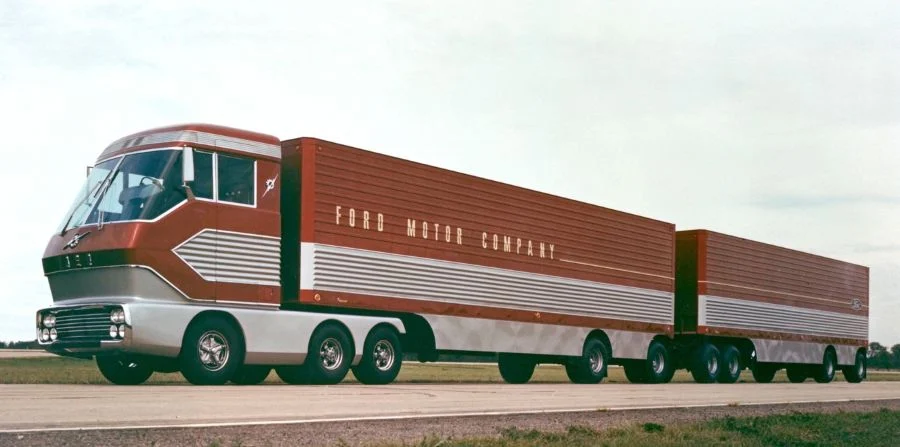
Capitalizing on the momentum of the World’s Fair, Ford sent its experimental heavy-duty tractor, affectionately dubbed "Big Red," on a grueling, cross-country promotional tour. In November 1964, the 96-foot-long rig embarked on a high-profile journey from Los Angeles to Washington, D.C. Along the way, it made strategic public viewing stops in major American hubs, including Denver, Dallas, Kansas City, and Chicago, demonstrating the viability of high-speed inter-state commerce.
1965: General Motors Retaliates with the Turbo Titan III
Not to be outdone by its cross-town rival, General Motors followed up its static 1964 World’s Fair exhibit—the twin-turbine Bison—with a fully operational, road-ready prototype in 1965: the Chevrolet Turbo Titan III. While the Bison served as a design study in modular freight and automated handling, the Turbo Titan III was built to interface with real-world infrastructure, testing aerodynamic body panels and space-age cockpit controls on actual asphalt.
Supporting Data: Engineering Specifications of the Titans
The engineering metrics behind these concept vehicles highlight just how radical a departure they were from the heavy-duty trucks populating American highways in the mid-1960s.
Ford’s Big Red: Specifications
- Overall Length: 96 feet (consisting of the tractor and a pair of streamlined tandem trailers built by Fruehauf).
- Powerplant: 600-horsepower gas turbine engine.
- Curb Structure: A towering 13-foot-tall fiberglass-over-steel aerodynamic body mounted on a tandem-axle tractor.
- Access: Drivers entered and exited the elevated cab via a unique, 5-foot-long ladder that deployed automatically upon opening the door.
- Weight Advantage: The turbine engine weighed roughly one-third of a comparable heavy-duty diesel engine of the era.
General Motors’ Bison: Specifications
- Wheel Configuration: Eight-wheeled chassis designed with four front steering wheels.
- Powerplant: Twin-turbine powertrain capable of generating an astonishing 1,000 horsepower.
- Cab Design: Low-slung, wrap-around glass cockpit featuring a clam-shell design where the entire cabin roof hinged forward instead of using traditional doors.
- Interior Controls: An aircraft-style control yoke replacing the traditional steering wheel, alongside a cutting-edge center-console telephone.
Chevrolet Turbo Titan III: Specifications
- Purpose: A fully functional prototype designed to pull a standard 40-foot stainless-steel commercial trailer.
- Aerodynamics: Extensive use of fiberglass-reinforced polyester for all exterior panels, incorporating massive functional air scoops and a skirted rear deck.
- Steering Console: A pedestal-mounted, fully adjustable steering console utilizing compact twin dials in place of a conventional wheel.
Official Responses: What the Brochures and Engineers Claimed
The promotional materials and engineering briefs published by Detroit during this period read like science fiction, yet they were backed by serious data collected during rigorous testing phases.
Ford Motor Co. released an extensive 44-page brochure detailing the immense promise of gas turbine integration for on-highway commercial transport. Company engineers argued that rapid advancements in manufacturing techniques and turbine metallurgy were quickly closing the cost gap between experimental turbines and long-established diesel powerplants.
One of the most potent arguments found in Ford’s official literature centered around payload capacity—the holy grail of the trucking industry. Because the gas turbine engine weighed approximately 67 percent less than a conventional diesel engine of equivalent output, the weight savings directly translated to the bottom line. Ford’s engineers calculated that on every single mile a fully loaded turbine truck traveled, it could legally transport approximately 2,000 additional pounds of freight compared to its diesel-powered counterpart. For fleet operators, that extra payload capacity represented a monumental leap in operational profitability.
General Motors made equally bold assertions regarding the future of freight logistics. In promotional brochures for the Bison and Turbo Titan III, GM executives envisioned a completely automated logistics ecosystem. They asserted that tomorrow’s express highways would see cargo modules automatically loaded, unloaded, sorted, and stored by centralized, electronically controlled equipment operating at unprecedented peaks of efficiency.
GM proudly marketed the "exotic contours" of the Turbo Titan III not merely as aesthetic styling exercises, but as functional blueprints showcasing advanced aerodynamic principles and space-age ergonomics that would inevitably migrate to production assembly lines.
Implications: Why the Dream Grounded Out
Despite the glowing press releases, cross-country promotional tours, and genuine engineering breakthroughs, the turbine-powered semi-truck ultimately failed to replace the diesel engine.
Several insurmountable economic and technical hurdles conspired to ground Detroit’s turbine ambitions:
- Fuel Consumption at Idle: While gas turbines were relatively efficient when operating at wide-open throttle on long, uninterrupted stretches of interstate highway, their fuel consumption spiked drastically when idling or operating in stop-and-go city traffic. For commercial trucking, where traffic jams, loading dock delays, and city driving are daily realities, this inefficiency was a dealbreaker.
- Manufacturing and Material Costs: The exotic superalloys required to withstand the blistering internal temperatures of a gas turbine engine made initial production costs prohibitively expensive. Even though engineers predicted long-term savings, fleet owners were unwilling to absorb astronomical upfront purchase prices.
- The Resilience of the Diesel Engine: Throughout the 1960s and 1970s, conventional diesel engine manufacturers were far from stagnant. They continuously improved the efficiency, reliability, and power output of diesel powerplants, narrowing the perceived performance gap that turbines initially exploited.
- The 1970s Energy Crises: The geopolitical and economic shocks of the 1973 oil crisis fundamentally shifted automotive research priorities. Automakers abruptly pivoted away from high-consumption alternative engines to focus strictly on fuel economy and basic passenger car emissions compliance.
Legacy of the Turbine Titans
Though Ford’s Big Red and General Motors’ Bison and Turbo Titan III were ultimately relegated to the history books—serving out their days as museum pieces and photographic relics of an unbridled industrial imagination—their legacy endures. They stand as monuments to a daring era when Detroit engineers refused to be constrained by convention, successfully reimagining aerodynamics, payload economics, and cabin ergonomics for the modern age of heavy-duty transport.