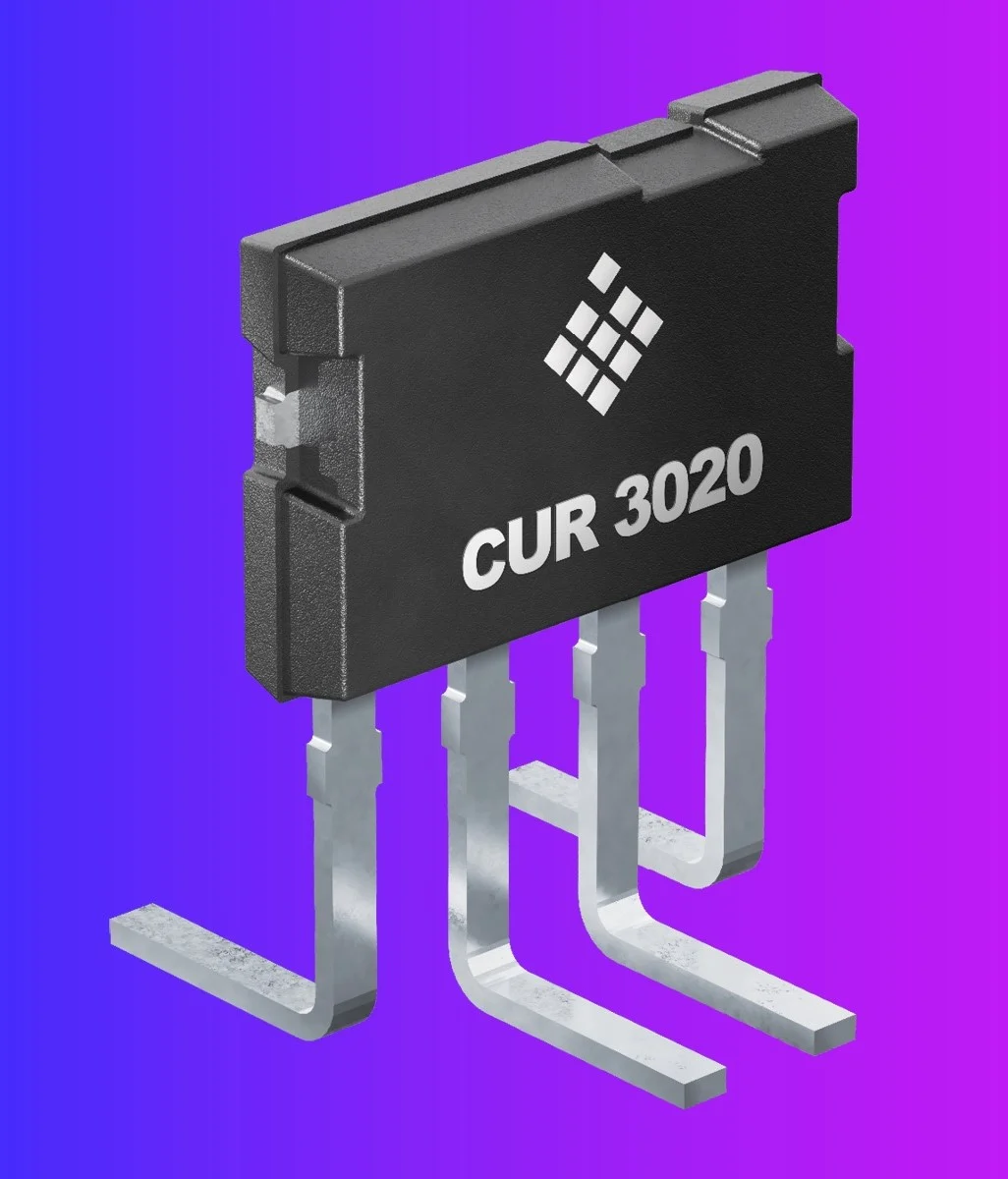
In an era where the global transition to electric mobility and high-efficiency industrial automation demands increasingly precise, robust, and fast-acting monitoring systems, TDK Corporation has unveiled its latest technological advancement. The company has officially announced the launch of the Micronas CUR 3020, a high-precision, customer-programmable linear Hall-effect current sensor IC designed to meet the rigorous demands of next-generation power electronics.
By offering selectable bandwidths of 250 kHz or 500 kHz and a highly flexible sensitivity range, the CUR 3020 positions itself as a critical component for developers tasked with optimizing xEV (Electric Vehicle) traction inverters, battery management systems (BMS), and industrial motor control modules.
Core Technical Specifications: Precision Meets Versatility
At the heart of the CUR 3020 is TDK’s commitment to "magnetic field sensing without compromise." The device is specifically engineered for use with a C-core concentrator, a design choice that maximizes magnetic flux efficiency while maintaining a compact footprint.
Key Performance Metrics:
- Selectable Bandwidth: Users can toggle between 250 kHz and 500 kHz, allowing engineers to balance signal noise filtering against the high-speed response times required for fast-switching power stages like Silicon Carbide (SiC) and Gallium Nitride (GaN) inverters.
- Sensitivity Range: The sensor offers a broad sensitivity spectrum ranging from 4.2 to 67.4 mV/mT, providing the granularity necessary to measure both small auxiliary currents and massive traction currents with high fidelity.
- Thermal Resilience: Rated for operation up to 165°C, the device comfortably exceeds the requirements of the automotive industry’s most demanding environments, including engine bay placement and high-current power distribution units.
- Packaging: The sensor is housed in a robust, industry-standard four-pin TO-92 package, ensuring ease of integration into existing PCB assembly lines while maintaining mechanical durability.
- Diagnostic Integrity: To address the critical safety requirements of modern vehicles, the CUR 3020 includes comprehensive, integrated diagnostics covering voltage monitoring, broken-wire detection, and overtemperature alerts.
A Chronology of Innovation: The Evolution of TDK Micronas
TDK’s journey into current sensing is rooted in its acquisition and integration of Micronas, a move that fundamentally reshaped the landscape of automotive Hall-effect sensors. The development of the CUR 3020 is not an isolated product release; it is the culmination of decades of research into magnetic sensing technology.
2010s: Establishing the Foundation
During the early 2010s, as the shift toward xEVs began to accelerate, TDK-Micronas focused on perfecting the linear Hall-effect sensor for basic automotive applications, such as pedal position and throttle control. The industry recognized that to achieve the next leap in efficiency, these sensors would need to move beyond simple position sensing and into the realm of high-current, high-frequency power measurement.
2020–2025: The Rise of Wide-Bandgap Semiconductors
With the widespread adoption of SiC and GaN power transistors, the switching frequencies of inverters skyrocketed. Traditional sensors could not keep pace with these high-speed transients. TDK responded by iteratively increasing the bandwidth of their sensor portfolio. The introduction of the CUR 3020 represents the current state-of-the-art in this trajectory, effectively bridging the gap between standard automotive sensors and the ultra-fast requirements of modern traction inverters.
2026: The CUR 3020 Milestone
The announcement of the CUR 3020 in 2026 marks a turning point where high-bandwidth, high-temperature, and diagnostic-heavy sensors move from being "premium-tier components" to "standard-tier requirements" for Tier-1 automotive suppliers.

Supporting Data: Why High-Bandwidth Matters
In power electronics, "current sensing" is not merely about measuring a value; it is about protecting the entire system. In a typical traction inverter, the current must be sampled at a rate significantly higher than the pulse-width modulation (PWM) frequency to prevent torque ripple and protect the power modules from short-circuit events.
The Role of 500 kHz Bandwidth
Modern GaN-based inverters can switch at speeds that would make older 50–100 kHz sensors essentially "blind" to current spikes. By providing a 500 kHz bandwidth option, the CUR 3020 allows the inverter’s control loop to react in microseconds.
- Reduced Over-Design: Because the sensor provides a more accurate and faster reading, engineers can tighten their safety margins. This results in smaller, lighter heat sinks and more compact inverter designs, which directly contribute to the vehicle’s overall range and efficiency.
- AEC-Q100 Grade 0 Compliance: The automotive industry’s most stringent reliability standard, Grade 0, ensures that the component can survive the extreme thermal cycling inherent in under-the-hood applications. The CUR 3020’s ability to function at 165°C is a testament to the robust silicon-on-insulator (SOI) process technology employed by TDK.
Industry Implications and Strategic Outlook
The release of the CUR 3020 by TDK is expected to have a ripple effect across several industrial sectors.
Impact on EV Traction Inverters
As automakers push for 800V architectures, the demand for sensors that can operate in high-EMI (electromagnetic interference) environments is surging. The CUR 3020’s design specifically addresses the need for stable operation in the presence of strong magnetic fields generated by high-voltage cabling. By using a C-core concentrator, the sensor is inherently shielded from stray fields, ensuring that the current reading remains pure and accurate even when placed near high-current busbars.
Impact on Battery Management Systems (BMS)
In modern BMS, the precision of current measurement directly influences the accuracy of State-of-Charge (SoC) and State-of-Health (SoH) calculations. An error of even a few percentage points in current measurement can lead to premature battery degradation or, in the worst case, a vehicle shutdown. The CUR 3020 provides the high-sensitivity, low-drift performance required to ensure the battery operates within its "sweet spot" for as long as possible.
Industrial Automation and Renewable Energy
Beyond automotive, the sensor is primed for use in industrial robotics and solar string inverters. As factories become increasingly automated, the need for motor controllers that can detect faults in real-time is growing. The CUR 3020’s diagnostic features (broken-wire detection and thermal warnings) mean that a single sensor can effectively serve as a "health monitor" for an entire motor drive system.
Official Perspective: Engineering for the Future
While TDK has not released a singular "executive quote" regarding the CUR 3020, their engineering documentation emphasizes a philosophy of integrated reliability. By moving the diagnostic logic onto the sensor IC itself, TDK is reducing the burden on the main system microcontroller (MCU).

In traditional designs, the MCU would have to perform complex software routines to verify if a sensor reading was valid. With the CUR 3020, the sensor handles the heavy lifting of self-diagnostics, sending a "safe-state" signal to the system if it detects an internal failure or an out-of-range environmental condition. This approach is consistent with the industry’s shift toward ISO 26262 functional safety, where individual components must contribute to the overall safety integrity level (SIL) of the vehicle.
Conclusion: Setting a New Benchmark
The Micronas CUR 3020 is more than just a component; it is a manifestation of the current engineering zeitgeist—faster, safer, and more compact. By successfully packaging high-frequency capability with automotive-grade durability, TDK has provided the market with a tool that solves the "trilemma" of power electronics: the need to increase efficiency without sacrificing safety or ballooning the size of the system.
As we look toward 2027 and beyond, the influence of this sensor will likely be seen in the next generation of electric powertrains. For engineers and system architects, the CUR 3020 offers a reliable, programmable, and highly capable building block that will undoubtedly accelerate the pace of innovation in the global transition toward electrification.
Whether it is in the high-torque environment of a sports SUV or the precision-controlled motor of an industrial robotic arm, TDK’s latest offering ensures that current measurement remains a cornerstone of safety and efficiency. The Micronas CUR 3020 is not just a sensor; it is a vital component in the infrastructure of the future.
About TDK Corporation:
TDK Corporation is a world leader in electronic solutions for the smart society based in Tokyo, Japan. Built on a foundation of material sciences, TDK welcomes societal transformation by leveraging its deep technical expertise to provide components that power the electronics of tomorrow.