MIAMI — July 28, 2026 — In an era defined by tightening budgets and expanding HR responsibilities, a new report from The Hackett Group, Inc. (NASDAQ: HCKT) signals a seismic shift in how global organizations identify and secure talent. The 2026 Talent Acquisition Vendor Assessments reveals that the rapid integration of advanced automation and agentic artificial intelligence (AI) has become the primary lifeline for HR departments struggling to balance increased workloads with reduced headcounts.
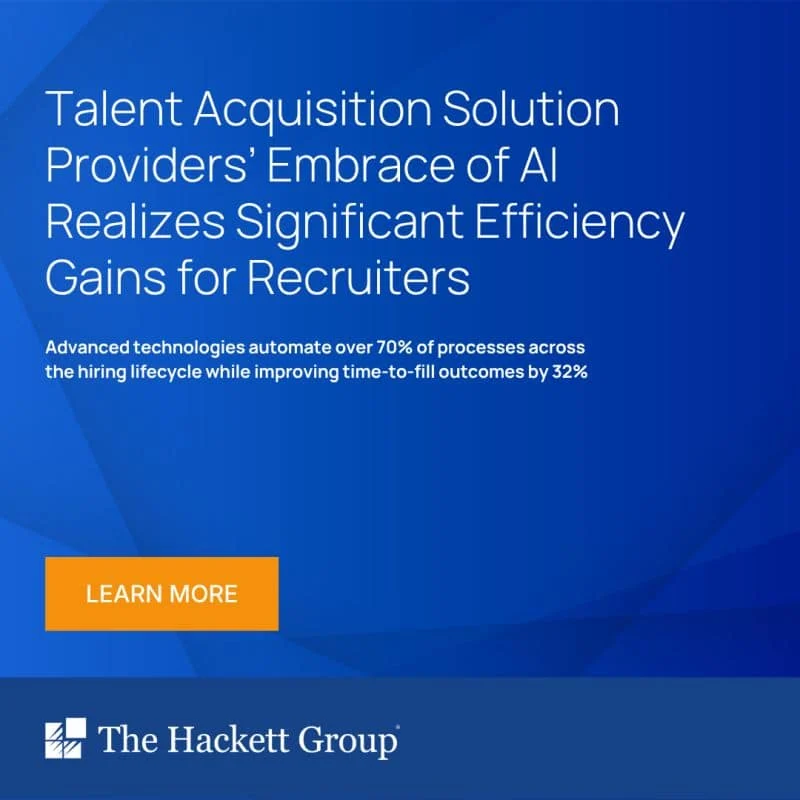
According to the research, organizations deploying these next-generation technologies have successfully automated over 70% of the hiring lifecycle, resulting in a remarkable 32% improvement in time-to-fill and time-to-hire metrics. As the talent acquisition landscape undergoes its most significant technological transformation in a decade, the report serves as both a roadmap for enterprises and a benchmark for the vendors powering this transition.
Main Facts: The New Standard for Digital Recruiting
The Hackett Group’s findings paint a clear picture of the "new normal" in human resources. Facing a projected 9% increase in operational workload alongside budget and staff reductions, HR leaders are pivoting toward technology-led efficiency. The report highlights that companies are not merely adopting software; they are re-engineering the recruitment process to be "AI-first."
Key findings include:
- Automation Saturation: Advanced technologies now handle more than 70% of processes across the hiring lifecycle.
- Performance Metrics: Firms utilizing these tools report a 32% increase in time-to-fill outcomes.
- Recruiter Efficiency: There has been a reported 70% surge in recruiter efficiency, allowing teams to focus on high-value candidate engagement rather than administrative bottlenecks.
- Strategic Investment: Organizations are increasing their technology spend by an average of 9% to bridge the resource gap created by reduced full-time equivalent (FTE) support.
The report evaluated 12 leading talent acquisition technology providers, assessing their impact on organizational agility and operational success. By analyzing vendor briefings and conducting extensive customer interviews, The Hackett Group mapped out which solutions are successfully moving the needle on critical KPIs like cost-per-hire, quality-of-hire, and candidate diversity.
Chronology of the Shift: From Manual Screening to Agentic AI
To understand the current state of the talent market, one must look at the evolution of the recruitment tech stack over the last twenty-four months.
2024: The Pilot Phase
Initial adoption was characterized by skepticism and experimentation. AI was primarily used for basic task automation—such as resume parsing and initial keyword-based filtering. Organizations were hesitant, wary of the "black box" nature of early algorithmic hiring.
2025: The Integration Era
As HR departments faced the brunt of budget cuts, the necessity of efficiency overtook the fear of technology. Organizations began integrating AI into their core HRIS (Human Resource Information Systems). During this period, the focus shifted from "can we use AI?" to "how can we use AI to handle the scale?" Job description generation and candidate matching became the baseline requirements for any serious vendor.
2026: The Age of Agentic AI
The release of the 2026 Vendor Assessments marks the arrival of the "Agentic AI" phase. Unlike standard AI, which requires constant human prompting, agentic solutions act autonomously to complete complex workflows. They can navigate candidate databases, reach out to prospects, schedule interviews, and even handle onboarding inquiries through conversational interfaces. This shift has allowed recruiters to act more like relationship managers and less like data processors.
Supporting Data: Benchmarking Success
The Hackett Group’s evaluation methodology was rigorous, utilizing 28 specific criteria to measure both "Capability" and "Value Realization."
Capability Ratings
Vendors were measured on their ability to provide seamless, end-to-end solutions. This included:
- User Interface (UI) Quality: The ease with which recruiters can navigate complex candidate pipelines.
- Platform Flexibility: The ability of the software to integrate with existing ERPs and payroll systems.
- Core Functionalities: From candidate assessment tools to internal mobility platforms that encourage talent retention.
Value Realization Ratings
The most compelling data points in the report relate to how these tools impact the bottom line. Beyond the 32% improvement in time-to-fill, the report highlights:
- Candidate Experience: Organizations reported that the use of conversational interfaces led to higher engagement rates and reduced candidate "ghosting."
- Quality of Hire: With AI handling the heavy lifting of matching, recruiters have more time to verify soft skills and cultural fit, leading to higher long-term retention.
- Internal Mobility: AI-driven analytics are now identifying "hidden" talent within organizations, allowing companies to fill roles from within rather than incurring the high costs of external headhunting.
Official Perspectives: Navigating the AI Frontier
Matthew Merker, Senior Research Director for HCM Solution Intelligence at The Hackett Group, emphasizes that the transition is no longer limited to high-tech firms.
"AI adoption in talent acquisition is ramping up in organizations from small and medium-sized businesses to large enterprises," Merker noted. "As AI solutions become more readily accepted, talent acquisition technology providers are blazing forward with new capabilities to improve candidate matching and recruiting operations while protecting organizations from risks such as candidate fraud."
Merker’s insights reflect a broader trend observed by the firm: the shift from viewing AI as a "threat" to viewing it as a "safety net." By automating the repetitive, high-volume tasks that historically led to recruiter burnout, firms are finding that they can maintain high-quality recruiting functions even while operating under significant financial constraints.
Implications: The Future of the Hiring Lifecycle
The implications of these findings are profound for both the C-suite and the HR professional.
For the Enterprise
The data suggests that failing to modernize the recruiting stack is now a competitive disadvantage. Companies that rely on manual or legacy processes are not just slower; they are becoming less cost-effective. As the market for top-tier talent remains competitive, the ability to engage candidates quickly—a key benefit of 32% better time-to-fill—is the difference between securing the best hire and losing them to a faster competitor.
For the Recruiter
The role of the recruiter is undergoing a fundamental evolution. The "administrative recruiter"—one who spends their day manually screening resumes—is being replaced by the "recruitment strategist." The technology is handling the data-heavy aspects of the job, which frees the human professional to focus on the human elements: negotiation, persuasion, and cultural alignment.
Strategic Workforce Planning
Perhaps the most significant long-term shift is the move toward predictive analytics. As organizations collect more data through these AI-driven platforms, they are using it for strategic workforce planning. Instead of reacting to a vacancy, companies are now able to forecast talent needs based on business growth projections and skill gaps identified by their HR analytics engines.
A Note on Research Methodology and Caution
While the benefits outlined in the report are significant, The Hackett Group emphasizes a cautious approach to implementation. The vendor assessments provided are intended as a guide, not an endorsement.
"The Hackett Group does not endorse any participant, vendor, product, or service depicted in its research," the firm stated in its disclosure. "This research should not be considered as advice that a buyer select only those participants based on their ranking. You should not rely upon any material or information within this research as a basis for making any business, legal, financial or any other decisions."
The firm further clarified that its findings are based on the aggregate experiences of global organizations, including a vast majority of the Fortune 100, and should be viewed as a snapshot of a rapidly evolving marketplace rather than static, immutable facts.
Conclusion: The Path Forward
The 2026 Talent Acquisition Vendor Assessments paint a portrait of an industry in the midst of a technological renaissance. For the HR professional, the message is clear: the integration of AI is not merely an upgrade to the tech stack—it is a transformation of the entire hiring value proposition.
As vendors continue to push the boundaries of what agentic AI can achieve, the gap between organizations that leverage these tools and those that don’t will only widen. By embracing these advancements, companies are better positioned to meet the dual challenges of the modern economy: doing more with less, and finding the people necessary to sustain growth in an unpredictable global market.
For those interested in the full analysis, The Hackett Group has made a 22-page summary available upon registration, with the comprehensive 59-page report available for purchase through their official portal.