


In the rapidly evolving landscape of corporate IT, "agentic" AI platforms have become the gold standard for security operations. In environments where agility is the primary design goal, the ability for a machine to autonomously detect, isolate, and remediate threats is a competitive advantage. However, as these high-velocity tools migrate toward Operational Technology (OT) and Critical Infrastructure (CI), a fundamental friction has emerged. While corporate IT prioritizes speed, critical infrastructure—power grids, water treatment plants, and manufacturing lines—prioritizes safety, stability, and, above all, accountability.
A new analysis from OPSWAT highlights a growing disconnect: the dangerous assumption that autonomous AI, which excels in the ephemeral world of business servers, can be seamlessly transplanted into the rigid, high-stakes domain of industrial control systems (ICS).
The Core Conflict: Speed vs. Physical Integrity
The fundamental failure of autonomous AI in OT stems from a mismatch in operational reality. In a standard enterprise IT environment, if an AI-driven security agent misidentifies a critical system process as a threat and terminates it, the result is an inconvenience—a temporary outage or a help-desk ticket. In an OT environment, the same action can have catastrophic consequences.
The Physics of OT Security
A protection relay in a power grid is designed to maintain the physical stability of the electrical supply; it cannot be restarted "mid-cycle" without risking a grid-wide surge or blackout. Similarly, a Programmable Logic Controller (PLC) managing a chemical manufacturing line operates under strict timing constraints. A configuration change that is pushed automatically—and incorrectly—cannot be "rolled back" in milliseconds. When an automated remediation step triggers during a production run, it acts upon physical processes rather than digital data.
The Accountability Gap
Corporate IT security platforms are architected for speed, emphasizing the minimization of "dwell time." In contrast, OT security teams operate under a mandate of accountability. When a system fails in a critical infrastructure setting, there must be a verifiable human trail. If an automated system acts without authorization, the "accountability gap" widens. Auditors, tasked with ensuring compliance, find themselves unable to trace the decision-making process to a human actor, rendering the security logs functionally useless for forensic or regulatory purposes.
Regulatory Frameworks: Why Human Oversight is Mandatory
The integration of AI into critical infrastructure is not a "move fast and break things" scenario. It is governed by stringent regulatory frameworks that mandate human intervention. The consensus among regulators—from NERC (North American Electric Reliability Corporation) to the IEC (International Electrotechnical Commission)—is that security is a human responsibility, not an algorithmic one.
Key Regulatory Requirements
| Framework | Scope | Key Requirement |
|---|---|---|
| NERC CIP-007 | Bulk Electric System | Documented assessment, testing evidence, and rigid deployment timelines. |
| IEC 62443-2-3 | Industrial Automation | Mandates specific authorization responsibilities for all patches and configuration changes. |
| NIST SP 800-82 | ICS Security | Requires risk assessment, validation testing, and stakeholder coordination prior to any change. |
These frameworks exist because the cost of failure is not merely financial; it is societal. When "the system decided" replaces accountable human authorization, the organization enters a state of non-compliance. If a patch deploys outside a maintenance window, or a firewall rule is altered during a production cycle without review, the regulatory burden falls on the asset owner, regardless of the sophistication of the AI that triggered the change.
The Danger of Autonomous Scaling: The "Blast Radius" Problem
Perhaps the most significant risk associated with autonomous security platforms is their potential to act as a force multiplier for an adversary. Security management platforms are, by necessity, highly privileged. They possess the keys to the kingdom: the ability to push configurations, deploy patches, and alter security policies across hundreds or thousands of distributed endpoints.
The Adversarial Inheritance
When a platform operates autonomously, it creates a massive, singular point of failure. If an attacker compromises that platform—either through stolen credentials or a zero-day vulnerability—they inherit the platform’s "execution authority."
In early 2026, the cybersecurity community saw this risk manifest when three critical zero-day vulnerabilities in a major patch management platform allowed for unauthenticated remote code execution. Because the platform was designed for high-speed, autonomous deployment, the "blast radius" was immense. Had that system been allowed to execute changes without human verification, the damage could have been replicated across the entire enterprise in seconds.
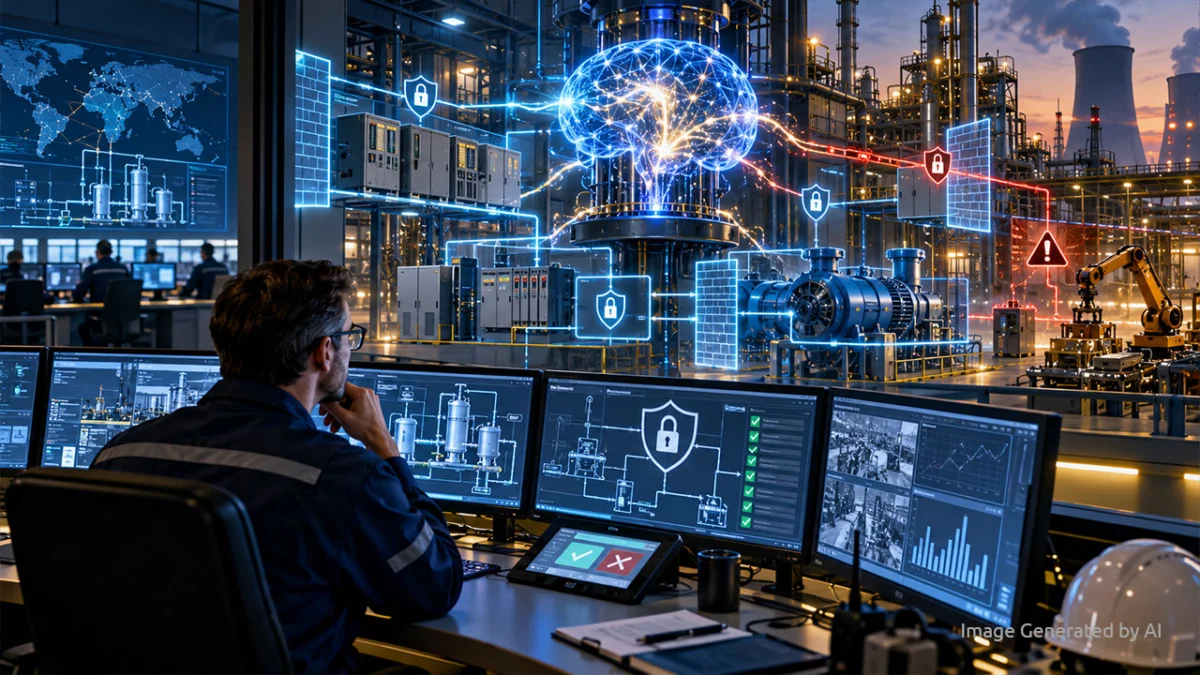
By contrast, a platform that requires human approval—the "Human-in-the-Loop" model—creates a critical bottleneck for the attacker. Even with stolen credentials, an adversary cannot trigger a mass-scale change because the system demands an out-of-band human authorization. This inherent friction is not a design flaw; it is a vital security feature.
Reframing the AI Role: The Analysis Layer
If autonomous action is the danger, where does AI belong? The consensus among security experts is that AI should move from the execution layer to the analysis layer.
In the analysis layer, AI acts as a force multiplier for the human analyst, not a replacement. It excels at the tasks that currently overwhelm security operations centers (SOCs):
- Risk-Ranked Vulnerability Triage: Sorting through thousands of alerts to find the ones that actually threaten physical safety.
- Configuration Drift Detection: Identifying when a device deviates from its baseline configuration before a failure occurs.
- Anomaly Correlation: Aggregating data from disparate sensors to identify patterns that a human analyst might miss.
By surfacing these prioritized findings, AI allows the analyst to make informed, high-speed decisions. The AI provides the "what," the "why," and the "how," but the human provides the "go-ahead."
Real-World Application: The EPAM Systems Model
The practical efficacy of this human-centric approach is demonstrated by firms like EPAM Systems. With a global workforce of approximately 40,000 employees across 30 countries, the scale of their security operation is immense.
By leveraging platforms like My OPSWAT Central Management and MetaDefender, EPAM manages more than 70,000 devices. Rather than automating their way out of the complexity, they used the platform to gain visibility—validating compliance, detecting unwanted applications, and identifying unpatched vulnerabilities. Even while processing upwards of 50 million files per day, the critical decisions—the ones that could impact the availability of their digital infrastructure—remained firmly under the control of their security team.
Implications for Future Critical Infrastructure
As we move further into the decade, the pressure to automate will only increase. Labor shortages in the cybersecurity sector, combined with the rising frequency of sophisticated cyber-attacks, make the allure of "set it and forget it" AI undeniable. However, for critical infrastructure, the risks of such a strategy are existential.
The Path Forward
- Governance by Design: Organizations must ensure that any security platform integrated into their OT environment includes mandatory "stop-gaps" that require human verification for any change affecting production assets.
- Auditability as a Priority: Security architectures must prioritize the logging of the human decision as much as the system alert. If an audit log does not explicitly name the person who authorized a change, the system is fundamentally insecure.
- Human-Centric AI Training: Security teams must be trained to use AI as an investigative partner. The goal is to reduce the time-to-decision, not the elimination of the decision-maker.
In conclusion, the goal of modernizing critical infrastructure should not be to remove the human from the loop, but to provide the human with the most accurate, context-rich information possible. In the high-stakes environment of the power grid and the manufacturing floor, the most powerful security tool remains a well-informed, accountable human operator. The AI’s job is not to replace that operator, but to ensure that when they make a decision, it is the right one.