Artificial Intelligence is not merely a tool for efficiency; it is a catalyst for a fundamental restructuring of the modern workplace. As organizations scramble to integrate generative AI and automation, they are fundamentally altering workflows, shifting decision-making authority, and redefining the very nature of job roles at a speed that has left many traditional Learning and Development (L&D) functions struggling to keep pace.
For years, the standard operating procedure for L&D has been reactive: wait for a change in technology or strategy, identify the resulting "skills gap," and deploy training programs to fill it. However, in the era of AI, this "wait-and-see" approach is becoming a liability. By the time L&D is asked, "How do we train people for this new workflow?", the most consequential decisions—how work is done, which tasks are automated, and what human accountability remains—have already been cast in stone.
To remain relevant and effective, L&D leaders must pivot. They must move upstream, transitioning from the creators of training content to the architects of work-capability, ensuring that human development is baked into the DNA of organizational transformation.
The Chronology of Transformation: A Shift in Sequence
The traditional corporate transformation sequence typically follows a linear, often flawed path:
- Technology Implementation: New AI tools or automation platforms are introduced to drive productivity.
- Workflow Redesign: Processes are streamlined to accommodate the new technology.
- Role Redefinition: Job descriptions are updated to reflect the new technical requirements.
- Skills Assessment: L&D is invited to identify gaps.
- Training Delivery: Educational programs are launched to bridge those gaps.
The flaw in this sequence is that the most critical element—human capability—is treated as an afterthought. If an organization automates a core task, it may inadvertently destroy the very experiences that junior employees need to build the expertise required for senior roles.
A more sustainable model, evidenced by the work of the Centre for Healthcare Innovation (CHI) at Tan Tock Seng Hospital in Singapore, suggests a radical departure. The CHI Innovation Cycle promotes a continuous feedback loop: Care and Process Redesign → Automation/IT/Robotics → Job Redesign. In this model, the organization first examines the work itself, challenges existing inefficiencies, and designs for a desired future state before selecting the technology. Only then are job roles revamped to ensure that employees are not just "using the tool," but are actually operating at a higher level of value.
Supporting Data: Efficiency vs. Human Capability
The impact of "Workforce Development by Design" is best illustrated through the CHI "Ward of the Future" initiative. By integrating technological support with deliberate role changes, the hospital achieved striking results: nurses saw a 24.8% increase in time spent on direct patient care, while their physical strain was reduced, with an average of 3.9 kilometers less walking per shift. Crucially, this wasn’t just a win for efficiency—staff attrition dropped from 8% to 6%, proving that strategic redesign improves both the bottom line and the human experience.
Furthermore, in their pharmacy transformation, the center reported that prescription rework fell from 30% to below 5%, while automation generated savings equivalent to 19 full-time employees. These metrics prove that when L&D is involved in the pilot phase, they can advocate for metrics that go beyond simple "output speed." They can ensure that the transformation tracks "capability measures," such as:
- Quality of Judgment: How well do employees handle exceptions that AI cannot process?
- Developmental Pipeline: If an AI takes over the "grunt work" that previously served as an apprenticeship for junior staff, how will that expertise be fostered now?
- Employee Confidence: Are staff members empowered to challenge or interpret AI-generated outputs, or are they merely passive observers?
The Strategic Implication: Capability Follows Work
Skills do not exist in a vacuum. A "data analysis skill" is useless if the employee isn’t empowered to interpret, challenge, or pivot based on that data. When an organization automates a task, L&D must stop asking, "What skills do we need to teach?" and start asking, "What is the new human contribution?"
If an AI tool drafts a report in seconds, the employee’s role shifts from "writer" to "editor" or "strategic advisor." The required capability is no longer about speed or formatting; it is about critical thinking, contextual synthesis, and stakeholder management. If L&D isn’t at the table when the decision to automate that report is made, they will spend their budget training employees on tools they don’t actually need, while failing to prepare them for the higher-order tasks they should be performing.
Moreover, there is the risk of "hollowing out" the organization. Much of the expertise in modern firms is built through the performance of operational, repetitive, or tactical work. If AI automates away all the "low-level" work, how will the next generation of managers learn the ropes? L&D leaders must act as the "conscience of the organization," ensuring that while we gain productivity, we do not sacrifice the long-term growth of our talent pipeline.
Official Perspectives: A New Mandate for Leadership
Industry experts are increasingly calling for the democratization of design. The mandate for the modern L&D leader is clear: you must become an architect of work.
"Being closer to the business does not simply mean aligning courses with strategic priorities," says one industry analyst. "It means participating in the high-level conversations about how the operating model itself is shifting."
This requires L&D to possess a deep understanding of:
- The Business Model: How do we create value, and where does AI fit into that value chain?
- The Workflow: Where are the bottlenecks, and how do they impact the employee’s developmental journey?
- The Human-Machine Interface: How do we define accountability when a machine makes a recommendation?
Moving Upstream: Preventing the Skills Gap
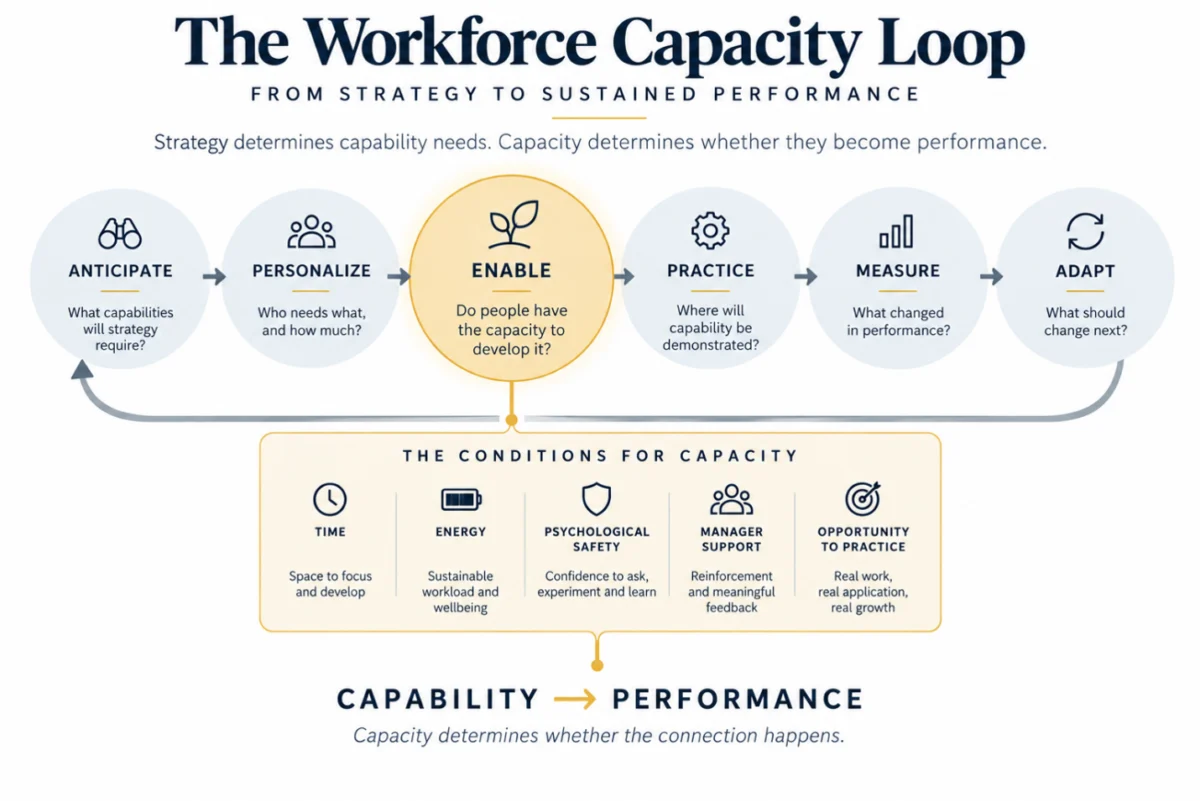
To successfully navigate the AI era, organizations must adopt a new sequence:
- Redesign the Work: Start with the business outcome, not the training.
- Determine the Human-Tech Split: Decide what AI handles and what remains uniquely human.
- Design Roles and Capability Together: Don’t write the job description until you know how the human will be supported.
- Build Learning into the Flow: Create "learning through work" rather than "learning for work."
This shift is subtle but profound. It moves the L&D function from a "reactionary cost center" to a "strategic growth partner." By involving L&D in the pilot phase of AI implementation, organizations can ensure that their workforce isn’t just surviving the transition, but thriving within it.
The ultimate goal of AI integration should not be to do less work, but to do better work. If 20% of an employee’s time is freed by automation, the conversation should not be about "headcount reduction." It should be about "talent redirection." What new, high-value initiatives can that 20% of capacity now address? What new problems can the team solve now that they are no longer burdened by manual processes?
In conclusion, as the boundary between workforce transformation, job design, and professional development continues to blur, the most successful organizations will be those that refuse to treat learning as a post-script. The question is no longer "Are our employees ready for the new AI-driven job?" The real question is: "Were we at the table when that job was designed?"
The future of work is being written today. It is time for L&D leaders to pick up the pen.