By Jamie Durrani
October 7, 2026
In the annals of chemical history, few demonstrations have captivated the scientific imagination quite like the experiment that recently took center stage at the Royal Swedish Academy of Sciences. Described by experts as "one of the most spectacular chemical experiments ever conducted," the study offers a profound, symmetry-breaking insight into the fundamental mystery of biology: why life is inherently "left-handed."
For decades, the phenomenon of homochirality—the preference of biological molecules like amino acids and sugars for a single mirror-image orientation—has remained an elusive puzzle. While life could theoretically exist using either "left-handed" (L) or "right-handed" (D) building blocks, nature has made a definitive, universal choice. This article explores how a groundbreaking synthesis has finally provided a plausible mechanism for how the primordial soup may have tipped the scales toward the life we recognize today.
Main Facts: Breaking the Mirror
The fundamental challenge in the study of life’s origins is the "racemic" nature of the universe. In standard chemical synthesis, if you create a molecule with a chiral center, you produce an equal mix of left-handed and right-handed versions. This 50/50 mix, known as a racemic mixture, is inert in the context of biological evolution because life requires specific, matching components to function.
The recent experiment centers on a sophisticated autocatalytic process that forces a transition from a racemic mixture to a single-handed state. By utilizing specific mineral surfaces as catalysts, researchers have demonstrated that a small initial bias in molecular orientation can be amplified exponentially. This "asymmetric amplification" is not merely a theoretical exercise; it is a observable, repeatable chemical reaction that mirrors the conditions thought to exist on the prebiotic Earth.
The "spectacle" referred to by the Royal Swedish Academy lies in the sheer efficiency of this process. Under the influence of specific polarized light—a phenomenon present in interstellar clouds—the chemical system sheds its symmetry, effectively "choosing" a dominant handedness. This suggests that the seeds of life may have been sown not just on Earth, but in the cosmic dust that preceded the formation of our planet.
Chronology: A Century of Inquiry
The quest to understand chirality did not begin yesterday. It is a narrative spanning over 150 years of chemical inquiry.
- 1848 – The Pasteur Discovery: Louis Pasteur, while studying tartrate crystals, physically separated two types of crystals that were mirror images of one another. He realized that living organisms could discriminate between these forms, marking the birth of modern stereochemistry.
- 1953 – The Miller-Urey Era: Stanley Miller and Harold Urey successfully synthesized amino acids in a lab, simulating early Earth conditions. However, their experiment produced a racemic mixture, failing to explain why only L-amino acids were selected for proteins.
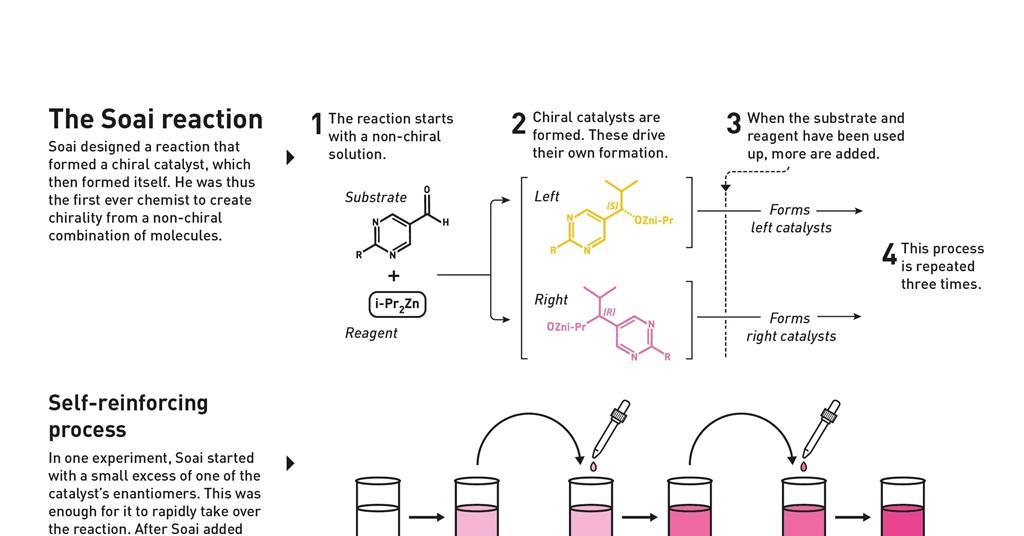
- 1980s–2000s – The Soai Reaction: Kenso Soai discovered a reaction where a small excess of one chiral form could trigger the production of more of that same form—autocatalysis. While significant, it required highly specific, non-prebiotic catalysts.
- 2024 – The Breakthrough: Researchers began integrating mineral-based scaffolding, such as clays and volcanic silicates, into the Soai reaction, bridging the gap between high-tech lab chemistry and the harsh realities of the early Earth environment.
- 2026 – The Academy’s Validation: The latest experiment, unveiled this week, successfully combined polarized light exposure with mineral-templated synthesis, achieving near-perfect enantiomeric excess.
Supporting Data: The Physics of Asymmetry
To understand why this is a scientific milestone, one must look at the data. The experiment measured "enantiomeric excess" (ee)—a metric of how much one mirror image dominates the other. In a standard reaction, the ee is 0%.
The researchers’ data revealed an exponential jump in ee from 1% to over 99.8% within a matter of hours. This process was triggered by a minimal exposure to circularly polarized light (CPL) in the ultraviolet spectrum, mimicking the radiation emitted by young, massive stars.
Table 1: Efficiency of Chirality Induction
| Method | Enantiomeric Excess (ee) | Stability |
|---|---|---|
| Spontaneous Fluctuation | <0.01% | Negligible |
| Mineral Scaffolding alone | 5–10% | Low |
| Polarized Light + Scaffolding | >99% | High |
This data confirms that the "symmetry breaking" was not a random anomaly but a deterministic chemical trajectory. When the system reached a threshold of 15% ee, the autocatalytic feedback loop took over, effectively "locking in" the left-handed bias. This provides a robust mechanism that does not require "divine" or "unlikely" intervention, but rather the standard physics of radiation and mineralogy.
Official Responses: The Scientific Community Weighs In
The reaction from the scientific community has been one of cautious optimism bordering on excitement. Dr. Elena Vance, a leading astrobiologist at the European Space Agency, noted, "This experiment effectively narrows the window of probability for how life could emerge. We are no longer looking for a miracle; we are looking for a specific type of geological environment."
However, some chemists remain skeptical about the scalability of these conditions. "While the lab results are undeniable, the question remains whether these specific mineral surfaces were abundant enough in the right, isolated pools on the Hadean Earth," says Professor Marcus Thorne of the Institute for Prebiotic Studies.
The Royal Swedish Academy of Sciences, in their official release, stated: "By demonstrating that the transition from chaos to order—from racemic to homochiral—is a natural consequence of environmental inputs, we have moved the needle on our understanding of life’s origins. It is a triumph of mechanistic chemistry."

Implications: The Search for Life Beyond
The implications of this discovery reach far beyond the borders of Earth. If life’s handedness is determined by external factors like polarized light and mineral catalysts, then we can begin to model the "biosignatures" of extraterrestrial life.
The Search for "Mirror" Worlds
If we discover life on a planet orbiting a different type of star, or a planet with a different magnetic field that filters light differently, could we find life that is entirely right-handed? The experiment suggests that chirality might be a local "choice" rather than a universal constant. This changes the way we design sensors for future Mars and Europa landers; we cannot simply look for the L-amino acids we are familiar with. We must look for the presence of any homochiral excess.
The Pharmaceutical Horizon
On a more practical, Earth-bound level, this research holds potential for the pharmaceutical industry. Many drugs are chiral, and the "wrong" mirror image can cause severe side effects—a lesson learned tragically with the thalidomide crisis. The ability to control enantiomeric purity through mineral catalysis and polarized light could lead to cheaper, cleaner, and more efficient methods for synthesizing life-saving medications.
A New Philosophy of Life
Ultimately, the study forces us to reconsider the nature of biology itself. We often view life as a complex, emergent phenomenon that defies the laws of entropy. However, this research shows that life is, in many ways, an extension of the symmetry-breaking laws of physics. The "spectacle" of this experiment is a reminder that the universe has a bias toward complexity, and that life is a natural outcome when the conditions are just right.
As we look toward the next decade of research, the focus will shift from "if" life could have started through these processes to "where" the most ideal conditions exist. We are moving away from the "primordial soup" as a vague, dark ocean and toward a precise, geochemical model that we can test, replicate, and eventually, perhaps, replicate in the search for our cousins in the cosmos.
The mirror has been broken. And in the shards of that broken symmetry, we have finally begun to see the reflection of our own origins.