The landscape of industrial automation underwent a tectonic shift this week at IMTS 2026, as Universal Robots (UR), a Teradyne Robotics company, unveiled its seventh-generation robotics platform: Gen 7. Representing the most significant overhaul in the company’s twenty-year history, Gen 7 is not merely an incremental update; it is a fundamental architectural reimagining designed to bridge the gap between theoretical artificial intelligence and factory-floor reality.
By integrating high-performance computing, a modular interface, and an AI-ready software ecosystem, Universal Robots is signaling to the manufacturing sector that the "Physical AI" era has officially arrived.
Main Facts: A Total System Redesign
At the core of the Gen 7 platform lies a commitment to reducing "integration friction." For years, manufacturers have struggled with the complexity of retrofitting AI vision systems and sensing arrays onto robotic platforms. Gen 7 solves this through a top-to-bottom reengineering of the robot’s physical and digital components.

The Hardware Overhaul
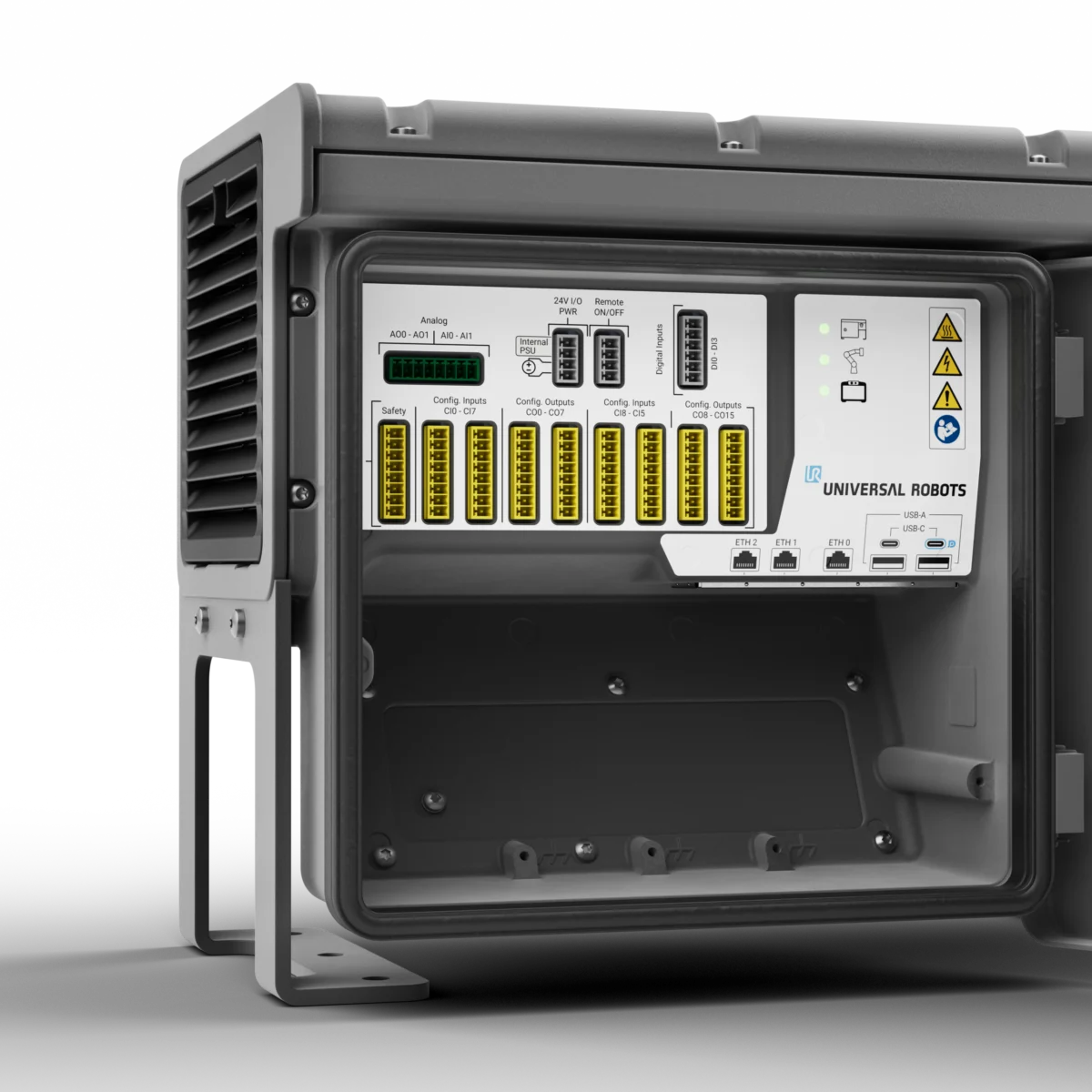
The centerpiece of the hardware upgrade is the CB7 Core controller. While maintaining the familiar footprint that integrators have come to trust, the new controller packs 40% more computing power into a chassis that is 30% smaller than its predecessors. This increased processing density is critical for handling real-time AI inference directly on the robot, eliminating the latency associated with off-board computing.
Perhaps most visible is the new SP7 Smart Panel tool flange interface. Designed for high-end machine vision and complex sensing applications, the SP7 features:
- Safety-compliant Free Drive functionality: Allowing for intuitive manual guidance.
- Integrated LED status indicators: Providing immediate visual feedback on task status.
- Configurable input buttons: These interface directly with the robot’s "Smart Skills," allowing operators to trigger complex sequences without external controllers.
The Software Engine: PolyScope X
The hardware is unified by PolyScope X, the next-generation operating system. Unlike previous versions, PolyScope X is built to serve as an open canvas for AI developers. It allows "Physical AI" models—vision, path planning, and adaptive gripping—to run natively on the controller. This removes the need for bulky external PCs and proprietary cabling, effectively turning the robot into a standalone edge-computing device.

A Chronology of Innovation
To understand the significance of Gen 7, one must look at the trajectory of Universal Robots since its inception.
- 2005–2010: The Cobot Genesis. Universal Robots pioneered the collaborative robot (cobot) market, emphasizing safety and human-robot interaction. The early generations were defined by their ease of use, democratizing automation for SMEs that were previously priced out of industrial robotics.
- 2015–2020: Ecosystem Expansion. With the launch of UR+, the company transitioned from a hardware provider to an ecosystem orchestrator. The introduction of standardized interfaces allowed third-party grippers, vision systems, and software tools to plug into UR robots with "plug-and-play" simplicity.
- 2023–2025: The AI Pivot. As AI models matured, UR began integrating advanced path planning and vision, though these often required external dependencies.
- October 2026 (IMTS): The Gen 7 Milestone. The unveiling of the Gen 7 platform marks the culmination of two decades of field data. By analyzing the performance of over 100,000 deployments, UR engineers identified the specific bottlenecks preventing AI from being "factory-ready," leading to the unified architecture introduced this week.
Supporting Data: Efficiency and Performance Metrics
The shift toward Gen 7 is driven by hard data regarding integration time and operational efficiency. According to early testing and partner feedback shared at IMTS:
- Footprint Efficiency: The 30% reduction in controller size allows for higher-density work cells, particularly critical in space-constrained brownfield factories.
- Processing Throughput: The 40% increase in compute power directly translates to a decrease in cycle times for AI-heavy tasks, such as bin picking with complex orientation or high-speed quality inspection.
- Deployment Velocity: By moving AI inference onto the controller (as demonstrated by partners like Inbolt), companies are reporting that "localization" tasks—the process of identifying parts without the use of expensive custom jigs or fixtures—can now be achieved in hours rather than weeks.
- Ecosystem Maturity: The platform is launching with support from over 20 global partners, including heavyweights like Cognex, Schunk, and Robotiq. This validated, "de-risked" ecosystem is expected to lower the barrier to entry for manufacturers who previously viewed AI as too experimental for high-volume production.
Official Perspectives
The leadership at Teradyne Robotics emphasized that Gen 7 was developed with a specific philosophy: Complexity is the enemy of adoption.

"The robots of the AI era must be advanced, not complicated," said Jean-Pierre Hathout, President of the Teradyne Robotics Group. "Built on what we have learned from over 20 years of cobot innovation and more than 100,000 industrial deployments worldwide, Gen 7 is an end-to-end redesign. It reduces integration friction and dramatically expands application capabilities. It will enable our customers and partners to confidently deploy advanced AI-powered applications in real-world operations."
The partner perspective was equally enthusiastic. Rudy Cohen, CEO of Inbolt, noted the radical shift in deployment logic: "Universal Robots and Inbolt share the same conviction: automation should be simple to live with. With Gen 7 and PolyScope X, our vision now runs natively on the UR controller itself. No external vision PC, no extra cabling. It’s a game-changer for production agility."
Implications for the Industry
The release of Gen 7 has profound implications for the manufacturing sector.

1. The Death of the "Jig and Fixture" Era
For decades, robotic precision was achieved by mechanically constraining parts (jigs) to ensure the robot always interacted with the object in the exact same orientation. Gen 7’s deep integration with machine vision makes "jig-less" manufacturing a standard rather than a luxury. Robots can now "see" and adapt to part variations in real-time, allowing manufacturers to switch between product lines on the fly.
2. Democratization of Edge AI
Until now, AI in manufacturing was largely siloed into high-budget, high-expertise facilities. By providing a standardized, "AI-ready" hardware flange and an open-architecture OS, UR is allowing smaller machine shops to leverage the same sophisticated machine vision and adaptive behaviors as Tier-1 automotive suppliers.
3. De-risking the "Black Box" of AI
One of the primary hurdles to AI adoption has been the fear of unpredictable behavior. By backing the platform with the UR+ ecosystem—where every partner component is rigorously validated by both the vendor and UR—the company is providing a "safe" path to innovation. This institutional validation provides the assurance that corporate IT and OT departments need before green-lighting AI investments.

4. A Shift in Human-Robot Collaboration
With the new Smart Panel on the tool flange, the human element of the assembly line is reinforced. The ability to use the robot’s own interface to "teach" it, adjust its path via free-drive, and receive visual status updates directly at the point of action brings the intelligence to the factory floor, rather than keeping it behind a locked office door.
Conclusion: The Future of the Factory Floor
The Gen 7 platform from Universal Robots represents the maturation of the cobot industry. It is no longer enough for a robot to be safe; it must now be smart, adaptive, and seamlessly integrated into the broader digital twin of the factory.
As manufacturers face increasing pressure to shorten lead times, manage labor shortages, and navigate product volatility, the Gen 7 platform provides a robust, future-proof foundation. By transforming the robot from a repetitive tool into an AI-driven agent, Universal Robots has set a new benchmark for what is possible in industrial automation. The "Physical AI" revolution is no longer a concept—it is currently being bolted onto assembly lines across the globe.