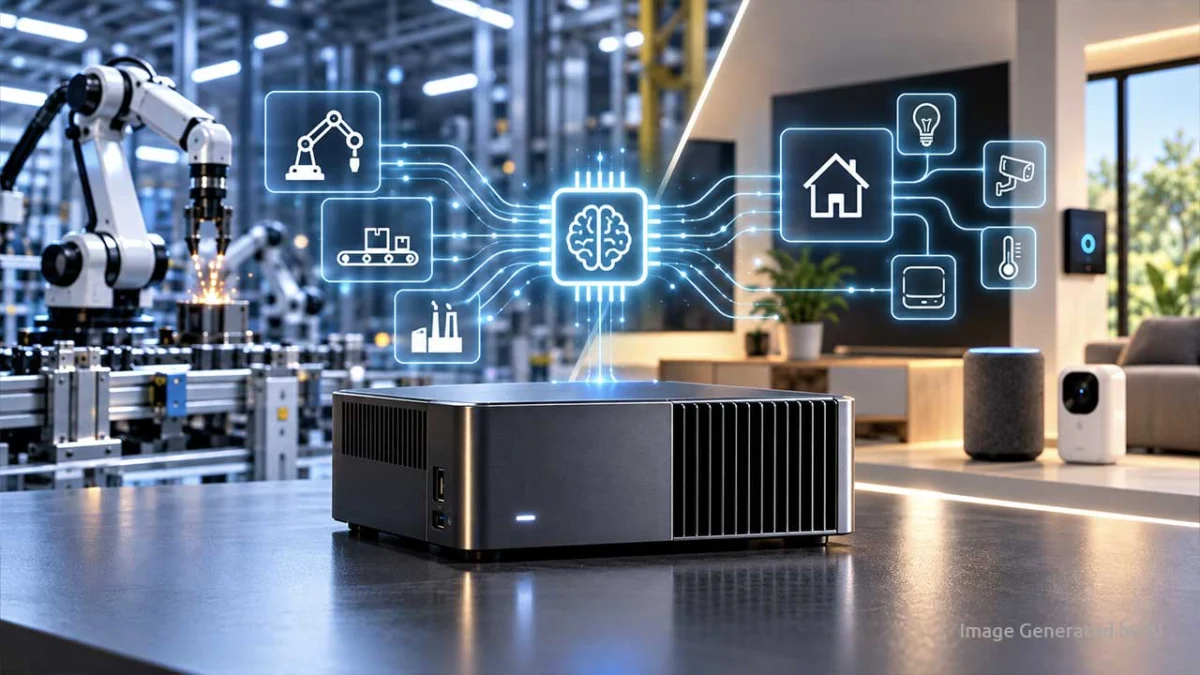
The boundary between industrial-grade edge computing and consumer electronics has officially dissolved. On September 1, 2026, the unveiling of the UGREEN MasterAgent MA100 marked a pivotal moment in the hardware landscape: the integration of the NVIDIA Jetson Thor T5000—a powerhouse module previously reserved for high-stakes industrial robotics and medical imaging—into a device management hub destined for the broader market.
This convergence is not merely a branding milestone; it represents a fundamental shift in how artificial intelligence (AI) is deployed. By leveraging the Arm v9 architecture and the Blackwell GPU, companies like UGREEN are democratizing high-performance inference, allowing developers to build once and deploy across a spectrum ranging from smart homes to automated factory floors.
The Technological Backbone: NVIDIA Jetson Thor T5000
At the heart of this transition is the NVIDIA Jetson Thor T5000. For industrial system builders, this module has become the gold standard for edge AI, delivering up to 2,070 FP4 TFLOPS. To put that in perspective, this level of compute enables real-time decision-making for autonomous mobile robots (AMRs), complex factory automation sequences, and high-fidelity medical imaging—all performed locally at the network edge rather than relying on cloud latency.
The T5000 architecture is defined by a 14-core Arm Neoverse V3AE CPU, integrated with NVIDIA’s revolutionary Blackwell GPU and 96 Tensor Cores. This hardware stack is designed to handle the heavy lifting of generative AI and large-scale inference models, which were historically too resource-intensive for edge devices. By packing this performance into a compact module, NVIDIA has effectively moved the data center to the machine.
Chronology of a Shift: From Factory Floor to Consumer Hub
The path to the MA100’s launch was paved by years of modular development.
- Pre-2025: NVIDIA solidified its dominance in industrial AI, with the Jetson series becoming the de facto choice for autonomous machines.
- Early 2026: The industry saw a surge in demand for "unified compute" models, where companies sought to standardize their software stacks across disparate hardware tiers.
- August 2026: The Connectivity Standards Alliance (CSA) officially accelerated its roadmap to expand the Matter protocol beyond consumer smart home applications, targeting industrial and commercial sectors.
- September 1, 2026: UGREEN introduced the MasterAgent MA100, marking the first major commercial consumer deployment of the Jetson Thor T5000 architecture.
This trajectory reflects a broader industry trend: the "trickle-down" effect of high-end silicon. As manufacturing volumes increase for industrial-grade components, the economies of scale allow consumer electronics companies to adopt enterprise-tier hardware, effectively raising the "floor" of what a typical consumer device can accomplish.
Scaling the Edge: The Role of Arm Architecture
One of the most significant themes of the recent UGREEN launch was the emphasis on developer portability. John Thompson, representing Arm, highlighted during the event that the core philosophy of modern silicon design is consistency.
"Software built for an Arm-based edge device should not just work—it should thrive—when deployed to cloud infrastructure," Thompson stated. This vision of a "seamless fabric" of compute means that developers can write code on a workstation, test it on a Jetson Thor-powered prototype, and deploy it across a fleet of devices—whether they are industrial IoT sensors in a refinery or a MasterAgent MA100 in a commercial office.
UGREEN’s own product strategy serves as a case study for this scalability. Their current portfolio is segmented into three distinct tiers:
- The RK3588 Tier (Arm v8): Designed for lightweight automation and basic device management.
- The CIX-P1 Tier (Arm v9): Focused on mid-tier AI processing and enhanced data security.
- The Jetson Thor T5000 Tier (Blackwell GPU): Reserved for high-stakes, compute-heavy inference and complex edge AI applications.
Because all three tiers share the same underlying instruction set, the software ecosystem remains unified. This eliminates the need for expensive, time-consuming re-writes when an enterprise decides to upgrade its hardware infrastructure.
Matter Protocol: The New Language of Industrial IoT
While the hardware enables the performance, the software protocol ensures the communication. Matter, which began as a consumer-focused standard for smart home interoperability, is undergoing a major evolution. The Connectivity Standards Alliance (CSA) has confirmed that the protocol is now being expanded to meet the rigorous demands of commercial buildings, industrial IoT, and large-scale energy management.
The shift is critical for industrial applications. In a factory or a healthcare facility, devices come from dozens of different manufacturers. Historically, this led to "siloed" ecosystems where data could not flow between machines. By adopting Matter, companies can ensure that an NVIDIA-powered edge controller can communicate seamlessly with sensors, actuators, and power management systems regardless of the manufacturer.
This interoperability is the final piece of the puzzle for industrial automation. It provides the reliability needed for multi-year deployment cycles, ensuring that a system installed today remains compatible with the devices of 2030 and beyond.
Implications for the Industrial Landscape
The implications of this convergence are far-reaching, affecting everything from cybersecurity to supply chain management.
1. The Commoditization of Edge AI
As industrial-grade silicon like the Jetson Thor enters the consumer market, the resulting volume will inevitably lead to cost reductions. System integrators who once struggled to justify the high price point of dedicated AI hardware may soon find it far more accessible. This could lead to a "golden age" of industrial sensor deployment, where even the smallest facility can afford to run advanced predictive maintenance models.
2. Cybersecurity by Design
The adoption of a unified architecture across both consumer and industrial sectors forces a higher standard of security. With devices running on Arm v9 and leveraging common protocols like Matter, security patches and firmware updates can be disseminated more efficiently. The "security through obscurity" model is being replaced by "security through standardization," where vulnerabilities identified in a consumer hub can be patched simultaneously across industrial edge deployments.
3. The End of "Vendor Lock-in"
The ability to move AI models between hardware tiers is the death knell for proprietary, locked-in ecosystems. For industrial users, this means greater leverage in negotiations and a more flexible infrastructure. If a specific module fails or becomes obsolete, the software stack can be migrated to a different device within the Arm ecosystem with minimal friction.
Looking Ahead: The 2027 Outlook
As we move into 2027, the industry is bracing for an influx of edge-AI-capable devices. The "Industrial Data & AI Readiness Survey" (currently open for industry participants) aims to benchmark exactly how organizations are preparing for this shift. Early data suggests that while the hardware is ready, the organizational bottleneck lies in data strategy—specifically, how to manage the massive influx of information that these high-compute edge devices will generate.
The collaboration between NVIDIA, Arm, and the CSA, as evidenced by the UGREEN MA100 launch, suggests that the future of industrial technology will not be built on isolated, custom-engineered islands. Instead, it will be built on a shared, scalable, and interoperable foundation that spans the entire global infrastructure—from the pocket-sized device to the massive factory floor.
Summary of Key Takeaways
- Compute Power: The Jetson Thor T5000 brings 2,070 FP4 TFLOPS to the edge, making real-time, high-level AI a reality for non-data-center environments.
- Portability: The shared Arm v9 architecture ensures that software investments are protected, allowing for seamless transitions between hardware tiers.
- Interoperability: The expansion of the Matter protocol into the industrial sector provides a universal "language" for devices, reducing the complexity of multi-vendor environments.
- Convergence: The distinction between consumer electronics and industrial machinery is fading, benefiting both sectors through increased scale, reduced costs, and faster innovation cycles.
As the industry continues to integrate these technologies, the focus will likely shift from "can we run AI at the edge?" to "how effectively can we orchestrate this intelligent network?" The tools are now in place; the next phase of the industrial revolution will be defined by how effectively these systems are deployed to solve real-world problems at scale.