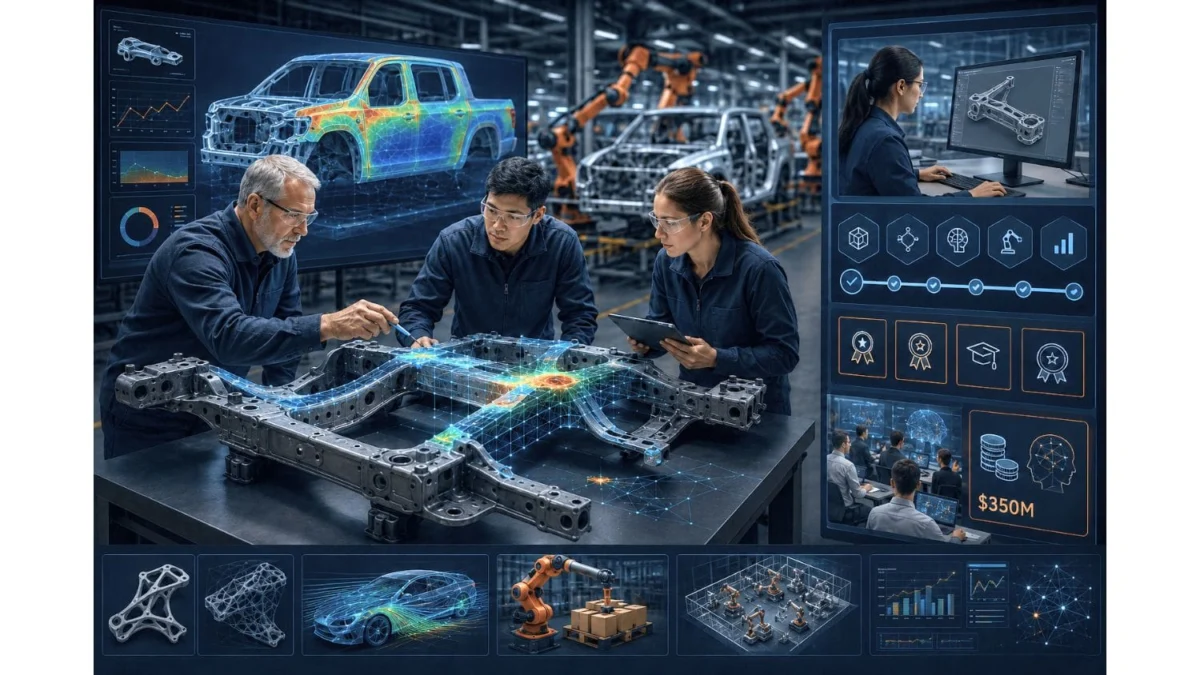
The convergence of artificial intelligence and physical manufacturing has officially moved past the era of flashy, speculative concept art and into the gritty, high-stakes realm of capital-intensive industrial deployment. Across the globe, venture capitalists, tech titans, industrial heavyweights, and government ministries are placing multi-billion-dollar bets on a singular premise: that the next industrial revolution will not be defined solely by smarter software, but by machines that can design, program, analyze, and repair the physical world.
Yet, as this new wave crests, a stark dichotomy has emerged. On one hand, astronomical funding rounds are bankrolling dreams of autonomous engineering. On the other, pragmatic plant managers and veteran machinists are demanding answers to a more fundamental question: Can these sophisticated models survive the messy, chaotic reality of a Monday morning on a real factory floor?
This comprehensive briefing examines the major developments shaping the intersection of AI and advanced manufacturing, tracing the trajectory from speculative mega-funding to practical, boots-on-the-ground deployment.
1. Main Facts: The Industrial AI Landscape at a Glance
The current industrial AI ecosystem is characterized by unprecedented capital inflows, targeted software automation, and a strategic pivot away from consumer-style gimmicks toward functional, domain-specific execution.
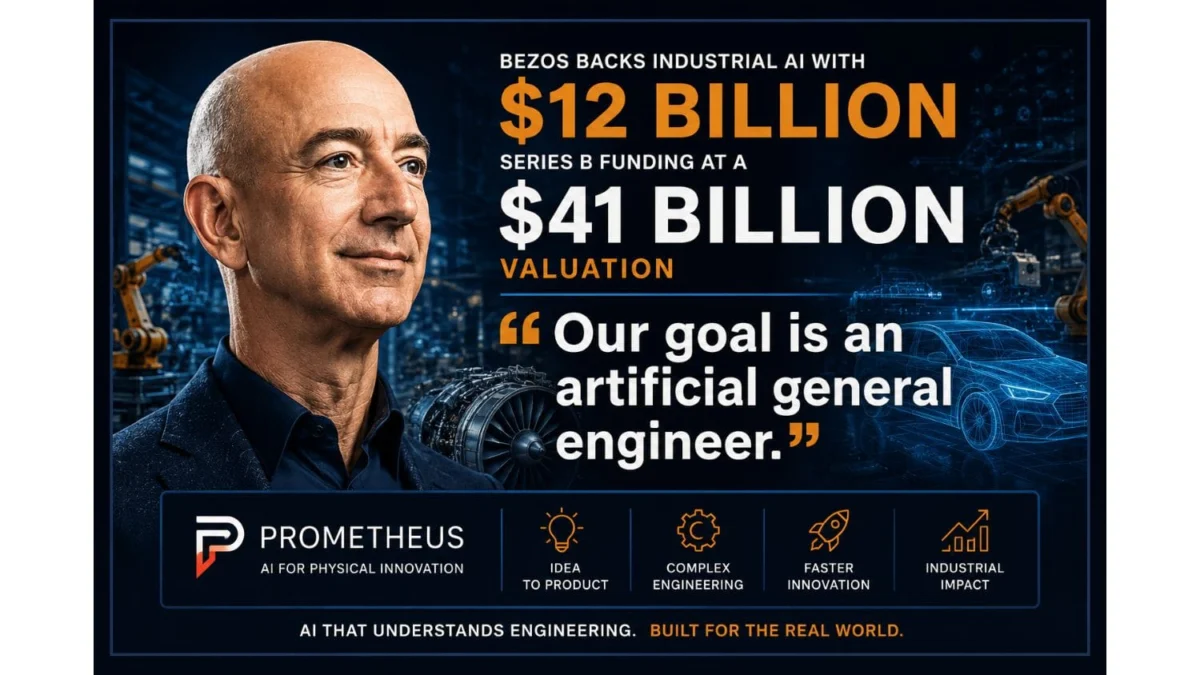
- The Megaround: Prometheus, an industrial AI startup backed by Amazon founder Jeff Bezos, has secured a staggering $12 billion in funding at a commanding $41 billion valuation. Their stated objective is the realization of an "Artificial General Engineer"—a system capable of compressing the entire journey from initial concept to manufactured product across complex domains like jet engines and medical devices.
- Precision CNC Automation: Limitless Labs (formerly LimitlessCNC) has raised $20 million in Series A funding to scale its agentic AI platform for Computer-Aided Design and Manufacturing (CAD/CAM). The startup claims its platform can reduce CNC programming time by up to 50%.
- Closed-Loop Field Intelligence: Industrial software giant PTC has launched "Orbit," an enterprise AI platform designed to aggregate fragmented data streams—spanning engineering designs, IoT sensors, customer service records, and business systems—to help engineering teams identify product failures before they trigger costly recalls.
- Democratizing Plant Analytics: Sight Machine has introduced a new manufacturing intelligence platform that empowers process engineers to build and interrogate a living digital model of their facilities using conversational AI agents, bypassing the need for dedicated data science teams.
- Macro-Level Strategies: The UK government has published a formal AI adoption roadmap for advanced manufacturing, emphasizing structured testing, validation, and support for small-to-medium-sized enterprises (SMEs) struggling with legacy equipment and skills gaps.
- Functional Robotics: Robotics lab Genesis AI has unveiled "Eno," a general-purpose robotic system that deliberately rejects humanoid aesthetics in favor of pragmatic functional capability designed to extend human labor in hazardous or constrained environments.
2. Chronology: The Evolution of Industrial AI
To understand where industrial AI is heading, it is necessary to chart how the technology has evolved from isolated digital prototyping tools into integrated, autonomous agents.
Phase 1: The Siloed Digital Era (Early 2010s–Early 2020s)
For over a decade, manufacturing software was defined by specialization. CAD, CAM, and Product Lifecycle Management (PLM) systems became deeply entrenched in engineering departments. However, these tools remained largely isolated. A CAD designer worked in a vacuum; a CNC programmer spent hours manually translating geometry into toolpaths; and field service data remained trapped in disparate customer relationship management (CRM) systems. AI during this period was largely restricted to predictive maintenance algorithms tracking basic machine vibration data.
Phase 2: The Generative Hype Cycle (2023–2024)
The explosive rise of Large Language Models (LLMs) triggered a wave of speculative enthusiasm. Tech companies attempted to apply generic conversational models to engineering workflows, often producing visually impressive demos that failed under rigorous industrial scrutiny. The focus was on "flash over function," leading to widespread skepticism among veteran manufacturing professionals who had seen previous technological silver bullets fall short.
Phase 3: The Agentic and Pragmatic Pivot (2025–Present)
The current landscape represents a maturation of the sector. Capital is no longer flowing exclusively into vague general-purpose models. Instead, it is being directed toward specialized "agentic" workflows that target acute, high-value bottlenecks—such as CNC programming, multi-source data synthesis, and shop-floor quality drift. Startups and legacy software vendors alike are realizing that the true value of AI lies not in replacing human expertise entirely, but in capturing tacit knowledge and scaling it efficiently.
3. Supporting Data: The Numbers Driving the Shift
The sheer scale of investment into industrial AI indicates that corporate balance sheets and venture capital firms view this transformation as existential.
- $12 Billion / $41 Billion: Prometheus’s recent funding round and valuation figures represent one of the largest capital accumulations in industrial tech history, underscoring the immense financial backing behind the pursuit of artificial general engineering.
- $20 Million: Limitless Labs’ Series A financing highlights robust investor appetite for targeted, vertical-specific physical AI foundation models that integrate directly into incumbent software stacks like Mastercam, NX, and Creo.
- Up to 50%: The headline efficiency metric claimed by Limitless Labs for its CAM Agent, targeting a process that has historically served as a critical bottleneck due to a shortage of senior programmers.
- Multi-Enterprise Integration: Platforms like PTC Orbit and Sight Machine rely on ingesting hundreds of disparate data points per second—ranging from factory-floor IoT telemetry to field service logs—illustrating the massive scale of data processing required to make industrial AI viable.
4. Official Responses and Industry Perspectives
As industrial AI transitions from boardrooms to factory floors, reactions from industry leaders, government bodies, and technical experts reveal a mixture of profound optimism and cautious pragmatism.
The Visionary Play: Prometheus and the Quest for General Engineering
Proponents of mega-scale industrial AI argue that modern manufacturing is fundamentally constrained by human cognitive and communicative friction. By compressing the timeline from ideation to physical realization, advocates believe startups like Prometheus can radically accelerate innovation cycles in aerospace, medical technology, and consumer hardware.
However, industry critics have raised valid cautionary flags. Technical analysts emphasize that unlike text-based data or clean software code, manufacturing operates in a physical continuum governed by thermodynamics, material science, and mechanical tolerances. Without absolute transparency regarding training data sets and underlying physical assumptions, an AI system that miscalculates a structural tolerance could lead to catastrophic mechanical failures.
The Practical Approach: Targeting Real Bottlenecks
In contrast to speculative artificial general engineering, platforms like Limitless Labs, PTC Orbit, and Sight Machine have gained traction by focusing on acute, localized pain points.
- Sandvik and Iscar Implementations: The adoption of agentic CAM platforms by established manufacturing heavyweights demonstrates that industrial users are willing to embrace AI if it integrates seamlessly into existing workflows without demanding a total overhaul of legacy infrastructure.
- Democratizing Plant Analytics: Sight Machine’s philosophy—putting AI agents directly into the hands of process engineers rather than forcing reliance on external data science teams—reflects a growing consensus that the people best equipped to validate manufacturing AI are the ones who already understand how a factory runs.
- Regulatory Roadmaps: The UK government’s advanced manufacturing AI adoption plan signals a shift in public policy. Rather than throwing subsidies at unproven technologies, the official framework stresses a methodical, phased approach: scan the opportunity, run localized tests, validate rigorously, and only scale what proves resilient.
5. Implications: Will AI Survive a Monday Morning on the Shop Floor?
The ultimate test for industrial AI is not how well it performs in a polished marketing video or a controlled laboratory demonstration. Its true measure of success will be determined on a Monday morning in a noisy, chaotic machine shop, surrounded by worn tooling, unusual fixtures, legacy machinery, and unexpected material variances.
The Risk of Confident Nonsense
One of the most significant hazards of deploying generative and agentic AI in manufacturing is the phenomenon of confident hallucination. A general-purpose language model or autonomous agent that generates a plausibly sounding—yet mechanically flawed—recommendation can cause severe financial and operational damage if executed on a live production line. Consequently, human-in-the-loop validation remains an absolute non-negotiable requirement for any system touching physical assets.
The Value of Tacit Knowledge Capture
Much of the world’s critical manufacturing expertise currently resides inside the heads of a rapidly retiring generation of senior machinists, process engineers, and toolmakers. Platforms that successfully capture this tacit knowledge—translating decades of shop-floor intuition into structured, accessible digital workflows—will provide enduring value. Those that merely generate prettier dashboards without grounding their outputs in physical reality will quickly be abandoned.
Conclusion
The transformation of advanced manufacturing through artificial intelligence is no longer a theoretical projection; it is an ongoing, capital-intensive reality. While multi-billion-dollar bets like Prometheus chase the holy grail of artificial general engineering, the immediate, practical victories are being won by software that respects the complexity of the physical world.
For engineers, plant managers, and enterprise leaders alike, the path forward requires a balanced mindset: embrace the unprecedented efficiency gains offered by targeted agentic tools, but maintain a healthy, rigorous skepticism until every algorithm proves it can survive the unyielding realities of the shop floor.