As the industrial sector marches through 2026, the narrative surrounding artificial intelligence has shifted dramatically. The early-decade euphoria—marked by promises of fully autonomous factories and unattended design loops—has matured into a more pragmatic, hard-nosed era of implementation. Across automotive, aerospace, heavy machinery, and industrial automation, companies are discovering that AI is not a standalone silver bullet. Instead, it is a high-octane accelerator that requires a carefully calibrated mixture of pristine data, cutting-edge software ecosystems, and, crucially, the irreplaceable wisdom of veteran human engineers.
This briefing provides an in-depth examination of the latest industrial developments, market studies, and technological rollouts from mid-2026. By dissecting major moves by industry giants like Ford, General Motors, Siemens, Autodesk, AVEVA, Doosan, Vention, and Teradyne, we map out the current state of engineering design, simulation, and manufacturing.
1. Main Facts: The 2026 Industrial AI Landscape
The middle of 2026 has brought a wave of announcements that underscore how manufacturers are deploying AI to solve hyper-specific engineering bottlenecks. The overarching theme across these developments is that algorithms excel at pattern recognition, rapid computation, and generation, but they require robust data foundations and human oversight to deliver real-world value.
- Ford’s Quality Turnaround: Ford clinched the top spot in J.D. Power’s 2026 Initial Quality Study among mainstream brands—its first win in this category since 2010. Crucially, Ford attributes this success not just to AI defect-detection systems, but to a strategic human capital initiative: hiring, promoting, or bringing back approximately 350 veteran technical specialists.
- Autodesk’s Workforce Investment: According to Autodesk’s AI Jobs Report 2026, roles requiring AI skills in architecture, engineering, construction, product design, and manufacturing have surged by 147% over the past two years. To feed this talent pipeline, Autodesk has committed $350 million over three years to train nearly one million people.
- Generative Physics and Concept Design: Siemens has introduced Simcenter PhysicsAI Generate in Simcenter Hypermesh 2026.1, allowing engineers to generate physics-aware 3D design concepts in seconds based on performance targets, bypassing the traditional blank CAD screen.
- Warp-Speed Vehicle Validation: General Motors reported that machine learning and advanced simulation have slashed roof-crush analysis cycles from an arduous 8 to 40 hours down to under five minutes, drastically expanding design iteration windows before physical prototyping.
- Robotics and Adaptive Automation: Doosan Robotics unveiled PalletizHD+ at Automate 2026, an AI-powered palletiser designed to handle chaotic box variations and accelerate changeovers. Concurrently, Vention and Teradyne Robotics teamed up to launch an integrated digital cell-design platform optimized for Universal Robots (UR) deployments.
- Industrial Data and Advanced Manufacturing: AVEVA announced comprehensive AI integrations across its industrial software suites at AVEVA World 2026, aiming to streamline plant and engineering data. Meanwhile, Siemens updated NX X Manufacturing 2606 with generative AI machining suggestions capable of designing parametric tools from scratch.
2. Chronology: Key Events and Milestones Leading to Mid-2026
To understand how the industrial sector arrived at this pivotal juncture, it is helpful to trace the timeline of key policy shifts, software releases, and organizational restructurings over the past three years.
The 2023–2024 Reset: The Limits of Automation
- Late 2023: Recognizing persistent warranty issues and manufacturing glitches, Ford initiates a quiet quality reset. Executives realize that relying solely on automated defect flags is insufficient; the company begins actively recruiting retired and veteran engineers who possess deep, institutional knowledge of where mechanical and electrical failures historically hide.
- 2024: Industrial software vendors begin aggressively embedding machine learning into legacy computer-aided engineering (CAE) and computer-aided manufacturing (CAM) platforms. However, early adoption is stymied by fragmented plant data, poor metadata standards, and a severe shortage of engineers trained in cross-functional AI workflows.
The 2025 Acceleration: Data Infrastructure Takes Center Stage
- Early 2025: Market data highlights an explosive demand for professionals skilled in both domain engineering and AI applications. Autodesk and other major software players begin drafting comprehensive educational frameworks to bridge the widening skills gap.
- Late 2025: Heavy manufacturers begin realizing significant time-savings in virtual validation. Initial tests by automotive OEMs prove that surrogate machine learning models can process structural crash simulations exponentially faster than traditional finite element analysis (FEA) solvers, though validation questions remain.
Mid-2026: The Convergence of Talent, Physics AI, and Digital Twins
- June 2026 (Ford’s Milestone): Ford wins the 2026 J.D. Power Initial Quality Study, validating its multi-year strategy of pairing AI data analytics with the intuition of 350 veteran engineers.
- June 2026 (Software and Hardware Debuts):
- Autodesk releases its 2026 AI Jobs Report alongside a $350 million upskilling initiative.
- Siemens rolls out Simcenter PhysicsAI Generate and NX X Manufacturing 2606, pushing generative AI deeper into early-stage conceptual design and CNC machining paths.
- General Motors details its virtual laboratory breakthroughs, cutting validation times for structural roof-crush tests to under five minutes.
- At Automate 2026, Doosan debuts its adaptive AI palletiser, while Vention and Teradyne launch their collaborative digital-twin cell builder.
- AVEVA announces broad AI harmonization across CONNECT and its PI Data Infrastructure at AVEVA World 2026.
3. Supporting Data and Market Metrics
The transformation of industrial engineering is underpinned by compelling quantitative metrics drawn from recent studies, corporate reports, and industry benchmarks:
| Metric / Indicator | Value | Source / Context |
|---|---|---|
| Ford Initial Quality Rank | #1 among mainstream brands | J.D. Power Initial Quality Study (2026) — First win since 2010. |
| Veteran Specialists Hired | ~350 engineers | Ford’s quality reset initiative (2023–2026) pairing human expertise with AI. |
| AI Job Role Growth | +147% over 2 years (33% in past year) | Autodesk AI Jobs Report 2026, spanning architecture, engineering, and manufacturing. |
| Autodesk Upskilling Commitment | $350 million over 3 years | Program targeting 1 million trainees and 200,000 industry certifications by end of 2028. |
| Siemens Concept Generation Speed | Under 10 seconds | Simcenter PhysicsAI Generate producing a 3D electronics housing concept from dimensional targets. |
| GM Validation Speedup | From 8–40 hours down to <5 minutes | Machine learning and simulation acceleration for roof-crush analysis. |
| Doosan Palletiser Throughput | Up to 11 boxes per minute | PalletizHD+ AI-powered automated end-of-line stacking system. |
4. Official Responses and Industry Perspectives
The Human Element: Ford’s Executive Realization
The most profound admission in recent automotive news came from Ford executives regarding their journey to the top of the J.D. Power study. While algorithms and machine learning models are exceptional at flagging repetitive patterns and manufacturing anomalies, Ford’s leadership openly admitted that AI and automation were insufficient on their own.
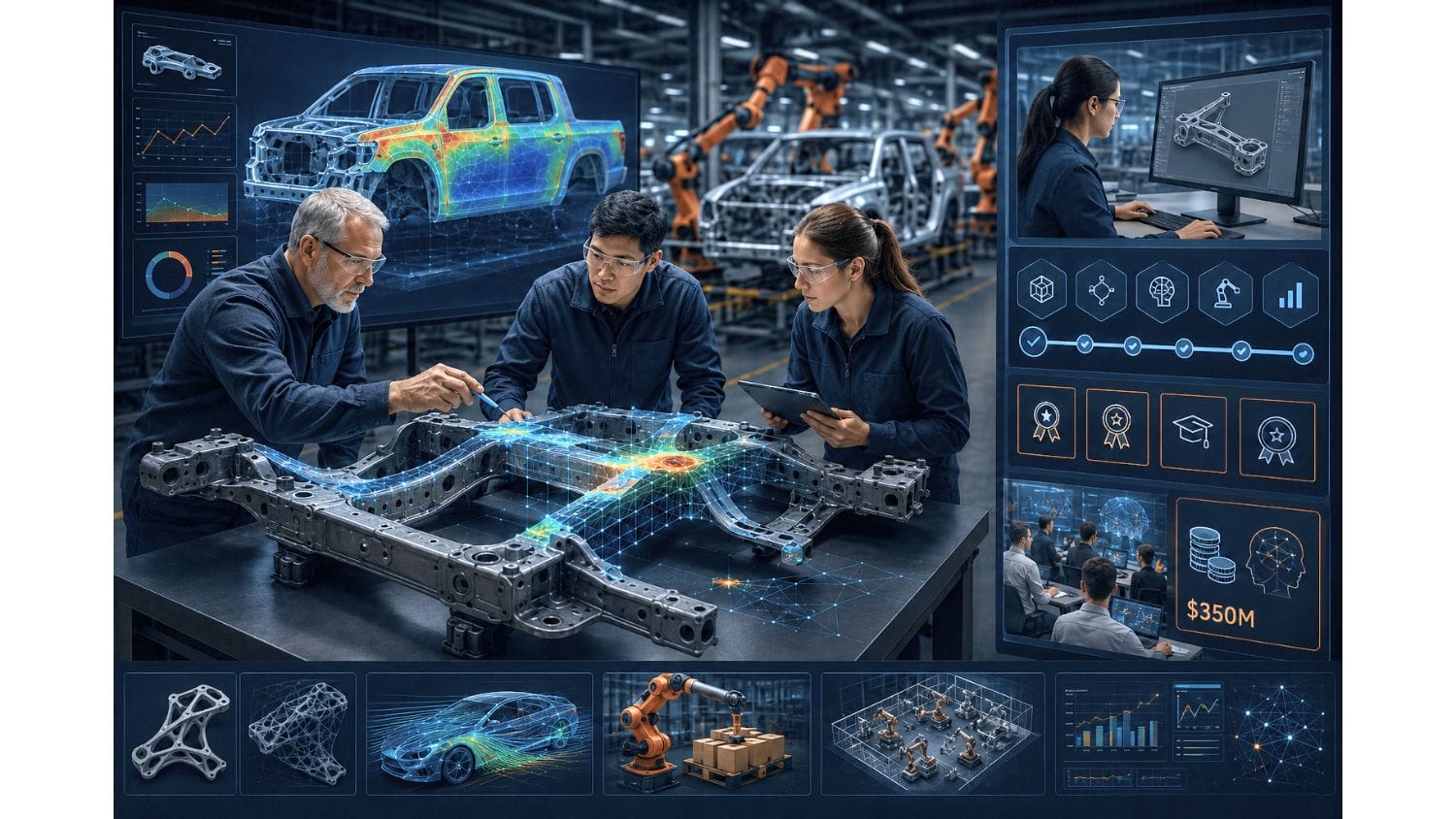
Veteran engineers bring an intuitive, battle-tested understanding of failure modes that cannot be synthesized from clean datasets alone. They know where structural stresses hide, why specific manufacturing tolerances drift over time, and—most importantly—which "minor" engineering compromises will ultimately morph into costly warranty nightmares. By integrating 350 seasoned technical specialists into their workflow, Ford bridged the gap between raw data processing and practical manufacturing wisdom.
Bridging the Skills Gap: Autodesk’s Strategy
Addressing the acute shortage of AI-fluent manufacturing professionals, Autodesk’s leadership emphasized that technology is only as effective as the people wielding it. With AI-related industrial roles skyrocketing by 147%, the company’s $350 million commitment is designed to ensure that the next generation of architects, product designers, and manufacturing engineers can seamlessly integrate algorithmic tools into physical workflows without getting lost in software complexities.
The Software Vanguard: Siemens, GM, AVEVA, and Robotics Pioneers
- Siemens: Positioning its latest tools as collaborative partners rather than replacements, Siemens argues that generative AI must speak the language of physics. By training models on historical simulation data, tools like Simcenter PhysicsAI Generate allow designers to bypass the intimidating blank CAD screen and instantly evaluate performance-compliant geometries.
- General Motors: Highlighting the pragmatic use of virtual labs, GM stresses that speed in vehicle validation is about expanding the exploration space. By compressing structural testing simulations to under five minutes, engineers can test extreme edge cases long before bending physical metal. However, GM maintains a strict commitment to physical validation, noting that surrogate models must always be tethered to real-world physical realities.
- AVEVA: At AVEVA World 2026, executives focused heavily on the unglamorous foundation of industrial AI: data hygiene. Without clean plant histories, unified engineering metadata, and synchronized asset tags, enterprise AI remains an expensive novelty. AVEVA’s updates aim to harmonize data infrastructure so factory-floor algorithms can operate reliably.
- Doosan, Vention, and Teradyne: In the robotics space, vendors are tackling the chaotic reality of the factory floor. Doosan’s PalletizHD+ and the Vention-Teradyne digital-twin cell designer address the reality that fixtures, part variations, and cell layouts are where automation projects traditionally fail. By simulating and proving out cells virtually before physical deployment, these platforms drastically reduce costly on-site rework.
5. Implications for the Future of Industrial Engineering
The convergence of AI tools, massive upskilling investments, and a renewed appreciation for veteran engineering talent carries profound implications for the global manufacturing sector.
1. The End of the "AI Autopilot" Myth
The industry-wide consensus in 2026 is clear: industrial AI is an amplifier of human capability, not a substitute for domain expertise. Whether reviewing Siemens’ new AI CAM tool paths in NX X Manufacturing 2606 or evaluating GM’s lightning-fast simulation models, the ultimate responsibility rests with the engineer. A faster simulation or an automated tool path suggestion is only as good as the operator’s ability to verify cutting data, clearances, material behavior, and real-world physical constraints.
2. The Resurgence of Institutional Knowledge
Ford’s success serves as a wake-up call to industrial human resources departments worldwide. For years, corporate trends favored youth and aggressive digital native recruitment at the expense of retiring senior engineers. The 2026 data proves that tribal knowledge—the accumulated wisdom of decades spent troubleshooting assembly lines and part failures—is the missing half of the industrial AI equation. Algorithms need historical context, and veteran engineers provide the narrative that transforms raw data into actionable manufacturing excellence.
3. Data Infrastructure as a Competitive Moat
As demonstrated by AVEVA’s 2026 platform updates and Siemens’ integrated design suites, companies with clean, well-structured plant data will pull far ahead of competitors plagued by siloed legacy systems. The race for industrial AI supremacy is, at its core, a race for data hygiene. Organizations that invest in unifying their engineering metrics, asset tags, and operational histories will unlock exponential gains in automation speed and product quality.
4. Collaborative Engineering and Immersive Digital Twins
The collaborative platforms launched by Vention, Teradyne, and Autodesk point toward an industry where the boundary between virtual design and physical manufacturing continues to dissolve. By empowering engineers to design, program, simulate, and stress-test complete robotic cells and manufacturing workflows in unified digital workspaces, the industry is dramatically lowering the financial and operational risk of deploying advanced automation.
Conclusion
The 2026 industrial landscape reflects a mature, grounded approach to technological innovation. By rejecting the false dichotomy between human labor and artificial intelligence, leading manufacturers and software vendors are forging a powerful synthesis. When veteran expertise guides generative design, when robust plant data feeds machine learning models, and when rapid virtual validation is anchored by rigorous physical testing, the result is what the market witnessed this year: superior product quality, accelerated development cycles, and a revitalized industrial workforce ready to build the physical world of tomorrow.