For three-quarters of a century, nature documentaries have served as humanity’s window into the untamed corners of the globe. From the pioneering broadcasts of James Fisher’s Birds in Britain in 1951 and David Attenborough’s Zoo Quest in 1954 to the establishment of the BBC’s Natural History Unit in 1957, the genre has thrived on discovery. Yet, as modern audiences grow accustomed to hyper-definition cameras tracking every corner of the earth, a lingering question remains: Can a contemporary nature show genuinely break new ground?
National Geographic answers with an emphatic affirmative in its landmark series, Africa: Earth’s Wild Home, premiering on October 2, 2026. The series promises a barrage of ecological revelations, ranging from meat-eating tortoises and 800-foot spiderwebs spun in just three hours to intricate insect moisture farming and life thriving in the world’s cleanest waters.
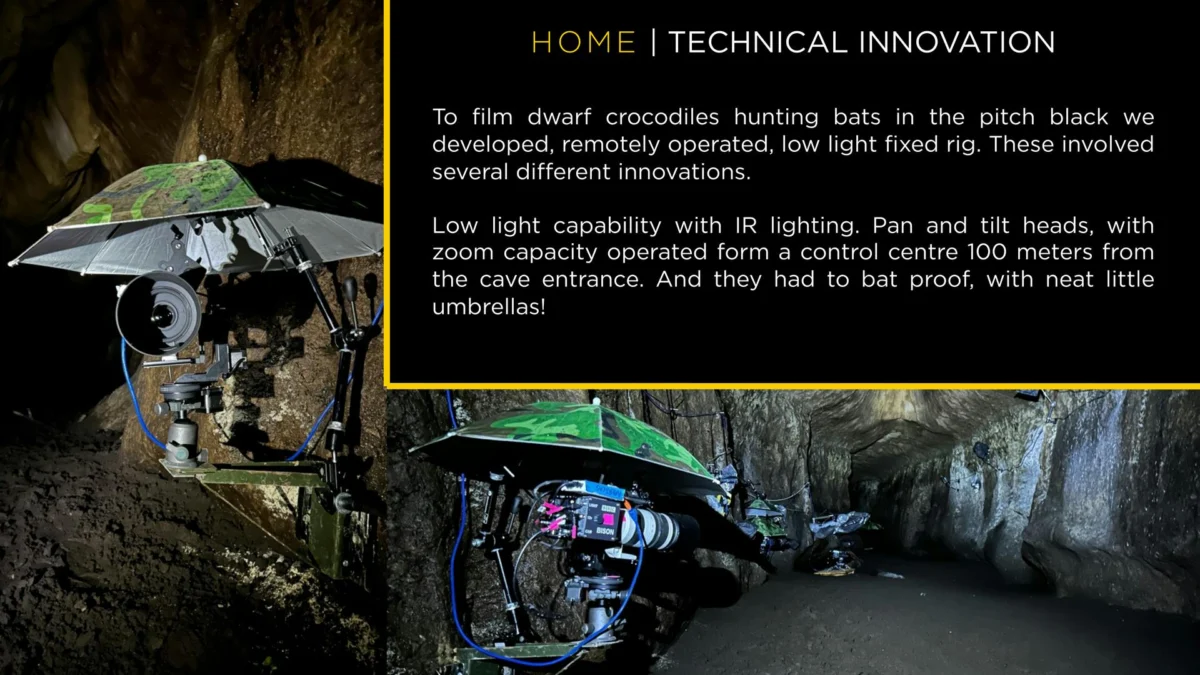
However, among these sweeping environmental spectacles, one technological and biological milestone stands apart: the first-ever footage of dwarf crocodiles hunting in the pitch-black caves of Gabon. Capturing this elusive behavior required more than standard wildlife filmmaking techniques. It demanded a cross-disciplinary fusion of field biology and custom electrical engineering—deploying retrofitted Z Cam digital cinema cameras, bespoke robotic pan-tilt mounts, and an elaborate remote-monitoring network spanning from the depths of a subterranean cavern to a jungle outpost above.
The Chronology of Discovery: Unlocking Subterranean Ecosystems
Documenting nocturnal or subterranean predators has always presented a formidable barrier for wildlife cinematographers. Traditional lighting disrupts light-sensitive species, driving them deeper into hiding and fundamentally altering natural behavioral patterns. To overcome this, the production team behind Africa: Earth’s Wild Home—led by documentary filmmaker Lillian Todd-Jones—devised a meticulous, phased approach to penetrating the caves of Gabon without alerting the local fauna.
Phase One: Hardware Modification
The team selected off-the-shelf Z Cams for their compact footprint and high-fidelity sensor output. However, stock models were incapable of seeing through absolute darkness. Engineers stripped and retrofitted the cameras to process infrared (IR) light. By pairing these modified sensors with discrete infrared lighting arrays, the production team could illuminate the scene in a spectrum entirely invisible to the cave-dwelling dwarf crocodiles and the bats they prey upon. To the animals, the environment remained pitch-black; to the crew, the scene was rendered in sharp, monochromatic detail.
Phase Two: Custom Mechanical Engineering
Positioning cameras in a cave presents unique physical hurdles. The flooring of the cavern was thick with corrosive bat guano, making traditional tripod setups impractical and messy. Furthermore, to achieve an immersive perspective, the cameras needed to be mounted at the eye level of the dwarf crocodiles—creatures whose diminutive stature required extraordinarily low angles.
Using modified tree mounts anchored directly into the damp cave walls, the crew engineered lightweight, bespoke robotic heads. These motorized mounts allowed remote pan-and-tilt control over the cameras. Because human technicians could not constantly re-enter the cave without disturbing the shy wildlife, mechanical limits had to be strictly observed. The tilt mechanisms were carefully calibrated to prevent the heavy camera packages from locking into vertical positions where they could not recover independently.
Finally, to protect the delicate electronics from a continuous rain of acidic bat guano, each camera assembly was sheltered beneath a compact, umbrella-like housing.
Phase Three: Remote Operations and the Waiting Game
All power and data signals were routed via extensive cabling fed upward from the cave floor to a monitoring shack situated safely in the jungle canopy above. This setup allowed a rotation of researchers and camera operators to monitor live video feeds day and night.
The operation devolved into a test of psychological endurance. Weeks blurred into sleepless nights of shift work. While the production team knew the dwarf crocodiles inhabited the cave and required sustenance, catching them in the act of hunting remained an elusive ghost hunt. Months of continuous monitoring passed before the remote feeds finally captured the breakthrough sequence: a motionless dwarf crocodile ambushing and seizing a bat within striking distance.
Supporting Data and Technical Specifications
The engineering marvel behind the Gabon cave shoot highlights a broader trend in modern wildlife filmmaking: the marriage of consumer-grade electronics with rugged, field-tested customization.
Camera Platform: Modified Z Cam units, chosen for their modular build and exceptional low-light capabilities.
Illumination Spectrum: Infrared lighting arrays operating outside the visible spectrum of cave-adapted species, ensuring zero behavioral disruption.
Mounting Infrastructure: Adapted tree-mounting brackets bolted directly to subterranean rock faces, paired with custom-built, motorized pan-tilt heads.
Data Transmission: Hardwired cable relays stretching from subterranean camera wells to an above-ground jungle monitoring station.
Environmental Obstacles: High humidity, absolute darkness, corrosive bat guano, and dense swarms of biting insects, including aggressive sweat bees capable of penetrating standard field attire.
Official Responses and Insights from the Field
In an exclusive interview with Electronic Design Technology Editor Cabe Atwell, filmmaker Lillian Todd-Jones detailed the logistical trials and inventive engineering required to bring the Gabon cave footage to light.
Reflecting on the novel setup, Todd-Jones noted:
"The cave crocs shoot that I directed was all very new. I mean, we were using off-the-shelf cameras, which are called Z Cams, but they were adapted so that they could record infrared, which meant that we could set infrared lights up in the cave and see what was happening. But to the animals in there, it still looked pitch black."
Addressing the mechanical design of the camera mounts, Todd-Jones explained that simplicity was paramount given the remote, hostile environment:
"They were developed by us… It’s pretty simple—simple when you know how—motors. The sort of theory of it is quite basic. But we just wanted something small that we could carry into the cave and set up, and then have control over our cameras, basically. So you could do pan, tilt. You can’t tilt it up too far because of the weight of it. They would get stuck up, and we couldn’t go back in there to sort them out. So you had to be quite careful."
Beyond the technical hurdles, Todd-Jones opened up about the grueling human cost of operating in extreme tropical environments—a reality often glossed over in finished broadcast cuts.
"I’ve done a lot of jungle shoots, and for me, it’s—everyone works so hard, and you often have to be up at all times of day. And all the time, there are just so many bugs trying to bite you. And everyone has to just develop this sense of Zen to not completely lose their minds, because it’s itchy and they won’t stop… I see it as, yeah, giving my pound of flesh for getting the privilege of being able to go to these places."
Implications for Engineering, Science, and Wildlife Documentation
The intersection of electronics design and wildlife cinematography yields implications that stretch far beyond television entertainment. As industrial and consumer electronics become smaller, more power-efficient, and easier to modify, field biologists and conservationists gain unprecedented tools for non-invasive species monitoring.
1. Non-Invasive Ecological Research
Traditional field research often requires human presence or heavy trapping, both of which stress wildlife and can skew behavioral data. The success of the Gabon cave shoot proves that remote, long-duration infrared monitoring can capture authentic, unmasked animal behaviors in extreme habitats. This methodology holds immense potential for monitoring endangered species in deep-forest, subterranean, or marine environments where human observation is otherwise impossible.
2. The Limits of Field Engineering
The challenges faced by Todd-Jones and her team mirror those encountered by engineers working in extreme industrial environments—whether installing skyscraper telecommunications antennas amidst spider infestations or maintaining remote sensor arrays in freezing, high-altitude terrain. The requirement for lightweight, resilient hardware that can withstand caustic biological agents (such as bat guano) and relentless moisture highlights the necessity of robust mechanical design and redundancy.
3. A New Standard for Natural History Programming
As Africa: Earth’s Wild Home hits television screens on October 2, 2026, it sets a new technical benchmark for the genre. Audiences no longer settle for generalized representations of animal life; they expect intimate, cinematic immersion. Achieving this standard requires engineers and filmmakers to continue pushing the boundaries of custom hardware adaptation, proving that science and art must work hand-in-hand to illuminate the most remote secrets of our planet.