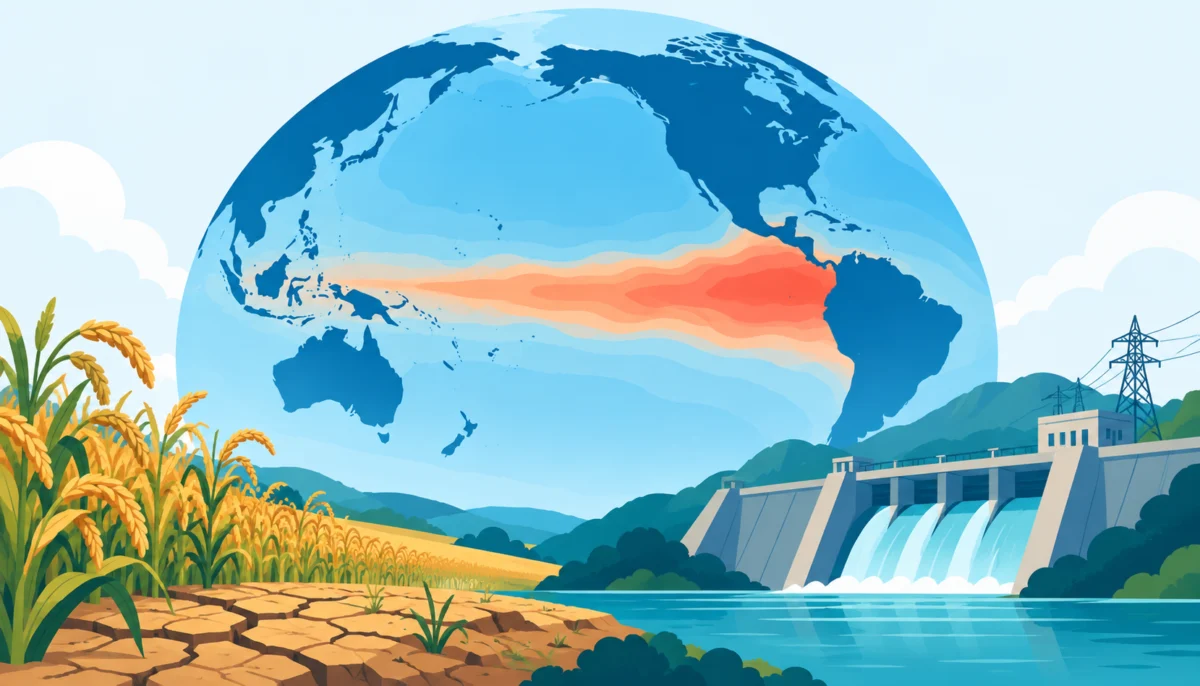
The World Meteorological Organization (WMO) issued a stark warning on October 8, confirming that the El Niño climate phenomenon is set to intensify, reaching a projected peak in December. With a near-100% probability of persisting through February 2027, the event promises to rewrite the climate narrative for the coming seasons. This isn’t merely a meteorological anomaly; it is a profound risk multiplier for global supply chains, energy grids, and sovereign balance sheets. As governments and businesses brace for hotter temperatures and volatile precipitation patterns, the challenge lies in translating these broad climate signals into granular, actionable intelligence.
The Chronology of a Climate Event
The current path of El Niño has been tracked with increasing precision throughout 2026. By early autumn, the consensus among climate monitoring agencies was solidified.
- June 2026: The Food and Agriculture Organization (FAO) released its comprehensive agricultural risk assessment, utilizing 41 years of satellite data to map the areas most susceptible to drought in the Sahel, Southern Africa, South and Southeast Asia, and Central America’s "Dry Corridor."
- September 10, 2026: The US Climate Prediction Center issued a diagnostic discussion assigning a greater-than-90% probability to a "very strong" El Niño event. This served as the primary precursor to the WMO’s later, more detailed October update.
- October 8, 2026: The WMO released its formal seasonal update, projecting a Niño 3.4 sea-surface temperature anomaly of 3.7°C. This report solidified the outlook for a peak in late 2026 and an extended duration into the first quarter of 2027.
These milestones provide a clear timeline for stakeholders, marking a transition from long-term probabilistic forecasting to immediate operational preparation.
Supporting Data: Understanding the Physics of Risk
The WMO’s October–December seasonal update does not operate in a vacuum. It relies on the convergence of three primary oceanic indicators:
- Niño 3.4 Anomaly: Projected at 3.7°C, this remains the gold standard for measuring the intensity of the event.
- Indian Ocean Dipole (IOD): Forecasted at a positive 0.5°C average, the IOD often amplifies the regional rainfall shifts initiated by El Niño.
- Tropical Atlantic Warming: Warmer-than-normal waters in the Atlantic further complicate global weather patterns, potentially intensifying hurricane activity or altering seasonal rain cycles.
It is vital, however, to distinguish these oceanographic measurements from economic outcomes. A 3.7°C anomaly is a physical indicator, not a direct proxy for crop yields or commodity price indices. The bridge between climate data and economic impact is built upon local variables: soil moisture levels, irrigation capacity, and the specific timing of crop growth stages.
Official Responses and Anticipatory Action
International organizations have moved beyond observation into active financial and logistical planning. The joint anticipatory appeal by the FAO and the World Food Programme, seeking $202 million to protect 8.8 million people across 22 high-risk countries, underscores the gravity of the situation. This funding is earmarked for early cash assistance and support for pastoralists and farmers—measures designed to mitigate the damage before it occurs.
However, these figures represent a target, not a guarantee of stability. The true test of resilience will occur at the national level, where governments must decide how to distribute limited fiscal resources between subsidizing food imports, providing tax relief to affected households, and maintaining debt service obligations.
Implications for Global Business and Infrastructure
The Agricultural Supply Chain
For the food processing and agricultural sectors, the primary risk is volume, not just price. A processor with contracts tied to a drought-stricken region faces a dual threat: a potential failure of supply and the inflationary pressure of sourcing from alternative, more expensive markets.
Credit analysis must move beyond price speculation. Analysts should focus on the "cash cycle" of the borrower. Does the farmer have insurance coverage? Is there liquidity to cover the increased cost of inputs like fertilizer or irrigation? If a producer’s harvest fails, the loss of revenue creates a debt-servicing vacuum that no amount of price appreciation in the broader market can fill.
Energy Security and Hydroelectric Dependency
The IMF’s historical research, while dating back to 2016, provides a chilling roadmap for energy vulnerability. El Niño-induced droughts frequently result in lower reservoir levels, crippling hydroelectric power generation.
For utility providers, this triggers a cascade of financial consequences. If electricity prices are fixed by regulatory decree, the cost of purchasing replacement fuel or power from external sources must be absorbed by the utility, weakening cash flow. If the government intervenes to protect the utility, the financial burden shifts from the private sector to the national budget. Manufacturers must also audit their energy dependencies; those relying on water-intensive processes or hydroelectric-heavy grids may find their operational costs spiking even if they are not directly involved in agriculture.
Sovereign Risk and Fiscal Pressure
Governments are currently at the highest risk of "shock transmission." The cost of importing food and energy, combined with the political necessity of providing social safety nets, can quickly erode fiscal reserves.
Analysts evaluating sovereign risk should focus on:
- Import Bill Sensitivity: How much of the national diet is reliant on vulnerable commodities?
- Fiscal Space: Does the government have the reserves to finance emergency imports without triggering a currency crisis or a default on existing debt?
- Monetary Policy: Central banks must navigate the delicate balance of managing inflation caused by supply-side shocks without inadvertently stifling growth through premature interest rate hikes.
Analyst’s View: Bridging the Gap Between Climate and Credit
As we head toward the February 2027 threshold, the following strategies are essential for institutional decision-makers:
1. Credit Risk Management: Lenders must conduct rigorous stress testing. This involves running "lower-output" and "higher-input-cost" scenarios to assess the resilience of a borrower’s cash flow. Collateral values for agricultural loans should be recalibrated to reflect potential losses in crop yields, not just historical land value.
2. Sovereign Monitoring: Move beyond regional climate exposure. Trace the flow of money: how will the costs of food support and utility subsidies be funded? The quality of a government’s response is determined by its refinancing schedule and the adequacy of its liquid reserves.
3. Strategic Market Positioning: Investors should demand transparency regarding sourcing diversity and hedging. A company that has secured alternative origins for its raw materials is fundamentally more valuable than one that has not. The current market volatility should be viewed as a filter; firms that have built physical and financial buffers will emerge with stronger market shares, while those relying on "business as usual" will face significant margin compression.
Conclusion: Preparing for the Unfolding Reality
The near-certainty of El Niño’s persistence through February 2027 grants leaders a vital, if narrowing, planning window. The physical climate signal is clear; the economic consequences, however, remain conditional on local variables and institutional responses.
The task for the coming months is one of observation and adjustment. By pairing satellite-derived climate data with corporate cash-flow disclosures and government fiscal updates, analysts can move from reacting to historical patterns to anticipating future disruptions. While the El Niño event will undoubtedly challenge global systems, the ability to identify, quantify, and mitigate these risks now will determine the difference between a manageable supply-chain fluctuation and a systemic economic crisis. The evidence is gathering; the window for preparation is now.