Hydraulic systems have long served as the muscular backbone of global manufacturing. From the immense pressure required in metal forming and plastics processing to the rugged reliability needed in heavy construction equipment, fluid power is indispensable. However, as the industrial landscape shifts toward decarbonization and aggressive sustainability targets, the traditional reliance on high-force hydraulics is facing a new challenge: energy optimization.
The industry is currently undergoing a pivotal transformation. Engineers are no longer merely asking how to achieve peak power; they are asking how to achieve that power with minimal waste. This shift marks the transition from "power-at-all-costs" to "intelligent, high-efficiency actuation," a change driven by technological innovation, stringent global regulations, and the integration of artificial intelligence.
The Core Challenge: Understanding Hydraulic Energy Transformation
At its most fundamental level, a hydraulic system is an energy converter. It takes mechanical energy—usually from an electric motor—and converts it into fluid power, which is then redirected to perform mechanical work at the point of use.
This multi-stage conversion process is where efficiency is often lost. Factors such as friction, internal leakage, and heat generation are inherent to fluid power, but they are often exacerbated by outdated sizing philosophies. Historically, hydraulic systems were "oversized" to ensure safety margins and consistent performance. While this guaranteed reliability, it often resulted in systems running at partial load or idling at high pressures, leading to significant energy dissipation through heat and wasted flow.
The Balancing Act: Performance vs. Efficiency
A common misconception is that energy efficiency necessarily degrades performance. On the contrary, modern engineering aims to balance stability, precision, and safety with reduced energy consumption. The objective is to design systems that are responsive when needed and dormant when idle, moving away from the "always-on" mentality that characterized early industrial hydraulic setups.
Chronology of Innovation: From Constant Speed to Digital Intelligence
The evolution of hydraulic efficiency has not happened overnight. It is the result of decades of incremental advancements, each building upon the last:
- 1970s–1990s: The Era of Fixed-Displacement Pumps. Systems relied on constant-speed motors and bypass valves. Energy loss was significant, as excess flow was often dumped back into the reservoir across a relief valve.
- Late 1990s–2000s: The Introduction of Load-Sensing. Technologies like pressure-compensated pumps allowed systems to modulate flow based on immediate load requirements, drastically reducing idle power consumption.
- 2010s: The Rise of Variable Speed Drives (VSDs). The integration of VSDs allowed electric motors to synchronize their output precisely with the hydraulic demand of the machine, representing a massive leap in energy efficiency for variable-load cycles.
- 2020s–Present: The Electrohydraulic & AI Era. We are now in the age of intelligent, decentralized systems. By merging electronic control with hydraulic hardware, manufacturers can now use predictive analytics and real-time sensor feedback to optimize performance at the millisecond level.
Technological Pillars of Modern Efficiency
Modern hydraulic systems are no longer "dumb" mechanical loops; they are sophisticated, interconnected networks. Several key technologies are currently defining the state of the art.
1. The Power of Variable Speed Drives (VSDs)
VSDs have become the "brain" of the modern hydraulic power unit (HPU). By allowing the electric motor to ramp up or down based on actual machine cycles—rather than running at a constant speed—VSDs eliminate the need for throttling valves that generate heat and waste energy. In many industrial applications, switching to a VSD-controlled system can reduce energy consumption by 30% to 50%.
2. Electrohydraulic Servopumps
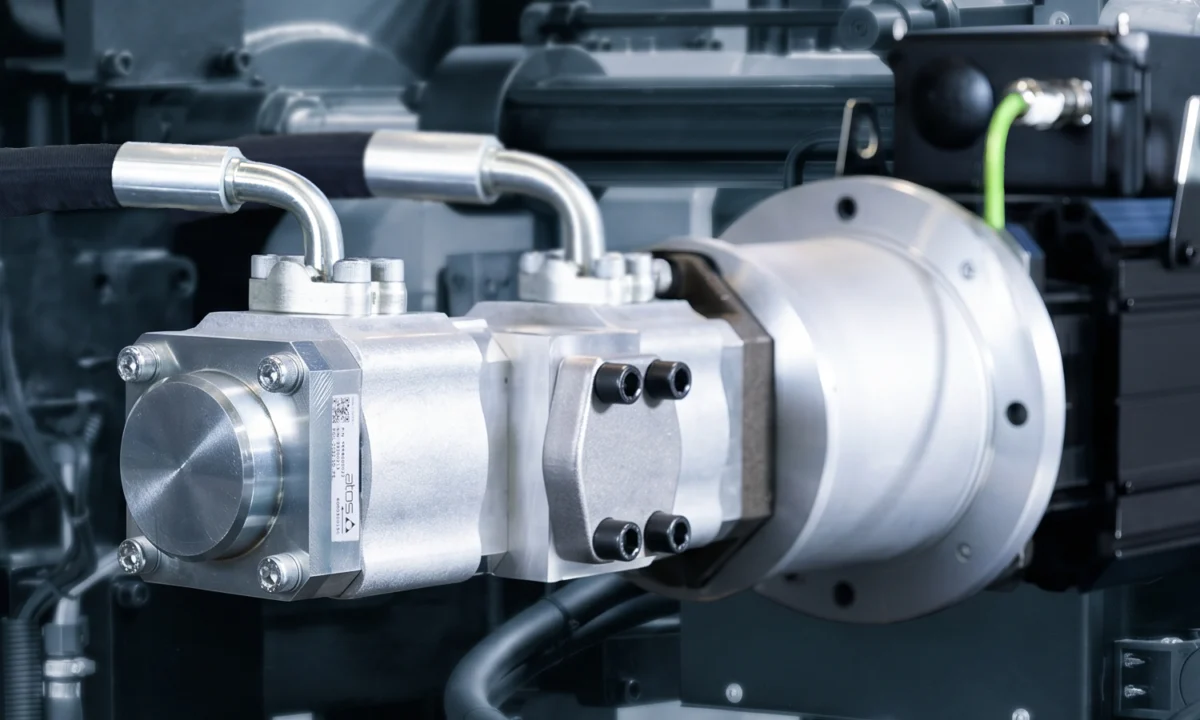
Companies like Atos are leading the charge with advanced electrohydraulic servopumps. These systems integrate digital controllers directly into the hydraulic architecture, allowing for instantaneous pressure and flow adjustments. Unlike traditional systems that rely on mechanical feedback, servopumps utilize digital loops to provide superior repeatability and lower energy signatures. They effectively bridge the gap between the raw power of hydraulics and the precision of electronic controls.
3. Energy Recovery and Regeneration
In applications such as heavy-duty presses or material handling, hydraulic systems can be configured to capture energy. During the deceleration phase or when a load is lowering, the potential energy that would normally be dissipated as heat can be redirected into accumulators. This stored energy is then reintroduced into the system for the next cycle, creating a "regenerative" loop that significantly lowers the total power draw from the grid.
Supporting Data: The Impact of Smart Integration
Industry studies consistently demonstrate that the transition to modern, electronically-controlled hydraulics provides a measurable return on investment (ROI).
- Operational Cost Reduction: Factories that have retrofitted older, fixed-speed hydraulic systems with modern servopump architectures report a reduction in electricity bills by an average of 40%.
- Thermal Management: Efficient systems generate less waste heat. This not only saves energy but also extends the life of hydraulic fluid and seals, reducing the cost of maintenance and the frequency of oil changes.
- Precision Metrics: Advanced electrohydraulic systems provide accuracy levels within 0.1% of set parameters, ensuring that "efficiency" does not come at the cost of product quality.
Official Perspectives: The Role of Policy and Industry Strategy
Regulatory bodies, particularly in the European Union and North America, are increasingly setting standards for industrial energy performance. Corporate sustainability reports now include "Fluid Power Efficiency" as a key performance indicator (KPI).
Industry experts argue that the focus should not be on replacing hydraulics with electromechanical alternatives, but rather on "hydraulics 2.0." The consensus is that for high-force applications, fluid power remains more compact and durable than electric actuators. Therefore, the strategic mandate is to modernize the hydraulic component to meet current carbon-neutral goals.
"The goal is not to eliminate the fluid," says a leading analyst at Atos. "The goal is to move the fluid only when, where, and at the pressure required to do the work. If you aren’t moving fluid, you aren’t wasting energy."
Implications: The Future of Industrial Automation
The integration of artificial intelligence (AI) and machine learning (ML) is the next logical step in this evolution.
Predictive Maintenance
By utilizing the sensors already present in electrohydraulic systems, AI can detect subtle changes in fluid pressure or pump noise that indicate an impending failure. This allows for predictive maintenance, preventing costly downtime and ensuring the system always operates at its peak efficiency rating.
The Hybrid Future
We are entering a period of "hybridization." Industry is moving toward a model where hydraulic systems are part of a broader, digitized infrastructure. These systems communicate with the factory’s central energy management system, allowing for load-leveling across the entire plant.
Training and Workforce Readiness
The transition to these high-tech systems carries a significant implication for the labor force. The hydraulic technician of the future must be as comfortable with a laptop and a diagnostic software suite as they are with a wrench. Investment in training and technical education is becoming as vital to efficiency as the hardware itself.
Conclusion: A Balanced Outlook
Energy efficiency in hydraulics is no longer a niche technical concern; it is a fundamental pillar of modern industrial operations. Through the adoption of variable speed drives, electrohydraulic control, and AI-driven predictive maintenance, the hydraulic industry is proving that it can evolve to meet the most stringent environmental standards while maintaining its status as the most robust and reliable power transmission technology available.
The future of hydraulics is not just about force—it is about intelligence. By viewing hydraulic systems as dynamic, energy-aware components of a larger digital ecosystem, manufacturers can ensure that their production lines are not only powerful but also sustainable, profitable, and prepared for the challenges of the coming decades.
This article was produced in partnership with The Atos Group, leaders in electrohydraulic innovation and industrial motion control solutions.