





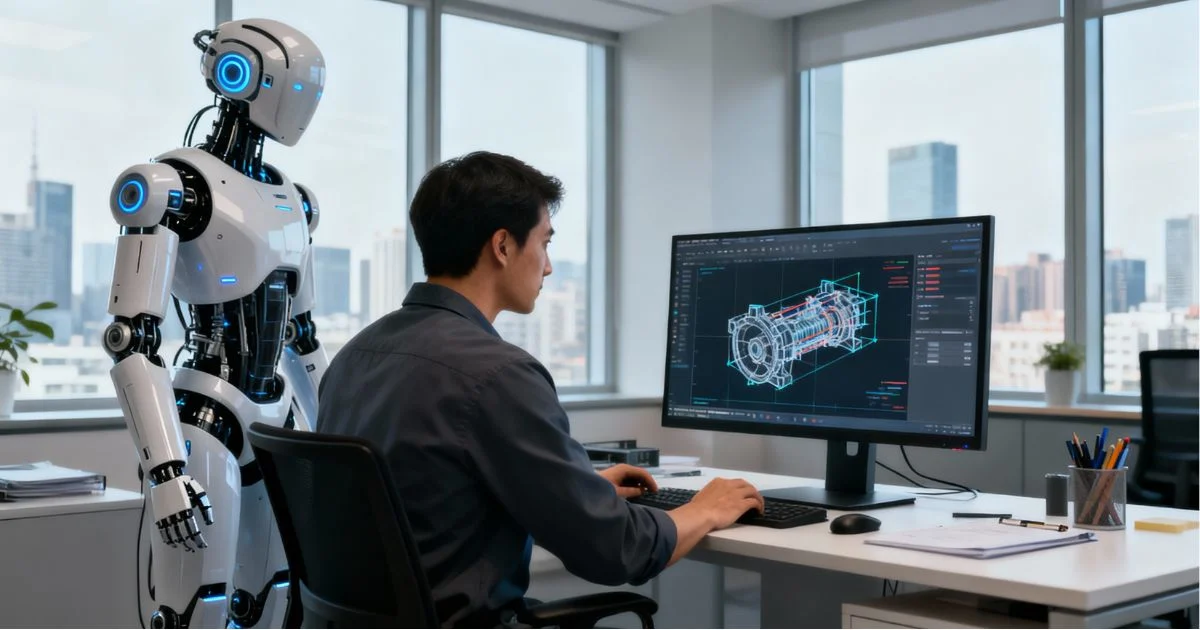
It was a quiet Friday afternoon, the kind where the deadlines for the upcoming design review loom large. I found myself wrestling with a complex housing model—a legacy assembly that had passed through a dozen hands, each leaving behind a slightly different modelling philosophy. As I stared at a series of broken fillet groups, I decided to test the AI assistant integrated into my CAD environment. I expected a misinterpretation or, at best, a generic error report. Instead, the AI pinpointed the specific geometric inconsistency and proposed a propagation path that perfectly honored the original design intent.
That moment wasn’t about the AI "doing" the engineering. It was about the sudden realization that the tedious, low-value friction of CAD maintenance—the "cleanup" work that eats into an engineer’s productive hours—was being quietly offloaded. This shift is not a future projection; it is the current reality of mechanical design.
The Changing Rhythm of Modern Design
For decades, the "mechanical engineering workflow" has been defined by a rigid adherence to parametric discipline. Engineers spend countless hours ensuring feature trees are clean, constraints are stable, and models are robust enough for downstream manufacturing. While these standards are essential for quality, they are also a tax on creative throughput.
The industry is currently undergoing a structural transformation. Leading CAD vendors are moving beyond simple automation to "intelligent collaboration." As noted in recent reports from industry leaders like Siemens, we are entering an era where AI doesn’t just accelerate existing tasks; it restructures the entire product development lifecycle. The goal is no longer just to build faster, but to build with a higher level of fluid intelligence.
A Chronology of the AI Integration
The evolution of CAD-based AI has been rapid, accelerating from basic geometry helpers to complex, context-aware copilots in just a few short years. The following timeline illustrates the swift progression of these tools across the mainstream CAD landscape.
Timeline: The Rise of the CAD Copilot
| Year | Month | Vendor | Feature | Description |
|---|---|---|---|---|
| 2022 | May | Autodesk | AI Modelling Assistance | Initial AI-based tools arrive in AutoCAD. |
| 2022 | Aug | Dassault Systèmes | AI Design Assistance | Geometry optimization enters SOLIDWORKS. |
| 2022 | Oct | Autodesk | Sketch Assist (Fusion 360) | AI suggestions for sketch creation. |
| 2023 | Mar | Siemens NX | AI Feature Recognition | Automated tagging for imported features. |
| 2023 | Jun | Siemens NX | Import Intelligence | Improved STEP feature recognition. |
| 2023 | Nov | Autodesk | Automated Mesh Insights | AI assistance for simulation setup. |
| 2024 | Mar | Leo AI | AI Copilot Beta | First engineering-focused CAD copilot. |
| 2024 | Jul | Dassault Systèmes | AI Mate Proposals | Automated assembly constraint suggestions. |
| 2024 | Sep | Siemens NX | Load Case Prediction | AI-supported simulation setup. |
| 2025 | Apr | IMSI TurboCAD | Copilot Professional | Plug-in for scene analysis and part creation. |
| 2025 | Aug | Leo AI | CAD-aware Part Search | PLM-integrated component sourcing. |
| 2025 | Sep | Autodesk | Neural CAD | Text-driven geometry and rendering. |
| 2025 | Sep | Leo AI | Assembly Troubleshooting | Step-by-step guidance for assembly repairs. |
| 2025 | Oct | PTC Onshape | AI Advisor | Real-time model guidance in the browser. |
| 2025 | Nov | Tech Soft 3D | HOOPS AI | Framework for embedded ML workflows. |
| 2025 | Nov | Dassault Systèmes | AURA AI Companion | Next-gen generative design integration. |
Defining the AI Copilot: More Than a Chatbot
It is vital to distinguish between a generic Large Language Model (LLM) and a true Engineering Copilot. A CAD-integrated copilot is a synthesis of geometry interpretation, constraint logic, and pattern recognition. It doesn’t just "talk"; it "sees" the model.
When you query an AI copilot about an assembly, it analyzes the boundary conditions, reads the feature history, and evaluates the mates. It can suggest structural improvements or flag a potential manufacturing clash before the design ever hits the shop floor. This aligns with the definition championed by Siemens: AI’s primary value is in amplifying human expertise, not replacing it. By handling the foundational grunt work, the AI allows the engineer to remain the architect of intent.
Supporting Data: The "Top Performer" Advantage
The industry is currently divided between those who are experimenting with AI and those who are operationalizing it. According to research from SOLIDWORKS’ State of Product Development, there is a clear performance gap.
- 72% of companies identify generative design and early-stage ideation as the primary targets for AI integration.
- 55% of organizations are leveraging machine-learning for predictive forecasting.
- "Top Performers" (organizations with high engineering maturity) are nearly twice as likely (43% vs 22%) to have active, AI-integrated workflows compared to their peers.
These statistics suggest that AI adoption is becoming a competitive differentiator. Teams that successfully integrate these tools are seeing shorter iteration cycles, reduced manual rework, and, most importantly, more time allocated to solving complex engineering problems rather than managing CAD software "noise."
Official Perspectives and Ethical Guardrails
As AI becomes embedded in the tools of trade, the conversation has shifted toward trust and ethics. Both Siemens and Autodesk have published extensive documentation regarding "Digital Trust."

The core concern for engineers is the "hallucination" factor—when an AI provides a confident but technically incorrect suggestion. To mitigate this, vendors are focusing on explainable AI. The guidance from industry leaders is consistent:
- Start Small: Pilot specific, low-risk use cases (e.g., sketch auto-constraining).
- Focus on Intent: Ensure that the AI understands the "why" behind the design, not just the "what."
- Governance: Maintain rigorous oversight of data privacy, ensuring that proprietary IP remains within the secure boundaries of the company’s PLM (Product Lifecycle Management) system.
The New Skill Set: Mentoring the Machine
The emergence of the AI copilot demands a shift in the engineer’s skill set. We are moving from being "manual modelers" to "intent communicators."
If you provide an AI with vague, poorly defined parameters, you will receive vague, unusable results. If you provide clear, logical constraints, the AI becomes a force multiplier. This is remarkably similar to the process of mentoring a junior engineer. The most effective engineers of the next decade will be those who can articulate their design requirements with precision—a skill that relies on a deep, fundamental understanding of mechanical principles.
Implications for the Future: A Holistic Vision
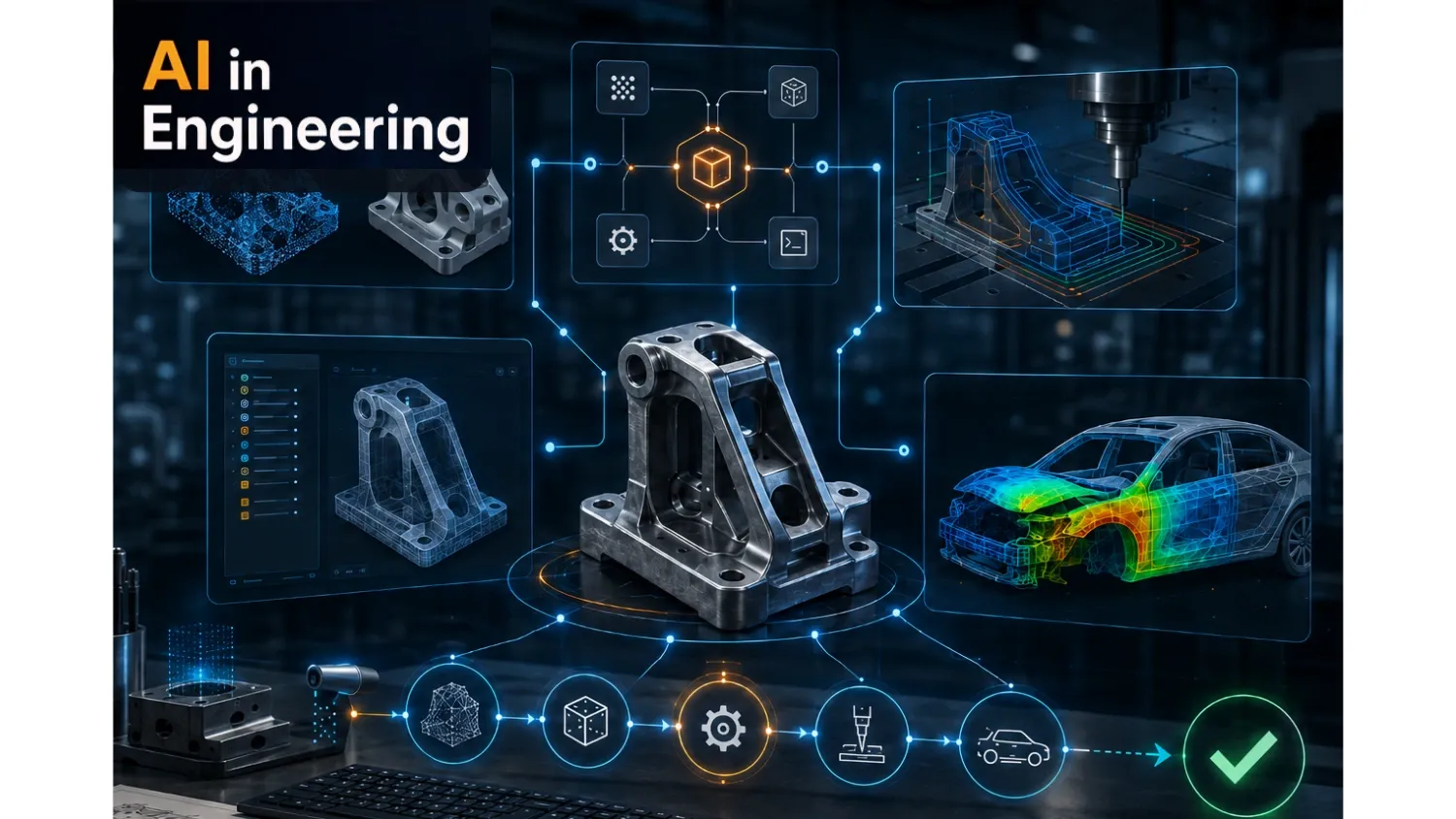
What does the future hold? We are already seeing the early stages of "AI-native modelling kernels." These systems treat geometry, simulation, and manufacturing cost as a single, interconnected decision space.
Imagine sketching a concept and, in the background, the system evaluates:
- Structural Integrity: Will it hold the load?
- Thermal Implications: Is it optimized for heat dissipation?
- Supply Chain Reality: Are the components available, and what is the current lead time?
This is the holy grail of product development: the ability to foresee downstream consequences during the first hour of the design process.
Closing Thoughts
When I reflect on that Friday afternoon, the utility of the AI tool was profound in its simplicity. It did not write a white paper or revolutionize my career in an instant; it smoothed the edges of a difficult task.
AI will not replace the mechanical engineer. The physical world—the world of gravity, friction, thermal expansion, and human safety—requires a level of judgment that an algorithm cannot replicate. However, the nature of our work is shifting. We are being liberated from the mundane to focus on the truly creative.
If you are an engineer working in CAD today, the best advice is to experiment. Treat these tools as the next evolution of your drafting board. Learn their strengths, understand their limitations, and—above all—keep your focus on the engineering intent. As the technology matures, the ability to work in tandem with these digital assistants will not just be a skill; it will be the defining characteristic of the modern mechanical engineer. The future of engineering isn’t about the machine taking over; it’s about the engineer finally having the support to focus on what matters most.