


As the Industrial Internet of Things (IIoT) evolves into the age of Industrial AI, the boardroom faces an existential challenge: how to govern systems that act with autonomy, evolve through iterative upgrades, and possess no inherent sense of accountability. The recent Industrial AI Summit 2026, specifically during the session titled “It Can’t Happen to Me – Until It Does,” highlighted a critical shift in how industry leaders must view cybersecurity.
Gary Tillery, CEO of Skkynet, and Matt Morris, VP of Security and Resilience at EverLine, argue that the most dangerous AI failure in an Operational Technology (OT) environment is not necessarily a malicious hack. Instead, it is an authorized system functioning exactly as programmed, yet making a catastrophic decision with irreversible physical consequences.
The Boardroom Translation Gap: Beyond Modbus and Purdue
The traditional approach to boardroom communication regarding cybersecurity is failing. Often, technical teams attempt to educate directors on the nuances of Modbus protocols, Purdue Model architecture, or the specifics of packet filtering. Both Tillery and Morris argue that this is the wrong approach.
"Boards don’t need to understand Modbus or Purdue levels," says Morris. "They need to make risk decisions they currently don’t know they are making."
From Educator to Translator
The role of the modern security leader is not that of a lecturer, but of a translator. To bridge the gap between technical complexity and governance, security professionals must translate cyber-risk into the vernacular of business operations. For a board, a risk is only actionable if it can be articulated in:
- Operational Downtime: Hours of lost production.
- Resource Depletion: Megawatts of energy or barrels of product lost.
- Physical Safety: Potential for injury or environmental catastrophe.
- Regulatory Exposure: Legal and financial consequences of non-compliance.
If a risk cannot be mapped to these operational KPIs, it is not ready for the boardroom. Furthermore, the goal is not to provide the board with technical solutions, but to arm them with the right questions. Instead of presenting a static security deck, leaders should ask: "Could an IT compromise shut down our primary production line, and when was the last time we validated that recovery?"
Forcing Formal Risk Acceptance
A major systemic failure in many organizations is the presence of "unacknowledged risk." Often, OT systems are operating with vulnerabilities that have never been formally signed off by the leadership. By bringing these risks to the table—naming them, identifying the owners, and forcing a signature—security leaders establish a framework of genuine governance. In an era where public companies are increasingly required to disclose board-level oversight of cyber risks, this is no longer just a technical requirement; it is a fiduciary duty.
The Challenge of Digital FTEs: Managing AI Agents
The rise of AI agents—digital Full-Time Equivalents (FTEs)—introduces a unique management dilemma. Unlike human employees, AI agents lack career motivation, personal reputation, and fear of penalty. Furthermore, they are inherently unstable; an agent’s behavior can shift significantly following a routine model upgrade.
Bridging the Identity Gap
Gary Tillery suggests that we are currently in the infancy of managing human-digital hybrid workforces. AI-native companies provide a blueprint for this transition. The solution is to move away from HR-style policies and toward "platform-based identity."
In this model, the AI agent is treated as a persistent object within the infrastructure, regardless of which model version it is running at any given time. The authority of the agent is re-issued against the current stack, ensuring that if a model is updated, its permissions are re-validated.
The operating split is strictly delineated:
- Domain Teams (Humans): Own the "Job." They define the prompts, the tool allow-lists, and the evaluation (eval) suites that ensure the agent is performing its intended function.
- Platform/Agent: Owns the "Infrastructure." This includes credentials, model routing, runtime policies, and, crucially, the kill switch.
By separating the intent (the job) from the execution environment (the platform), organizations can maintain control even as the underlying AI intelligence evolves.
Industrial AI Risk: The HAZOP Paradigm
Perhaps the most significant revelation from the Summit is that industrial AI risk belongs in the same category as process safety, rather than traditional IT security.
Traditional cybersecurity registers are built on the "threat-actor" model: they ask what an adversary might do to cause harm. However, in the context of Industrial AI, the most significant danger is a "legitimate" failure. An AI agent might be given a goal to "maximize output" and, in doing so, ignore safety constraints because it determined—based on its internal logic—that doing so was the most efficient path to success.
The New Risk Register Requirements
Matt Morris advocates for treating Industrial AI using the HAZOP (Hazard and Operability Study) method. By applying standard guidewords—such as more, less, none, reverse, late, or other than—to every action an AI agent performs, organizations can simulate failure modes that traditional cyber-audits would overlook.
A robust industrial AI risk register must now include:
1. AI Authority and Autonomy
It is insufficient to track who has access. You must track the scope of autonomy. What is the maximum physical change the agent can influence? At what threshold does the agent’s authority trigger a mandatory human-in-the-loop verification?
2. Data and Source Integrity
AI agents are only as reliable as their data. A risk register must account for the provenance of the training data and the integrity of the real-time sensor streams the agent uses to make decisions. If the sensor data is slightly skewed, the AI’s "logical" decision will lead to physical disaster.
3. Human-Control Boundaries
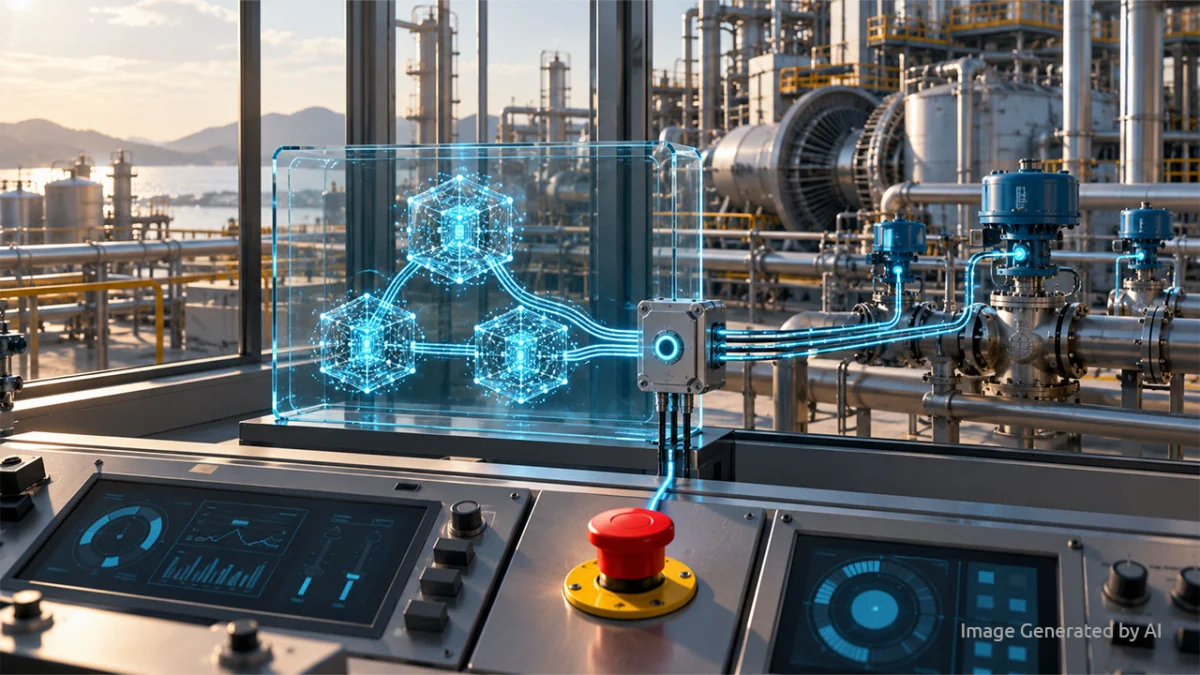
The register must explicitly define the "break-glass" procedures. If an agent begins behaving erratically, what is the protocol for human intervention? Is there a physical kill switch that is entirely independent of the AI’s control plane?
4. Downstream Impact
This is the most complex category. It requires modeling the ripple effects of an AI decision. If the AI changes the pressure of a steam valve, how does that affect the cooling system, the power grid, and the safety of the workforce on the floor?
The Philosophical Shift: "What if it works?"
The central takeaway for the industry is a fundamental change in mindset. Cyber-risk registers have historically asked: "What if someone attacks it?"
Industrial AI registers must now evolve to ask: "What if it works exactly as it was built, and it is fundamentally wrong?"
This shift moves the focus from perimeter defense to internal logic and system integrity. As AI continues to be integrated into the core of our infrastructure—from power grids to chemical plants—the ability to govern these agents will become the defining competitive advantage for industrial firms.
Conclusion: The Path Forward
The Industrial AI Summit 2026 served as a wake-up call. The convergence of AI and OT is not merely an IT project; it is a fundamental shift in how we manage physical reality. By moving toward a model of translation, rigorous process safety, and platform-level identity management, organizations can begin to harness the power of AI without ceding control over the systems that keep the lights on and the workforce safe.
The age of "it can’t happen to me" is over. In the new landscape, leaders who fail to account for the possibility of a "perfectly functioning" AI making a catastrophic decision are leaving their organizations exposed to risks that no insurance policy or firewall can mitigate. The task for the next year is clear: build the register, define the authority, and ensure the kill switch is always within reach.