




By Industrial Automation News Desk
Main Facts: A New Era in CNC Customization and Performance
The Drives & Motion division of Yaskawa America, Inc., a global leader in industrial automation, robotics, and drive technology, has officially announced the release of Compass 2. This advanced Computer Numerical Control (CNC) software solution is specifically engineered to operate seamlessly with Yaskawa’s cutting-edge iCube Control platform.
At its architectural core, Compass 2 bridges the gap between high-level computing power and deterministic real-time control. It cleverly combines the immense scalability and user-interface flexibility of an Industrial PC (IPC)—which handles heavy computations, path planning, and operator interactions—with the bulletproof, real-time motion and logic control delivered by Yaskawa’s flagship iC9200 machine controller.
By marrying these two technological paradigms, Yaskawa has provided machine tool builders with a versatile, high-performance CNC control option tailored for a wide variety of industrial applications. Primarily designed to optimize the operation of modern CNC routers and complex machining centers, Compass 2 brings sophisticated G-code processing, advanced macro logic, and robust path-planning tools directly to demanding production environments.
Key technical highlights of the Compass 2 release include:
- Hybrid Architecture: Leverages an Industrial PC for HMI and path planning alongside the iC9200 machine controller for real-time motion and logic.
- High-Speed Contouring: Features advanced block look-ahead and contouring capabilities designed to maintain sustained feed rates and tight corner tolerances.
- No-Code Customization (Compass Designer): Empowers builders to craft bespoke Windows WPF user interfaces without writing a single line of C# code.
- Extensive Programmability: Supports custom G-codes, M-codes, and macro programming for specialized routines like automated tool changing and part probing.
- Streamlined Integration: Integrates effortlessly with the iCube Engineer library, starter projects, and Yaskawa Sigma-X servo drives.
Chronology of Development: From iCube Control to Compass 2
To understand the strategic significance of the Compass 2 release, it is essential to trace the evolutionary timeline of Yaskawa’s motion control and software ecosystem.
The Foundation: The Rise of the iCube Platform
Over recent years, Yaskawa recognized a shifting paradigm in factory automation. Traditional, closed-architecture CNC systems were becoming too rigid for modern smart manufacturing environments. Machine builders increasingly demanded open, scalable systems that allowed for deep customization, IoT connectivity, and superior graphical user interfaces (GUIs).
In response, Yaskawa developed the iCube Control platform, anchored by advanced hardware like the iC9200 machine controller. This hardware was engineered to deliver lightning-fast processing speeds, EtherCAT network connectivity, and precise synchronization of multi-axis servo systems. However, hardware alone is only half the equation; a powerful, intuitive CNC software layer was required to unlock the full potential of the iCube architecture.
The Evolution of Compass
Yaskawa’s initial software iterations laid the groundwork for PC-based machine control, but market feedback indicated that builders wanted more intuitive ways to design custom operator screens without enduring lengthy software development cycles. Furthermore, as machining speeds increased, path-planning algorithms needed refinement to prevent micro-stops, stuttering, and tool wear during high-speed contouring tasks.
The Birth of Compass 2
The development of Compass 2 represents the culmination of years of engineering refinement. By focusing heavily on user experience (UX) design tools—such as the introduction of Compass Designer—and upgrading the core math engines responsible for block look-ahead, Yaskawa transformed Compass 2 from a standard software package into a comprehensive development ecosystem. Released to the market to support next-generation CNC routers and machining centers, Compass 2 marks a milestone in how machine tool builders conceptualize, program, and deploy custom CNC solutions.
Supporting Data & Technical Deep Dive: Under the Hood of Compass 2
The true value of Compass 2 lies in its comprehensive suite of technical features designed to solve real-world manufacturing bottlenecks. Let’s break down the core functional pillars that make this software solution stand out in the automation landscape.
1. High-Speed Contouring and Path Planning
In modern production environments—particularly those involving high-speed routing of wood, plastics, composites, or non-ferrous metals—maintaining a constant, fluid velocity along complex toolpaths is critical. Variations in feed rates can lead to tool burning, poor surface finishes, and excessive mechanical wear on the machine.
Compass 2 addresses this challenge through advanced block look-ahead and high-speed contouring algorithms. By analyzing hundreds of upcoming G-code blocks simultaneously, the software anticipates sharp corners, curves, and directional changes. It dynamically adjusts acceleration and deceleration profiles before the tool reaches the geometry change. This ensures:
- Sustained Feed Rates: Eliminates unnecessary deceleration on minor contour variations.
- Corner Tolerance Control: Maintains dimensional accuracy even at high linear velocities.
- Consistent Cut Quality: Preserves uniform chip loads, significantly improving surface finish and extending cutting tool lifespan.
2. Compass Designer: Empowering the Custom HMI
One of the most friction-heavy aspects of building a custom machine is designing the Operator Interface (HMI). Traditionally, creating a polished, functional, and responsive graphical interface required specialized software engineers fluent in complex programming languages like C# or C++.
Yaskawa has completely reimagined this workflow with Compass Designer.
- Out-of-the-Box Templates: Builders can start immediately using a fully functional, pre-configured example interface provided within the software suite.
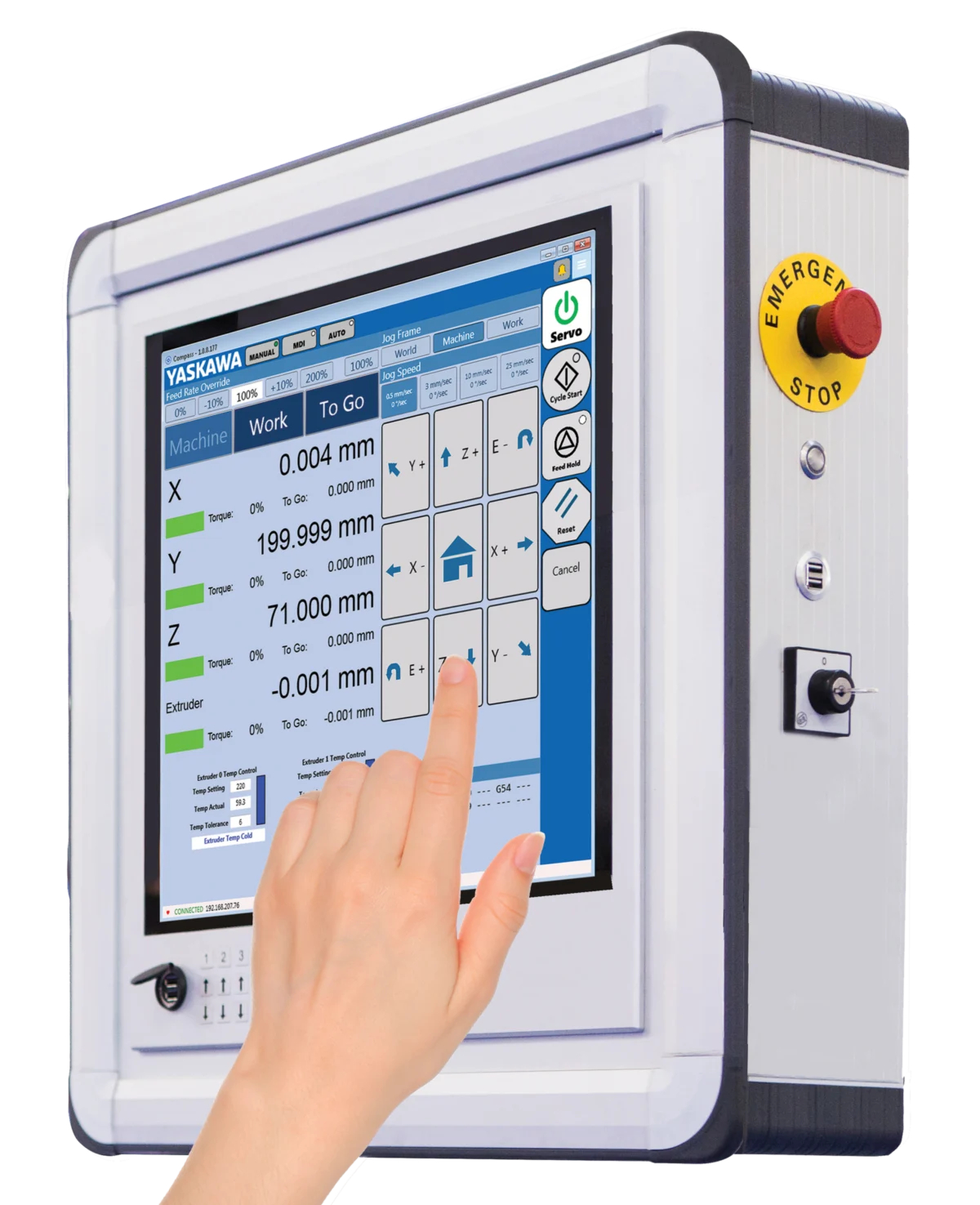
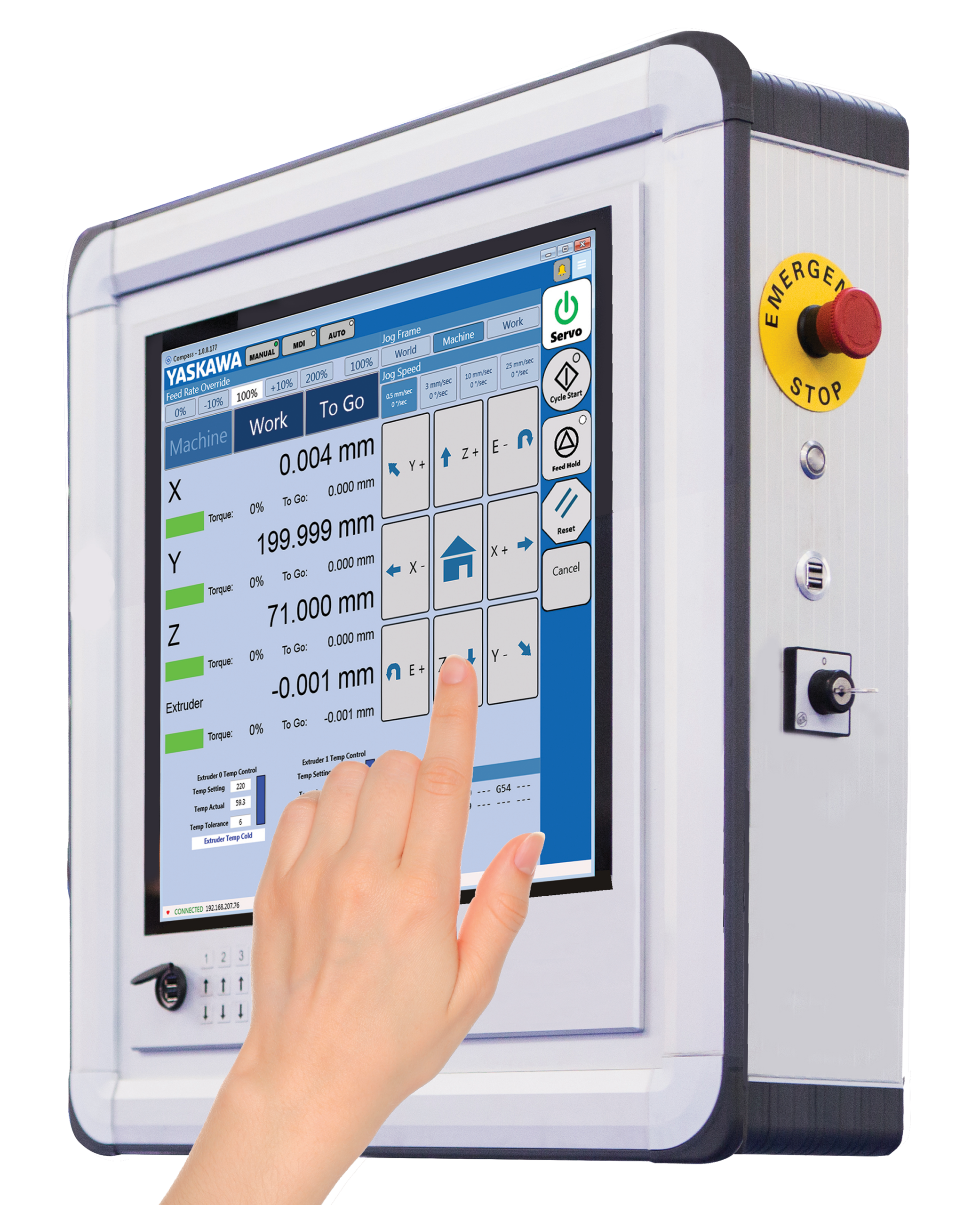
- No-Code Windows WPF Development: For those wishing to build a proprietary look and feel, Compass Designer allows users to create customized CNC HMIs as standard Windows Windows Presentation Foundation (WPF) applications—without writing any C# code.
- Standalone Executables: The design tool compiles the interface into a robust, standalone executable that includes Compass NC and incorporates built-in, optimized communication protocols with the iC9200 machine controller. This ensures secure, low-latency data exchange between the screen and the machine axes.
3. Advanced Customization and Macro Programming
Every machine tool builder has proprietary routines that give their equipment a competitive edge. Compass 2 supports deep customization through user-defined programming structures:
- Custom G-codes and M-codes: Builders can write custom codes to trigger specific machine states, pneumatic clamps, dust collection systems, or coolant flows.
- Macro Programs: Essential automated routines—such as automatic tool changers (ATC), laser or touch-probe workpiece zeroing, and complex canned drilling or pocketing cycles—can be seamlessly integrated into the machine’s operational logic.
4. Seamless PLC and Servo Integration
A CNC software package is only as good as its integration with the physical hardware. Compass 2 integrates fluidly with the iCube Engineer software library and starter projects.
Once an engineer configures Yaskawa’s high-performance Sigma-X servo axes and associated digital/analog I/O modules within the system, the platform is instantly ready for commissioning. The harmonization between the Sigma-X drives—known for their ultra-fast frequency response and tuning-less stability—and the Compass 2 control software ensures rigid, highly accurate motion execution.
Official Responses and Industry Perspectives
While official product rollouts often focus strictly on spec sheets, industry analysts and Yaskawa leadership emphasize that Compass 2 is a direct response to the evolving needs of Original Equipment Manufacturers (OEMs) and system integrators.
In statements accompanying the release, representatives from Yaskawa America’s Drives & Motion division highlighted the strategic importance of giving machine builders the freedom to innovate. In today’s competitive manufacturing landscape, an OEM’s brand identity is heavily tied to the user experience of their machine. By lowering the barriers to HMI customization through tools like Compass Designer, Yaskawa is enabling smaller and mid-sized machine builders to deliver enterprise-grade, highly polished user interfaces that rival those of legacy, high-end machine tool conglomerates.
Furthermore, automation experts have noted that the split-architecture model—utilizing an Industrial PC for heavy-duty user interfaces and path planning while leaving hard real-time tasks to the dedicated iC9200 controller—represents the gold standard in modern industrial control design. This separation of concerns ensures that a background graphic intensive task or a heavy file transfer on the HMI side will never compromise the safety, determinism, or precision of the real-time motion control loops running the servo motors.
Implications for Machine Builders, Manufacturers, and the Future of CNC
The introduction of Yaskawa’s Compass 2 has profound implications across the manufacturing ecosystem, touching machine tool builders, end-user manufacturers, and the broader industrial automation sector.
Empowering Machine Tool Builders (OEMs)
For OEMs, engineering time equals capital. By providing a pre-integrated software suite that couples advanced motion control with an intuitive drag-and-drop HMI designer, Yaskawa significantly slashes time-to-market.
- Reduced Development Costs: Eliminating the need to hire specialized C# software developers to build custom HMI screens saves thousands of dollars in engineering overhead.
- Differentiation: Builders can rapidly prototype and deploy unique machine features, branding the interface to match their corporate identity and giving them a distinct marketing advantage over competitors stuck using rigid, off-the-shelf control screens.
- Reliability: Because the communication pathways between Compass NC, the Windows WPF application, and the iC9200 machine controller are pre-engineered and tested by Yaskawa, integration risks are dramatically minimized.
Elevating End-User Productivity
For manufacturers operating CNC routers and specialized machining centers in their production facilities, Compass 2 delivers tangible shop-floor benefits:
- Maximized Throughput: The combination of block look-ahead, high-speed contouring, and ultra-fast Sigma-X servo drives means machines can run faster without sacrificing precision.
- Minimized Downtime: Robust macro programming capabilities allow for rapid, automated tool changes and precise probing routines, reducing setup times between job batches.
- Intuitive Operation: Operators benefit from clean, responsive, and application-specific touchscreens that reduce training times and minimize the likelihood of costly operator input errors.
The Broader Automation Landscape
Compass 2 is a prime example of the ongoing convergence between IT (Information Technology) and OT (Operational Technology). By leveraging standard Windows WPF frameworks for the user interface while maintaining rigorous, deterministic OT control via the iC9200 controller, Yaskawa demonstrates how modern industrial platforms can achieve the best of both worlds: open, flexible computing paired with uncompromised motion safety and precision.
As industries increasingly demand smart, connected, and highly customizable manufacturing machinery, software solutions like Compass 2 will serve as the backbone of next-generation industrial automation.
Conclusion
Yaskawa’s release of the Compass 2 CNC software solution marks a significant leap forward for the iCube Control ecosystem. By skillfully blending PC-based HMI flexibility and path planning with deterministic real-time machine control, Yaskawa has equipped machine tool builders with a powerful tool to conquer modern manufacturing challenges.
Featuring advanced high-speed contouring, the no-code Compass Designer interface, deep macro programming capabilities, and seamless integration with Sigma-X servo drives, Compass 2 is poised to become a staple in the world of CNC routing and specialized machining.
For more information on the new Compass 2 software solution, technical documentation, or to explore Yaskawa’s comprehensive automation portfolio, visit the official corporate website at yaskawa.com.