September 23, 2026
By Mary Bailey
Main Facts
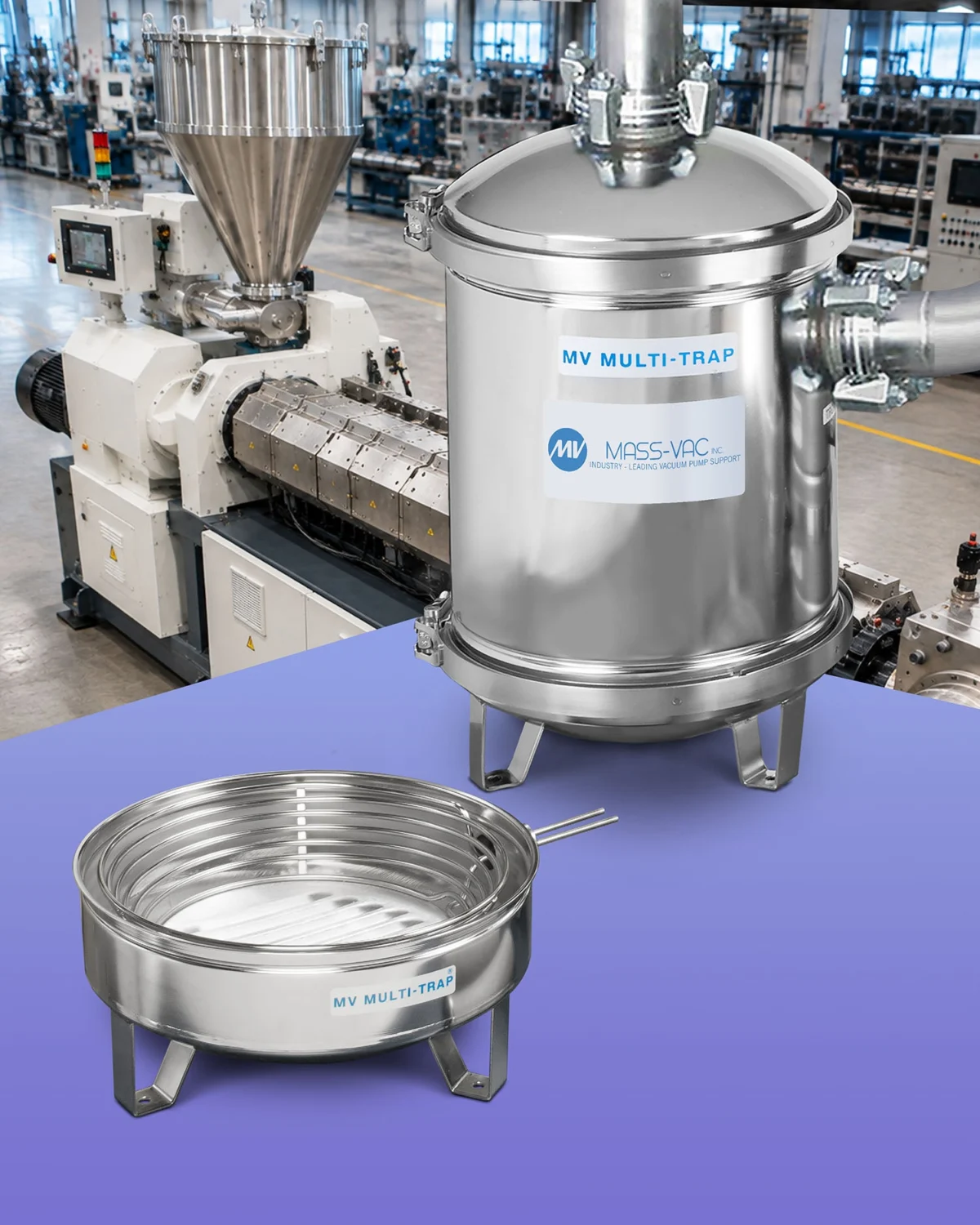
In the high-stakes realm of industrial manufacturing, maintaining equipment reliability is a constant battle against aggressive chemical byproducts, volatile organic compounds, and particulate contamination. Addressing a critical vulnerability in polymer processing, Mass-Vac, Inc.—a recognized leader in vacuum technology based in North Billerica, Massachusetts—has officially introduced the MV Multi-Trap Vacuum Inlet Trap.
Engineered specifically for heavy-duty plastic extrusion and composite manufacturing processes, this high-capacity vacuum inlet trap is designed to intercept and remove volatile liquids and solids before they can reach and compromise downstream vacuum pumps. The system relies on a rugged, all-304 stainless-steel construction housing a sophisticated multi-stage filtration architecture. This setup includes a full first-stage knockdown baffle, a second stage composed of high-efficiency stainless-steel gauze filters, and an optional bottom cooling mechanism.
Field-proven to extend vacuum pump operational lifespans by upwards of 12 years, the MV Multi-Trap caters to large-scale industrial setups. It is manufactured in robust 10-, 12-, and 16-inch diameter models capable of handling pump capacities exceeding 2,000 cubic feet per minute ($textft^3/textmin$). Furthermore, the units feature flexible port sizes ranging from 1.5 inches to 6.0 inches, alongside customizable options such as integrated drainage ports, allowing the hardware to be tailored precisely to the user-selectable filtration needs of individual plant operators.
Chronology: The Evolution of Vacuum Protection in Extrusion
To fully appreciate the significance of the MV Multi-Trap’s release, it is essential to examine the historical trajectory of contamination management within the polymer extrusion and vacuum engineering sectors.
Early Days of Extrusion and Pump Vulnerability
During the mid-to-late 20th century, the expansion of the plastic extrusion industry created unprecedented demands for vacuum degassing systems. As molten polymers are shaped under extreme heat and pressure, they routinely release trapped air, moisture, and low-molecular-weight oligomers, plasticizers, and unreacted monomers.
In the early decades of large-scale extrusion, these volatile byproducts were frequently allowed to pass directly into rotary vane and liquid ring vacuum pumps. The consequences were predictable and costly: volatile liquids condensed inside the pump housing, contaminating the sealing fluids, while sticky solids coated internal valves and vanes. This led to catastrophic pump seizures, severe loss of vacuum efficiency, and frequent, unscheduled production line stoppages.
The Shift Toward Inlet Filtration
By the 1990s and early 2000s, engineers recognized that downstream maintenance alone was insufficient. The industry witnessed a gradual pivot toward proactive protection through specialized vacuum inlet traps. Early iterations of traps utilized basic mesh screens or single-stage baffles. While these rudimentary devices caught large debris, they frequently failed when confronted with the complex, sticky, and corrosive chemical cocktails generated by modern engineering plastics and composite resins.
The Modern Era of Multi-Stage Engineering
Over the past decade, advancements in metallurgy, computational fluid dynamics (CFD), and modular industrial design have enabled manufacturers to engineer far more resilient solutions. The evolution culminated in the September 2026 unveiling by Mass-Vac. By combining a heavy-duty knockdown baffle with high-surface-area gauze filtration and active thermal management (bottom cooling), the MV Multi-Trap represents the current state-of-the-art in industrial vapor and particulate capture, bridging the gap between heavy chemical processing demands and delicate vacuum hardware preservation.
Supporting Data and Technical Specifications
The operational efficacy of the MV Multi-Trap is rooted in its rigorous engineering metrics and flexible configuration parameters. Below is a comprehensive breakdown of the system’s specifications, operational thresholds, and technical capacities:

| Technical Feature | Specification Details |
|---|---|
| Manufacturer | Mass-Vac, Inc. (North Billerica, MA) |
| Primary Application | Plastic extrusion, composite manufacturing, degassing systems |
| Construction Material | 100% 304 Stainless Steel (shell, baffles, and internal components) |
| Filtration Architecture | Stage 1: Full knockdown baffle; Stage 2: Stainless-steel gauze filters |
| Thermal Management | Optional bottom cooling mechanism for enhanced condensation |
| Unit Diameters Available | 10 inches, 12 inches, and 16 inches |
| Pump Capacity Range | Designed for systems exceeding 2,000 $textft^3/textmin$ |
| Port Size Range | 1.5 inches to 6.0 inches |
| Customization Options | Integrated drainage ports, user-selectable filtration media |
| Field-Proven Longevity | Extends vacuum pump operational life by over 12 years |
Fluid Dynamics and Filtration Mechanics
The internal architecture of the MV Multi-Trap is optimized to maximize particle capture without inducing unacceptable pressure drops across the vacuum line.
- The Knockdown Baffle: As the incoming stream of gas and volatile byproducts enters the trap, it immediately encounters the full first-stage knockdown baffle. This physical barrier forces a sudden change in flow direction and velocity, causing heavy liquid droplets and large solid particulates to drop out of the gas stream via gravity and inertia.
- The Gauze Filters: Remaining sub-micron aerosols and fine particulates are subsequently driven through the second-stage stainless-steel gauze filters. The immense surface area of the gauze promotes efficient impingement and coalescence of vapors.
- Thermal Control: The optional bottom cooling feature lowers the internal temperature at the base of the trap, ensuring that condensable volatile organic compounds (VOCs) solidify or liquefy safely within the collection zone rather than migrating toward the pump intake.
Official Responses and Industry Insights
While Mass-Vac’s official product release highlights the mechanical robustness of the 304 stainless-steel body and its 12-year pump-saving track record, industry analysts and chemical processing engineers have been quick to weigh in on the broader operational impacts of this technology.
"In high-volume polymer processing, downtime is measured not just in lost hours, but in tens of thousands of dollars per incident," notes a senior industrial chemical engineer specializing in extrusion lines. "When volatile plasticizers coat the internals of a high-capacity vacuum pump, you are looking at complete teardowns, costly rebuilds, or outright pump replacement. An inlet trap that reliably strips out these aggressors before they enter the pumping chamber changes the financial calculus of plant maintenance entirely."
Furthermore, representatives from Mass-Vac emphasized that the modular nature of the 10-, 12-, and 16-inch models—coupled with adaptable port configurations from 1.5 to 6.0 inches—ensures that facility managers do not have to compromise on flow conductance. By tailoring the internal user-selectable filtration capabilities to match specific polymer formulations (such as PVC, PET, or specialized aerospace composites), operators can maintain optimal pumping speeds while achieving near-total capture efficiency of destructive byproducts.
Implications for the Plastics and Composites Industry
The commercial availability of the MV Multi-Trap carries profound implications for multiple sectors within manufacturing, environmental compliance, and long-term capital expenditure management.
1. Capital Preservation and Pump Longevity
Vacuum pumps represent a substantial capital investment in any extrusion or composite manufacturing facility. By extending the operational lifecycle of these pumps by over 12 years, facilities can drastically reduce capital expenditure (CapEx) allocated toward equipment replacement. Furthermore, maintenance teams can shift their focus from reactive, emergency pump repairs to predictable, scheduled preventive maintenance.
2. Enhanced Process Reliability and Product Quality
Inconsistent vacuum levels during plastic extrusion often manifest as structural defects in the final product—such as internal voids, bubbles, surface blistering, or inconsistent density in foamed and extruded profiles. By maintaining stable, uninterrupted vacuum performance, the MV Multi-Trap indirectly safeguards final product quality, reducing scrap rates and ensuring strict adherence to industrial and regulatory standards.
3. Environmental Safety and Operator Protection
Volatile organic compounds and hazardous plasticizer byproducts generated during high-temperature extrusion pose occupational health risks and environmental compliance challenges. The trap’s ability to efficiently condense and contain these materials within a sealed stainless-steel vessel—combined with accessible drain options—prevents harmful vapors from exhausting into the workspace or escaping unchecked into the plant’s broader exhaust infrastructure.
Conclusion
As polymer manufacturing processes grow increasingly complex and demand higher throughputs, the hardware protecting vital plant machinery must evolve in lockstep. Mass-Vac’s MV Multi-Trap Vacuum Inlet Trap exemplifies this necessary evolution, offering a robust, field-tested, and highly adaptable defense mechanism that secures industrial vacuum infrastructure against the relentless onslaught of extrusion byproducts.
For further technical details, custom engineering inquiries, or to review product documentation, visit the official manufacturer website at www.massvac.com.