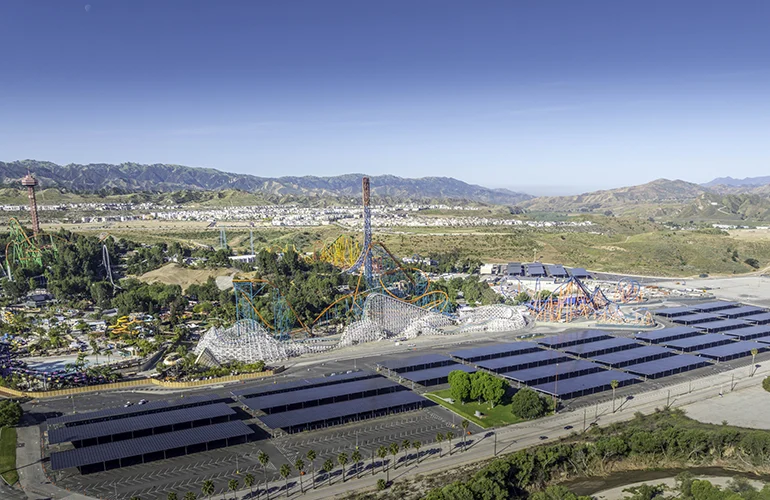
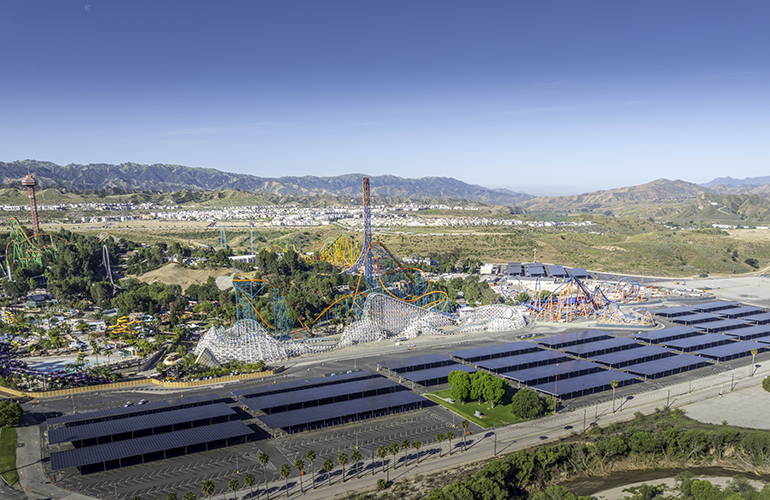
LOS ANGELES COUNTY, California — In a landmark development that redefines the intersection of high-octane thrills and environmental stewardship, Six Flags Magic Mountain has officially energized its massive 12.37-megawatt (MW) photovoltaic (PV) solar project. Developed in close collaboration with premier solar engineering firm Solar Optimum, the sprawling installation brings an entirely new, literal meaning to the industry-coined term "solarcoaster."
Spanning the vast expanse of the park’s primary guest and employee parking infrastructure, the newly operational system stands as the largest solar carport installation in the state of California. Furthermore, it proudly claims its place among the largest single-site commercial solar carport projects in the entire United States. Designed with ambitious environmental targets in mind, the installation is engineered to completely offset 100% of the annual electricity consumption for both Six Flags Magic Mountain and the adjacent Six Flags Hurricane Harbor Los Angeles water park.
The unveiling of this monumental clean energy initiative coincides deliberately with the nationwide launch of National Energy Awareness Month, observed annually throughout October to promote energy efficiency, resource conservation, and the accelerated adoption of cleaner energy technologies. By flipping the switch on this multi-million-dollar project, Six Flags Entertainment Corporation is not only dramatically reducing its corporate carbon footprint but is also establishing a towering new benchmark for sustainable infrastructure deployment within the global attractions and entertainment industry.
Main Facts
At its core, the newly energized Six Flags Magic Mountain renewable energy project is a marvel of modern commercial engineering, blending massive scale with cutting-edge energy storage and smart-grid integration.
The project’s physical footprint is immense, encompassing approximately 637,000 square feet of previously unused parking lot space. This vast expanse has been retrofitted with 36 heavy-duty, long-span solar carports that cleverly double as protective, shaded canopies for roughly 4,315 guest and employee parking spaces. Beneath and atop this network of steel and silicon lies a robust array of advanced clean-energy hardware.
The system comprises 22,908 high-efficiency RECOM 540-watt solar modules, capturing Southern California’s abundant sunlight to generate clean electricity. To ensure that this power generation is both reliable and resilient, the installation incorporates a state-of-the-art 2-megawatt / 8-megawatt-hour (MW/MWh) battery energy storage system (BESS). This massive battery bank allows the park to store excess energy generated during peak sunlight hours and deploy it during periods of high demand or grid instability.
Recognizing the accelerating shift toward personal electric mobility, the project also integrates 109 dedicated electric vehicle (EV) charging stations, directly supporting the green transit goals of park visitors and staff.
To put the system’s colossal output into perspective, park analysts estimate that the solar installation will produce roughly 1.5 kilowatt-hours (kWh) of clean solar power for every single ride operated across both the theme park and the water park annually.
Rather than operating as an isolated, off-grid microgrid, the entire facility is seamlessly interconnected with the local utility provider, Southern California Edison (SCE). The system is intelligently designed to offset the cumulative annual electricity consumption of the dual-park property. During periods of peak demand or when onsite generation and battery reserves are temporarily insufficient—such as during overcast days or heavy nighttime operations—the parks can draw supplementary electricity from the SCE grid, ensuring uninterrupted operations for roller coasters, water slides, and guest facilities alike.
Chronology
The realization of California’s largest commercial solar carport was no overnight achievement; it represents the culmination of years of rigorous planning, structural engineering, logistical coordination, and phased construction.
- Initial Conception and Feasibility Studies (2021–2022): Leadership at Six Flags Magic Mountain, in alignment with corporate sustainability mandates, began evaluating the feasibility of maximizing their vast parking acreage for renewable energy generation. Initial site assessments, environmental reviews, and grid-interconnection studies were initiated in partnership with solar industry experts.
- Partnership and Design Phase (2023): Six Flags officially partnered with Solar Optimum to design a bespoke engineering solution capable of spanning wide parking lanes without obstructing traffic flow or parking capacity. The engineering team finalized plans utilizing long-span steel carports to support tens of thousands of high-output photovoltaic panels while simultaneously providing much-needed shade for visitors’ vehicles.
- Permitting and Groundbreaking (Late 2023–Early 2024): Following the successful acquisition of necessary local permits and finalization of interconnection agreements with Southern California Edison, construction crews broke ground. The project required massive civil engineering work, including deep foundation drilling, structural steel erection, and the careful laying of miles of electrical conduit.
- Component Installation and BESS Integration (Mid 2024–Early 2025): The massive task of mounting 22,908 RECOM 540-W solar modules took place across the 637,000-square-foot parking footprint. Concurrently, technical teams installed the 2-MW/8-MWh battery energy storage system and the 109 EV chargers, creating a comprehensive energy hub.
- Grid Interconnection and Commissioning (Late 2025–October 2025): Rigorous safety inspections, system testing, and final synchronization with the Southern California Edison grid were successfully completed.
- Official Energization and Public Launch (October 2025): Aligning with the beginning of National Energy Awareness Month, Six Flags Magic Mountain officially energized the system, bringing the transformative "solarcoaster" project fully online.
Supporting Data
The scale of the Six Flags Magic Mountain solar project is best understood through the quantitative metrics that define its infrastructure, capacity, and environmental impact:
| Metric Category | Project Specification |
|---|---|
| Total System Capacity | 12.37 Megawatts (MW) |
| Physical Footprint | Approximately 637,000 square feet |
| Parking Spaces Covered | ~4,315 spaces |
| Solar Canopy Structures | 36 long-span carports |
| Photovoltaic Modules | 22,908 units (RECOM 540-W modules) |
| Battery Storage Capacity | 2 MW / 8 Megawatt-hours (MWh) |
| Electric Vehicle Chargers | 109 dedicated EV charging ports |
| Energy Offset Target | 100% of annual consumption for Magic Mountain & Hurricane Harbor |
| Power Generation Metric | ~1.5 kWh of solar power produced per ride across both parks |
| Utility Interconnection | Southern California Edison (SCE) grid-tied system |
These figures place the project in an elite tier of commercial renewable energy installations nationwide, proving that large-scale industrial and entertainment complexes can successfully transition to 100% renewable energy portfolios without compromising operational reliability.
Official Responses
Leadership from both Six Flags Entertainment Corporation and Solar Optimum expressed immense pride and forward-looking optimism regarding the successful completion and energization of the project.
Brian Oerding, Park President of Six Flags Magic Mountain, emphasized the transformative nature of the milestone within the park’s broader corporate history:
"This is a transformative moment for Six Flags Magic Mountain and our sustainability journey," said Oerding. "By investing in renewable energy, we’re taking meaningful action to reduce our environmental impact while helping build a more sustainable future for our guests, team members, and community. This project demonstrates what’s possible when organizations commit to innovation and responsible environmental stewardship."
Echoing these sentiments, Arno Aghamalian, Chief Executive Officer of Solar Optimum, highlighted the collaborative effort required to bring such an extraordinary engineering feat to life:
"We are proud to celebrate the energization of this extraordinary project with Six Flags," stated Aghamalian. "This system demonstrates how innovative renewable energy solutions can help organizations meet ambitious sustainability goals while delivering long-term environmental and economic benefits. Together, we’re creating a cleaner energy future for generations to come."
Both executives noted that the project serves as a blueprint for other major entertainment venues, theme parks, and large-footprint commercial enterprises seeking viable pathways toward aggressive decarbonization.
Implications
The activation of the 12.37-MW solar carport system at Six Flags Magic Mountain carries profound implications across multiple domains, ranging from corporate economics and guest experience to regional grid stability and industry-wide environmental standards.
Environmental and Climate Impact
By offsetting 100% of the annual electricity consumption for both Six Flags Magic Mountain and Hurricane Harbor Los Angeles, the project drastically slashes the enterprise’s indirect greenhouse gas emissions. In a region like Southern California—which frequently battles air quality challenges and high ambient temperatures—eliminating the burning of fossil fuels to power major commercial operations yields immediate, measurable improvements in local air shed quality and contributes meaningfully to state-level carbon neutrality mandates.
Enhanced Guest Experience
Beyond the intangible benefits of carbon reduction, the project delivers tangible, day-to-day improvements for park visitors. The 36 long-span solar carports cover thousands of vehicles, providing deep, consistent shade across vast parking lots. In the scorching Southern California sun, keeping cars significantly cooler while parked directly enhances the visitor experience from the moment guests arrive. Furthermore, the inclusion of 109 EV chargers accommodates the surging population of electric vehicle owners, encouraging sustainable transit choices among park patrons.
Economic Resilience and Energy Security
Commercial electricity rates in California are among the highest in the nation, presenting a substantial operational overhead for energy-intensive businesses like theme parks, which run massive electric motors, lighting arrays, water pumps, and refrigeration units continuously. By generating their own power on-site and storing excess energy in the 8-MWh BESS, Six Flags insulates itself against future utility rate hikes and grid volatility. The stored battery energy also provides a crucial buffer against potential rolling blackouts or grid strain during peak summer heatwaves, ensuring that rides and park facilities remain fully operational.
A New Benchmark for the Attractions Industry
Historically, theme parks have been viewed as heavy energy consumers due to the sheer mechanical power required to launch roller coasters, chill water parks, and illuminate sprawling entertainment complexes. With this project, Six Flags Magic Mountain has shattered that paradigm. By proving that a major amusement resort can achieve complete energy self-sufficiency via on-site solar deployment, the park has established a new gold standard.
As regulatory pressures mount and consumers increasingly favor environmentally conscious brands, the "solarcoaster" project at Six Flags Magic Mountain serves as an inspiring proof-of-concept. It signals to the global entertainment industry that ecological responsibility and high-capacity commercial operations are not mutually exclusive—rather, when paired with visionary engineering, they represent the ultimate ride into the future.