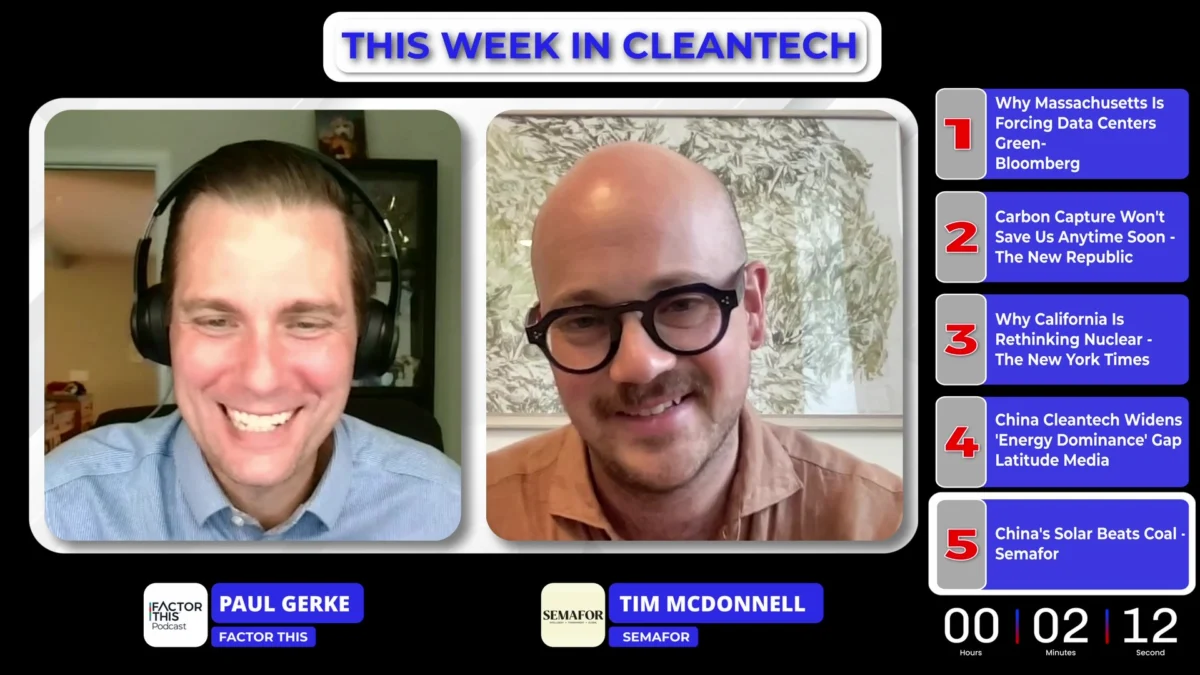
Welcome to This Week in Cleantech, your premier weekly podcast breakdown covering the most impactful, fast-moving stories in clean energy, climate policy, and technological innovation. Hosted by Paul Gerke of Factor This and Mike Casey of Tigercomm, the show dives deep into the forces reshaping our global energy economy.
This week’s episode features a powerhouse lineup of insights, headlined by special guest Tim McDonnell of Semafor, who breaks down a historic milestone: solar energy officially overtaking coal as China’s leading power source for the first time in history. Meanwhile, our "Cleantecher of the Week" honors Kofi Asante, founder and CEO of Bluecore Energy. Fresh off a stealth launch, Asante’s startup just secured an oversubscribed $50 million seed round to build mobile, barge-mounted small modular nuclear reactors designed to deliver emissions-free power directly to ports and coastal infrastructure.
Beyond the podcast studio, the clean energy landscape is shifting rapidly. From aggressive new state mandates on AI and data center power consumption to sobering warnings about engineered carbon removal and a surprising nuclear revival in California, here is your comprehensive, data-driven look at the top cleantech stories of the week.
1. Main Facts: The Pivotal Shifts Reshaping Global Energy
The global energy transition is no longer a theoretical projection; it is a chaotic, accelerating reality defined by unprecedented milestones and defensive regulatory guardrails.
- China’s Historic Solar Milestone: Following an unprecedented, decade-long infrastructure buildout, solar energy has officially surpassed coal as China’s largest installed power source. Accounting for nearly one-third of the nation’s total generation capacity, renewables are now single-handedly absorbing surging power demands driven by artificial intelligence and heavy industry.
- Massachusetts’ Data Center Mandate: Anticipating a massive wave of energy-hungry artificial intelligence and cloud-computing infrastructure, Massachusetts Governor Maura Healey signed a sweeping executive order. The mandate forces new data centers with peak demands exceeding 25 megawatts to directly procure clean energy and clear strict local zoning hurdles before filing for state construction permits.
- California’s Nuclear Reversal: In a dramatic about-face for a state that spent half a century shunning atomic energy, California is actively working to extend the operational lifespan of the Diablo Canyon nuclear plant while weighing the repeal of its 50-year-old moratorium on new nuclear reactor development.
- The Carbon Capture Reality Check: A stark new report from the United Nations Environment Programme (UNEP) has thrown cold water on tech-optimistic climate strategies, revealing that engineered carbon capture and storage (CCS) accounts for a negligible fraction of global carbon removal—leaving traditional ecosystem management to carry the heavy load.
2. Chronology: How the Week’s Events Unfolded
To understand how these disparate global events connect, it helps to trace the timeline of policy announcements, economic reports, and industrial breakthroughs that dominated the news cycle:
- Early Week (Semafor & Ember Reports): Energy think tank Ember released comprehensive tracking data revealing that China’s clean technology exports reached $140 billion in the first half of the year—accounting for 6.6% of the nation’s total exports. Simultaneously, data confirmed that solar power had officially clinched the top spot over coal in China’s capacity matrix.
- Tuesday, September 8 (Massachusetts Policy Action): Governor Maura Healey enacted executive action in Massachusetts. By targeting data centers exceeding 25 megawatts, the state positioned itself ahead of the tech-infrastructure boom, establishing financial penalties and renewable procurement prerequisites for developers.
- Wednesday, September 9 (California Legislative Pivot): The New York Times highlighted California’s shifting stance on nuclear energy. Following a legislative bill passed the previous month to study lifting the state’s nuclear ban—backed by federal Department of Energy funding—momentum behind Diablo Canyon’s life extension solidified.
- Mid-Week (UNEP & New Republic Warnings): Climate analysts reviewed the latest UNEP findings, noting that the globe is on a dangerous trajectory to breach the 1.5-degree Celsius warming threshold within years unless atmospheric carbon removal scales by orders of magnitude—a feat current industrial infrastructure is nowhere near achieving.
3. Supporting Data: The Numbers Behind the Transition
Data remains the ultimate arbiter of the energy transition. The metrics released this week highlight both staggering clean energy growth and daunting technological deficits:
- $140 Billion: The value of China’s clean energy technology exports in just the first half of the year, representing 6.6% of the country’s total exports—up drastically from 2.7% in 2020.
- 25 Megawatts: The peak electricity demand threshold in Massachusetts that triggers Governor Healey’s new clean energy procurement and mitigation fund mandates for data centers.
- 15 to 24 Gigatonnes: The annual amount of carbon dioxide the world must capture by the year 2100 to successfully pull global temperatures back down to 1.5 degrees Celsius after an inevitable temperature overshoot.
- 2.2 Gigatonnes: The current total global carbon removal capacity. Alarmingly, 99.95% of this volume relies on conventional biological methods (like afforestation and forest management), leaving engineered carbon capture to do less than 0.05% of the heavy lifting.
- 8% and $1.1 Billion: Diablo Canyon’s reactors accounted for over 8% of California’s total electricity generation last year. To support its continued operation, the federal government has already committed $271 million, with up to $1.1 billion more available through the Department of Energy.
- 10.4 Trillion Kilowatt-Hours: China’s record-shattering total power consumption over the past year. Crucially, 100% of the country’s 5% year-over-year demand growth was met entirely by clean energy sources, causing coal generation to plateau or decline across 17 of the 26 monitored regional jurisdictions.
4. Official Responses and Industry Stakeholders
The tension between rapid technological scaling and regulatory oversight drew sharp commentary from political leaders, industry executives, and environmental analysts this week:
- Governor Maura Healey (Massachusetts): Defending her administration’s preemptive guardrails on data centers, Healey noted that while Massachusetts has thus far avoided the massive, unmanaged data center buildouts seen in other tech-heavy states, proactive policy is essential to protect residential ratepayers from surging grid costs and grid reliability shocks.
- Tim McDonnell (Semafor / This Week in Cleantech Guest): Speaking on the podcast, McDonnell emphasized that China’s historic pivot from coal to solar is not merely an environmental win, but a calculated geopolitical strategy. By aggressively electrifying its economy with domestic renewables, Beijing is insulating itself from volatile fossil fuel markets—a strategy validated by ongoing disruptions in Middle Eastern oil supply lines.
- Kofi Asante (Founder & CEO, Bluecore Energy): Highlighted as "Cleantecher of the Week" after closing an oversubscribed $50 million seed round just two months out of stealth, Asante is pioneering mobile, barge-mounted small modular nuclear reactors. By bringing clean, firm power directly to ports and maritime infrastructure without the immense permitting timelines of fixed land-based sites, Asante’s venture represents a radical reimagining of nuclear logistics.
5. Implications: What This Means for the Future of Cleantech
The convergence of these weekly developments points to several profound macroeconomic and geopolitical implications for the clean energy sector:
The AI-Energy Collision Forces State-Level Interventions
As artificial intelligence, cloud computing, and advanced manufacturing drive electricity demand to unprecedented heights, local and state governments can no longer afford a laissez-faire approach to grid planning. Massachusetts’ executive order serves as a blueprint for other states looking to balance the economic allure of tech hubs against the grid-destabilizing realities of power-hungry data centers. Developers can no longer expect unfettered access to fossil-heavy grids without paying a steep price or building their own clean generation.
China’s Export Dominance Reshapes Global Trade
With cleantech exports soaring to $140 billion and domestic solar capacity eclipsing coal, China is cementing its status as the undisputed architect of the 21st-century energy economy. Western nations face a difficult balancing act: they must accelerate their own domestic clean energy manufacturing to avoid strategic dependency, yet refusing Chinese solar panels, wind turbines, and batteries risks delaying their own near-term climate targets.
The Hard Realities of Carbon Removal
The UNEP report serves as a much-needed reality check for corporate net-zero pledges. Relying on speculative, multi-gigatonne engineered carbon capture facilities to offset continued fossil fuel combustion is a dangerous gamble. Because 99.95% of current removal relies on nature-based solutions, policymakers must aggressively decouple emissions reduction from carbon offsets while scaling funding for genuine technological breakthroughs—such as Bluecore Energy’s mobile nuclear barges and advanced geothermal systems.
The Nuclear Renaissance Finds Its Footing
The stigma surrounding nuclear energy is steadily evaporating under the immense pressure of decarbonization deadlines and round-the-clock power requirements for data centers. From California rethinking Diablo Canyon and its historical atomic moratorium to venture-backed startups commercializing barge-mounted reactors, nuclear energy is shedding its image as an obsolete hazard and reclaiming its role as a vital, emissions-free pillar of the future clean energy grid.
Tune in to This Week in Cleantech every week on your favorite podcast platform to catch full interviews with leaders like Tim McDonnell and deeper breakdowns of the policies and technologies driving the global energy transition.