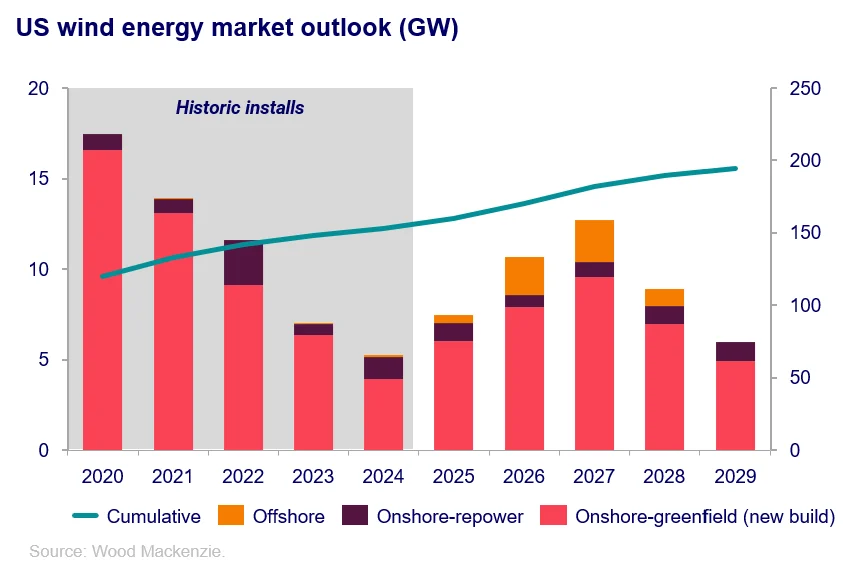
The United States wind energy sector is bracing for a pivotal year in 2025, with industry forecasts signaling a robust 36% increase in new installations compared to the previous year. According to the latest "U.S. Wind Energy Monitor" report, published jointly by Wood Mackenzie and the American Clean Power Association (ACP), the nation is on track to commission over 7 gigawatts (GW) of new wind capacity in the coming year.
While the five-year cumulative outlook for the sector remains steady, the industry is navigating a paradoxical environment: record-breaking demand for clean power is clashing with persistent inflationary pressures, supply chain complexities, and shifting regulatory landscapes.
Main Facts: A Sector in Transition
The latest data indicates that the U.S. wind industry is shifting gears. While 2024 saw a measured pace of development, the 2025-2029 window is projected to see a total of 46 GW of new capacity added to the grid. This growth is not linear; rather, it is concentrated in the mid-to-late decade, with 2026 and 2027 expected to be banner years for project commissioning, delivering 10.7 GW and 12.7 GW, respectively.
This surge is largely driven by the urgent need to address a dramatic shift in the U.S. power market. After a decade of largely stagnant demand, the grid is now under immense pressure. Utilities have committed to 160 GW of large-load additions—a phenomenon driven almost exclusively by the explosive growth of energy-intensive data centers and the broader electrification of the economy. Projections show that power demand growth through 2029 will average approximately 3% annually, a stark contrast to the 0.7% growth observed over the previous decade. Data centers alone are expected to account for 59 GW of the 90 GW total peak demand growth expected by 2029.
Chronology of Development: From 2025 to 2029
The timeline for U.S. wind energy development is currently defined by a "back-loaded" installation pattern. This was evident in the third quarter of 2025, where installations came in at 932 megawatts (MW)—approximately 23% below initial forecasts. However, industry analysts remain undeterred by this quarterly dip.
The 2025 Closing Surge
The market is currently pivoting toward a strong finish, with 3.8 GW of capacity queued for completion in Q4 2025. This volume represents 52% of the year’s total expected capacity, confirming that project-commissioning timelines remain consistent with typical industry cycles where the final quarter serves as the primary window for bringing major assets online.
The Peak Years (2026–2027)
The outlook for 2026 and 2027 remains exceptionally strong. These years are characterized by a fully committed pipeline, with all planned projects already having secured turbine orders. This stability provides a clear runway for the industry to scale operations. Significant projects, such as Pattern Energy’s 3.5-GW SunZia project in New Mexico, are set to dominate this period, establishing the developer as the leading installer for 2026. Similarly, the 998-MW Towner Energy Center in Colorado, scheduled for 2027, highlights the scale of individual projects currently moving through the development cycle.
The Late-Decade Outlook (2028–2029)
The long-term horizon is marked by a noticeable cooling. Projections for 2029 have weakened quarter-over-quarter. This decline is attributed to a combination of project cancellations and the reclassification of late-decade capacity as "inactive." These setbacks are primarily driven by persistent challenges in the permitting process and a broader inability to navigate the complex regulatory hurdles required for long-term development.
Supporting Data: Economic Fundamentals and Turbine Dynamics
Despite the regulatory challenges, the economic business case for wind energy remains formidable. The Levelized Cost of Energy (LCOE) for wind remains highly competitive, making it a primary candidate for utilities looking to meet rising baseload demand.

Turbine Order Intake
The market for turbine orders has shown signs of a significant rebound, returning to levels seen prior to the implementation of the "One Big Beautiful Bill Act" (OBBBA). In Q3 2025, the industry saw 2 GW of firm commitments—the highest intake in nine months and a 79% increase quarter-over-quarter. However, transparency in this segment is waning. Original Equipment Manufacturers (OEMs) are increasingly withholding granular project details, and a significant portion of "start-of-construction" activity is now taking place off-site through component manufacturing, making it difficult for analysts to gain true visibility into the immediate future.
Geographical Expansion
The geography of wind energy is also evolving. While the Western states (notably Wyoming and New Mexico) continue to lead, accounting for 34% of activity, the market is diversifying. A prime example of this maturation is Arkansas, which recently brought its first utility-scale onshore wind project—Cordelio’s Crossover Wind—online. This indicates that the appetite for wind power is expanding beyond traditional hubs.
Official Responses: Navigating the Policy Maze
Leila Garcia da Fonseca, director of research at Wood Mackenzie, notes that while the fundamentals are strong, the industry remains in a delicate state of flux.
"The U.S. power market is facing mounting strain… this represents a significant opportunity for wind energy, which benefits from strengthened economic fundamentals and a compelling business case driven by its competitively low LCOE," Garcia da Fonseca stated. However, she warned that optimism must be tempered by reality. "Turbine costs remain elevated due to tariffs, and mid-term wind growth will depend heavily on our ability to resolve permitting and policy uncertainty."
The issue of tariffs is a recurring theme. The report highlights that conflicting market and regulatory forces have created "unprecedented uncertainty" in pricing. While domestic manufacturing overcapacity would theoretically drive down costs by 2028, the reality is that onshore wind capital expenditure (CAPEX) is projected to increase by 5% through 2029, largely due to the tariff exposure on essential raw material inputs and subcomponents.
Implications: Offshore and The Road Ahead
The offshore wind sector presents a study in contrasts. While the onshore market is characterized by steady growth and massive project pipelines, offshore momentum is described as "diverging."
The Offshore Challenge
Offshore projects currently under construction, such as Vineyard Wind—which successfully connected 15 turbines in Q3 and delivered 200 GWh in nine months—are hitting their milestones. However, the path for post-2027 developments is fraught with risk. The primary bottleneck is the availability of specialized wind turbine installation vessels (WTIVs). This constraint is already leading to project delays and, in some cases, outright contract terminations. Furthermore, the industry faces seasonal vulnerabilities, with harsh winter conditions in Q4 2025 expected to slow installation paces significantly.
Strategic Considerations
The path forward for the U.S. wind industry hinges on three critical pillars:
- Permitting Reform: The weakening outlook for 2029 demonstrates that without meaningful streamlining of the permitting process, the U.S. will struggle to meet the long-term energy demands of its growing tech and manufacturing sectors.
- Supply Chain Resiliency: While onshore CAPEX is rising, the industry must find ways to localize supply chains to mitigate the impact of international trade tariffs.
- Grid Integration: With data centers driving a massive surge in peak demand, the integration of wind energy must be coupled with investments in grid infrastructure to ensure that this renewable energy can be delivered efficiently to the load centers where it is needed most.
Ultimately, the U.S. wind sector is entering a period of high-stakes expansion. The demand is undeniable, the technology is proven, and the economic rationale is clear. However, the success of this 46 GW build-out will depend on the industry’s ability to navigate the "cost-tariff-policy" triangle, ensuring that the wind energy transition remains both affordable and reliable for the American consumer.