By Industry News Service
Published: August 2026
Main Facts: A Unified Approach to Critical Infrastructure
As artificial intelligence (AI) workloads continue to reshape the digital landscape, the physical infrastructure supporting them faces unprecedented pressure. In response, global technology and engineering leader Emerson has officially launched the DeltaV Automation Platform for Data Centers. This comprehensive, scalable automation portfolio is specifically designed to monitor, manage, and optimize the complex thermal, mechanical, and electrical subsystems that keep modern AI data centers running.
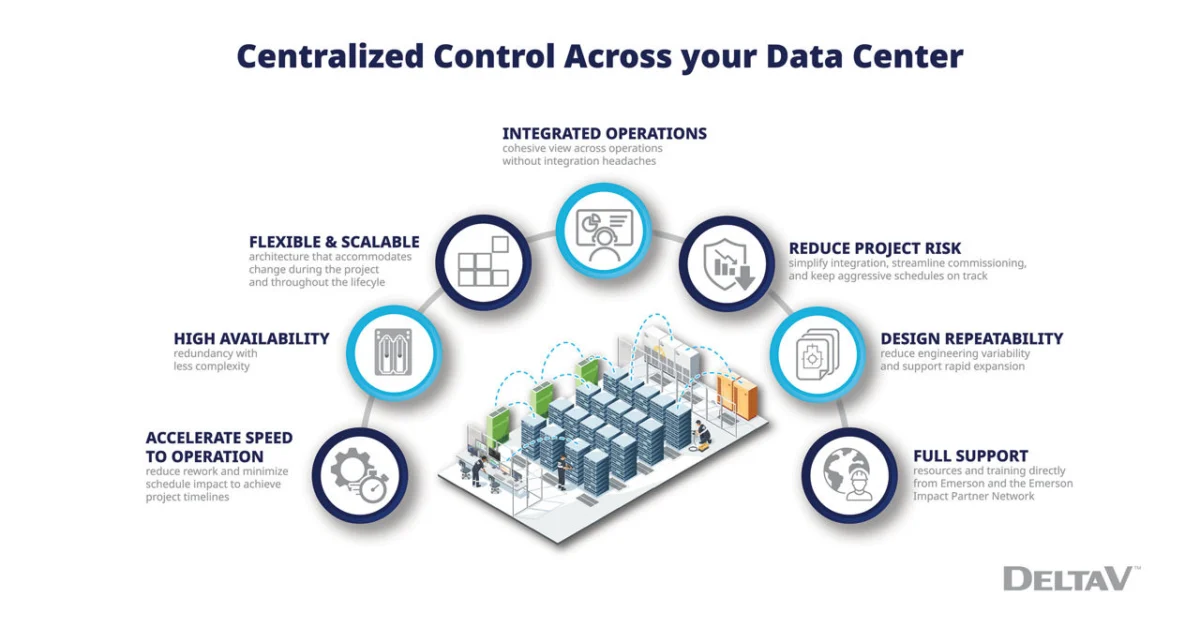
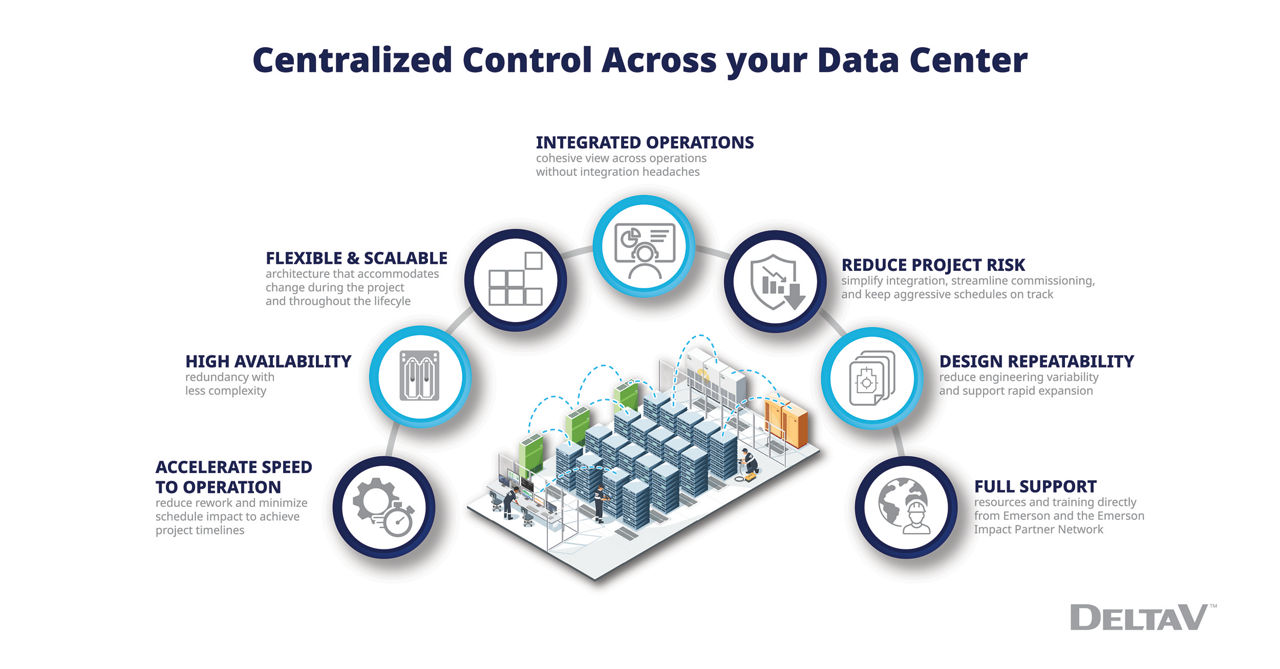
By bridging the gap between disparate facility systems, the DeltaV platform delivers a centralized, unified control architecture. Rather than relying on fragmented point solutions—where cooling, power distribution, and server management operate in silos—Emerson’s system integrates these critical pathways into a single ecosystem.
The core elements of the announcement include:
- Holistic Subsystem Integration: Seamlessly connects electrical grids, backup generators, chillers, computer room air handlers (CRAHs), and building management systems.
- AI-Ready Control Architecture: Combines Emerson’s industry-proven DeltaV distributed control system (DCS) with advanced DeltaV programmable logic controllers (PLCs).
- Embedded Artificial Intelligence: Features context-specific AI tools embedded directly into the control workflows to streamline engineering, optimize process control, and interface smoothly with external AI optimization models.
- Streamlined Project Lifecycle: Designed to accelerate deployment timelines from initial engineering and design through commissioning, ongoing operations, and eventual facility maintenance.
Chronology: The Evolution Toward AI-Centric Automation
The rapid convergence of industrial automation and hyperscale computing did not happen overnight. To understand the significance of Emerson’s latest release, it is helpful to trace the timeline of challenges that led to the development of the DeltaV platform for data centers.
The Pre-AI Era: Traditional Facilities Management (Pre-2020)
For decades, data centers were primarily built to handle enterprise computing, cloud storage, and web hosting. While power density and thermal management were important, facilities generally operated on predictable load curves. Building automation systems (BAS) and basic supervisory control and data acquisition (SCADA) software were sufficient to monitor temperatures and manage standard HVAC units. Coordination between electrical and mechanical teams was sequential rather than concurrent.
The Generative AI Boom and the Density Crisis (2023–2024)
The widespread adoption of generative AI models and massive large language models (LLMs) changed the equation almost overnight. High-performance computing (HPC) clusters packed with specialized GPUs began drawing unprecedented amounts of power—often exceeding 40 to 100 kilowatts per rack. Traditional air cooling proved inadequate, forcing a rapid industry-wide pivot toward liquid cooling and high-capacity electrical switchgear. Facility engineers struggled to coordinate supply chains under compressed timelines, as legacy control systems lacked the integration needed to manage these hyper-dense environments safely.
The Shift Toward Modular and Unified Engineering (2025)
As data center developers faced severe bottlenecks in getting grid connections and specialized equipment, the industry recognized that software and automation had to be introduced much earlier in the design phase. Manual subsystem coordination resulted in costly delays during commissioning. Operators began demanding out-of-the-box automation architectures that could be pre-engineered, simulated, and deployed rapidly.
The Launch of Emerson’s DeltaV for Data Centers (2026)
Emerson formally enters the market with a dedicated solution tailored specifically for the unique demands of AI workloads. By adapting its flagship DeltaV DCS—traditionally trusted in mission-critical process industries like chemical plants, oil refineries, and pharmaceutical manufacturing—Emerson brings industrial-grade reliability to the digital infrastructure space.
Supporting Data: The Scale and Strain of Modern AI Workloads
To fully grasp why automation platforms like Emerson’s DeltaV are critical, industry analysts point to the staggering metrics defining the modern data center boom.
- Exponential Power Demands: Standard enterprise data centers historically operated at power densities of 5 to 10 kW per rack. Modern AI clusters routinely demand 30, 50, and even upwards of 100 kW per rack. This dramatic increase generates localized heat loads that require real-time, closed-loop thermal management.
- Compressed Construction Timelines: Historically, planning, designing, and commissioning a enterprise data center took 24 to 36 months. Today, hyperscalers and co-location providers are pressured to bring massive facilities online in 12 to 18 months to keep pace with soaring AI compute demand.
- The Cost of Downtime: In a mission-critical AI training facility, unplanned downtime is extraordinarily expensive. Millions of dollars in computational work can be lost if a multi-week model training run is interrupted by a power surge or a cooling failure.
- Engineering Labor Shortages: The engineering and construction sectors face a severe shortage of skilled personnel. Streamlining project execution through unified automation software helps engineering teams do more with fewer resources, reducing human error during complex system integrations.
Official Responses and Strategic Intent
Industry experts and corporate leaders emphasize that building an AI data center is no longer just a real estate or IT challenge—it is an advanced systems-engineering problem.
According to industrial automation strategists, the integration of DCS and PLC technologies into data center operations represents a maturation of the sector. Industrial facilities have relied on distributed control systems for decades because failure is not an option in a chemical refinery; bringing that same level of fault tolerance and deterministic control to digital infrastructure is a natural evolution.
Emerson’s product roadmap highlights that the inclusion of context-specific AI tools within the DeltaV platform is a deliberate strategy. Rather than treating AI solely as a workload housed inside the data center servers, Emerson is leveraging AI within the infrastructure management layer. This allows the facility to dynamically predict thermal spikes, adjust chilled water flow rates preemptively, and balance electrical loads across substations in micro-seconds before hardware throttling can occur.
Furthermore, by utilizing standard communication protocols and scalable architectures, the platform addresses the friction points that typically occur when general contractors, mechanical engineers, electrical subcontractors, and software integrators attempt to harmonize their respective deliverables on a fast-track job site.
Implications: What This Means for the Future of Digital Infrastructure
The introduction of unified automation platforms like Emerson’s DeltaV for Data Centers carries profound implications for the broader technology, energy, and industrial landscapes.
1. Bridging IT and OT (Information Technology & Operational Technology)
For years, the boundary between the data hall (IT) and the mechanical plant (OT) was distinct. IT managers worried about servers and software; facilities managers worried about chillers and generators. AI workloads have obliterated this boundary. Because high-density computing requires instantaneous adjustments to environmental conditions, IT and OT must operate as a single, cohesive organism. Emerson’s platform provides the underlying nervous system to achieve this convergence.
2. Energy Efficiency and Grid Stability
AI data centers are placing unprecedented strains on municipal and regional power grids. By utilizing advanced process control and AI-driven optimization models, automated data center infrastructure can dynamically shift energy consumption, participate in demand-response programs with local utilities, and maximize the efficiency of power usage effectiveness (PUE) metrics. Better monitoring means less wasted energy, which is crucial as sustainability mandates tighten globally.
3. Redefining Project Delivery and Risk Mitigation
As capital expenditures for hyperscale AI facilities reach astronomical figures, financial stakeholders demand risk mitigation. Unified control platforms reduce the risk of catastrophic commissioning failures—the dreaded phase where disparate systems are turned on together for the first time and fail to communicate. By simulating and integrating electrical, thermal, and control logic digitally from day one of the design phase, projects can achieve predictable, on-time delivery.
Conclusion
As the artificial intelligence revolution accelerates, the bottleneck for progress is no longer just silicon chip manufacturing or algorithm design—it is the physical ability to power, cool, and sustain hyperscale computing environments. Platforms such as Emerson’s DeltaV Automation Platform for Data Centers signal a vital shift toward industrial-grade maturity in digital infrastructure. By combining robust distributed control, programmable logic, and embedded AI optimization, the industry is better equipped than ever to meet the high-stakes demands of the next generation of computing.