The debate over the future of satellite-based mobile telephony has reached a fever pitch. On one side, Elon Musk, CEO of SpaceX, envisions a future where Starlink’s direct-to-cell capabilities transcend the limitations of terrestrial cellular networks, offering ubiquitous, high-bandwidth coverage that ignores geographical barriers. On the other, industry veterans like AT&T CEO John Stankey argue that the laws of physics and economics remain immutable; he contends that the small terrestrial radios required to support a satellite-linked mobile network will ultimately necessitate a capital expenditure footprint comparable to traditional cellular infrastructure.
At the heart of this conflict lies a fundamental question of network architecture: Can a satellite-based system scale effectively in high-density environments, or will it inevitably be forced to retreat to the ground? New analysis, spearheaded by telecommunications expert Vish Nandlall, suggests that the true constraint for Starlink Mobile is not the reach of its satellites, but the capacity per square kilometer.
The Mathematical Boundary: Why Density Dictates Connectivity
To evaluate the feasibility of Starlink Mobile, one must look at the network through the lens of a single square kilometer during the "busy hour"—the period of peak demand for mobile traffic. While satellites are unparalleled at broadcasting a signal across vast, sparsely populated landscapes, their ability to concentrate capacity into a crowded suburb or an urban center is physically constrained.
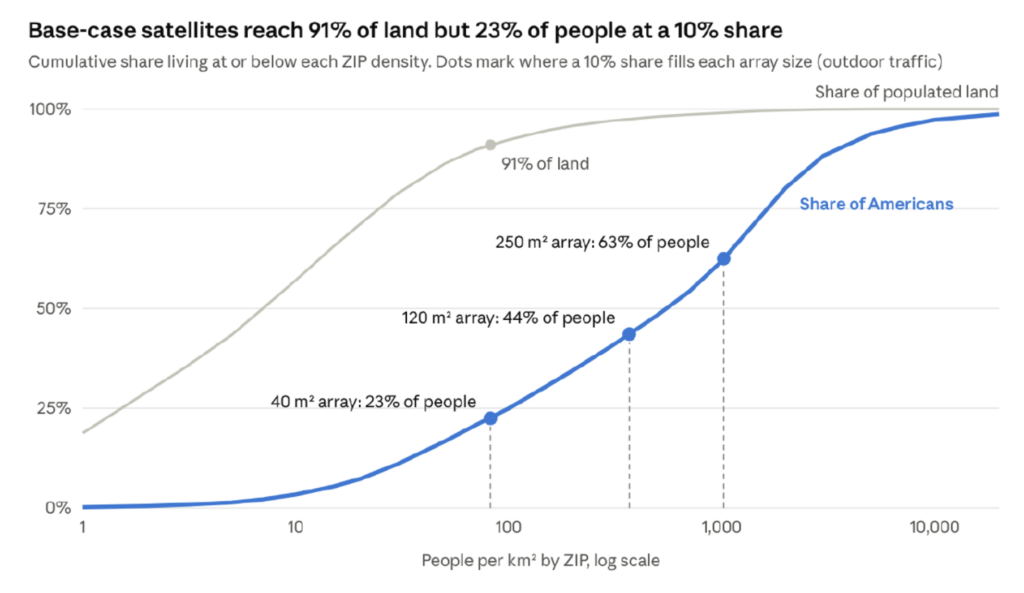
Nandlall’s model establishes a critical threshold: at a 10% mobile market share, a next-generation Starlink beam can accommodate outdoor busy-hour traffic only until the population density reaches approximately 82 people per square kilometer. This figure serves as a "boundary line" for the industry debate.
Using a 40-square-meter antenna array at an orbital altitude of 330 kilometers, with 25 MHz of downlink spectrum and a spectral efficiency of 1 bit per second per hertz, the resulting beam capacity is roughly 25 Mbps. When spread across a beam width of 9.3 kilometers, the capacity sits at approximately 0.33 Mbps per square kilometer. Accounting for the fact that roughly 40% of cellular traffic occurs outdoors—where a satellite link is viable—and calculating the average subscriber usage, the math dictates that the system can support roughly eight subscribers per square kilometer.
Chronology: From Experimental LEO to Direct-to-Cell
The trajectory of non-terrestrial networks (NTN) has been marked by ambition and failure.
- 2000s – 2010s: The Failed Predecessors: Early attempts to bridge satellite and terrestrial coverage, such as ICO (later DBSD) and TerreStar, sought to utilize the 2 GHz band. Both companies ultimately filed for Chapter 11 bankruptcy, unable to bridge the gap between their orbital assets and the terrestrial infrastructure required to make the service commercially viable for mass-market mobile users.
- 2012: The DISH Acquisition: DISH Network acquired the defunct assets of these satellite pioneers for $2.86 billion. While DISH eventually deployed a terrestrial network of 24,000 sites covering 75% of the U.S. population at a cost of $7.7 billion, it struggled to attract a significant subscriber base, eventually offloading its spectrum and assets to AT&T in 2025.
- 2024 – 2025: The SpaceX Pivot: Leveraging its massive constellation of low Earth orbit (LEO) satellites and the development of 3GPP-compliant hardware for mobile handsets, SpaceX moved to enter the mobile market. Unlike its predecessors, Starlink benefits from a vertically integrated launch system and an established global broadband business.
- 2026: The Density Conflict: Industry analysts have begun to question whether SpaceX’s current satellite-first strategy can survive the transition from rural "coverage" to urban "capacity."
Supporting Data: The 82-Person Threshold
The implications of the 82-person-per-square-kilometer threshold are profound. While 91% of populated U.S. land sits below this density level, only 23% of the U.S. population resides there.

Density and Infrastructure Requirements
The model demonstrates that as population density rises, the Starlink architecture must shift. To cover ZIP codes with 100 to 1,500 people per square kilometer, the system requires terrestrial nodes—effectively small cells—spaced at 150-meter intervals. Providing this coverage would necessitate approximately 8.1 million nodes, or one host for every eight households.
For context, current industry estimates suggest SpaceX has roughly 2.7 million Starlink subscribers, with over 85% located in rural environments. Transitioning to a suburban-capable network would require a 20-fold increase in the number of terrestrial hosts. Each of these hosts requires power and backhaul, creating a secondary capacity bottleneck. If Starlink uses its own satellite broadband to provide backhaul for these nodes, the congestion in sold-out areas would exacerbate.
The Role of Partnerships
This is why reports of SpaceX engaging in talks with cable operators like Charter Communications are significant. Cable providers possess existing powered locations and established fiber/coaxial backhaul. Utilizing this existing "strand-mounted" infrastructure for CBRS radios could bypass the logistical nightmare of deploying millions of consumer-hosted nodes, a strategy that previously proved difficult for entities like Helium.
Official Responses and Industry Skepticism
The industry remains divided. Musk maintains that the scalability of LEO constellations, combined with ever-increasing satellite antenna sizes, will eventually allow Starlink to offer better performance than traditional cellular networks. Proponents point to the "V2 Mobile" satellite generation as a game-changer.
Conversely, the "Stankey Argument" remains the dominant counter-narrative among traditional telco executives. They argue that once a network enters a high-density environment, the economics of satellite service break down. To reach parity with a terrestrial macro-site, which typically carries 300 Mbps using 300 MHz of spectrum, a satellite system would need to deploy seven times the site density in urban cores to handle the same traffic load. This, they argue, is the "economic trap" that killed ICO, DBSD, and TerreStar.
Implications: The Long-Term Economic Outlook
For Starlink Mobile to succeed, it must manage the economic dependency of its fleet. Assuming a fleet of 15,000 satellites with a 5.5-year lifespan and an 8% cost of capital, the annual fleet cost is approximately $15.4 billion.
The viability of the U.S. business depends heavily on how this cost is allocated.
- The Global Model: If the U.S. segment carries only 4% of the fleet cost—reflecting the time satellites spend over the lower 48 states—the cost per line per month is estimated at $37.
- The Domestic Model: If the U.S. market is forced to fund a dedicated, U.S.-specific fleet, the cost rises to $53 per line.
For comparison, major carriers like T-Mobile generate approximately $42 in service revenue per customer per month, with network capex and operations accounting for roughly $16 per customer. The "rural-first" strategy, where international roaming partners subsidize the satellite transit costs, appears to be the most viable path to profitability.
Future Technological Shifts
The density threshold is not static. It is a function of antenna size and beam width:
- 40 m² Array: Supports a 10% market share at 82 people per km².
- 120 m² Array: Raises the threshold to 368 people per km².
- 250 m² Array: Pushes the threshold to just over 1,000 people per km².
While these technological advancements will expand the "satellite-only" footprint, the "urban core" remains a distinct challenge. Even with a 250-square-meter array, the capacity per square kilometer (roughly 4.2 Mbps) remains a fraction of the 770 Mbps per square kilometer provided by dense suburban terrestrial grids.
Conclusion
The future of Starlink Mobile will be decided not in the stars, but in the ZIP codes. The data indicates that SpaceX has successfully identified a massive, underserved rural market where the economics of satellite connectivity are superior to traditional cellular expansion. However, the move into urban and suburban environments introduces a dependency on terrestrial infrastructure that shifts the business model from a "space-based" service to a "hybrid-terrestrial" one.
As SpaceX continues to refine its V2 Mobile hardware and navigate the regulatory landscape, the primary indicator of success will be its ability to manage "busy-hour capacity per square kilometer." Until then, the boundary line of 82 people per square kilometer remains the most critical metric for investors and analysts tracking the intersection of satellite technology and the mobile communications industry.