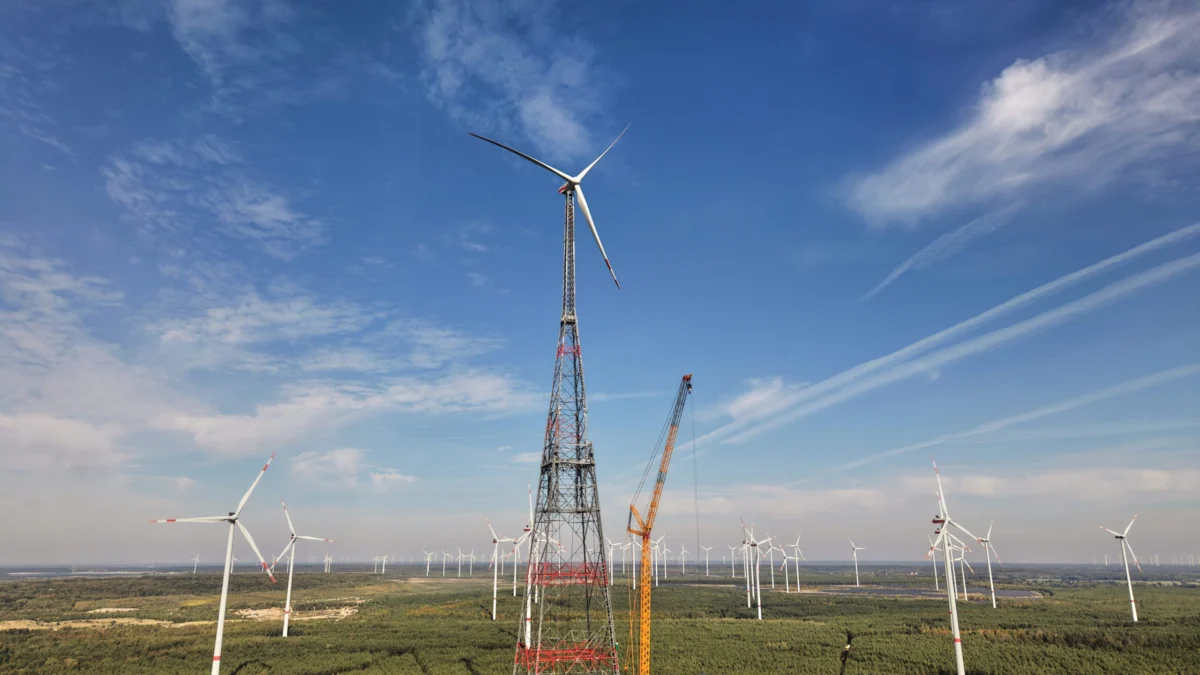
SCHIPKAU, Germany — Rising majestically 365 meters (1,197 feet) above the sparsely populated terrain of eastern Germany, a colossal new engineering marvel has officially claimed the title of the world’s tallest wind turbine. Overtopping the iconic Eiffel Tower and coming within a hair’s breadth of Berlin’s soaring television tower, this towering structure represents a monumental leap forward in renewable energy technology.
Constructed in the heart of Lusatia—a region southeast of Berlin historically scarred and shaped by heavy lignite coal mining—the turbine symbolizes a profound industrial metamorphosis. As Germany aggressively accelerates its nationwide transition away from fossil fuels and nuclear power toward a fully green grid, this record-breaking prototype could fundamentally redefine how the world harnesses wind power.
Main Facts: Engineering a Giant
At its core, the Schipkau project is an exercise in reaching for the sky to unlock atmospheric potential that standard wind infrastructure simply cannot touch. Developed by Gicon, a Dresden-based engineering firm, the turbine boasts staggering physical dimensions:
- Total Height: 365 meters (1,197 feet) from the base to the highest tip of the rotor blade.
- Hub Height: 300 meters (984 feet)—the distance from the ground to the center of the rotor.
- Comparative Scale: It stands significantly taller than Paris’s Eiffel Tower (330 meters / 1,083 feet) and is just three meters shy of the Fernsehturm Berlin, Germany’s tallest structure at 368 meters (1,207 feet).
- Location: Integrated into an existing wind farm in the Lusatia region.
- Current Status: The prototype reached its full structural height in late September 2026, with internal wiring and final technical preparations underway ahead of its formal inauguration scheduled for November 19, 2026.
Unlike conventional wind turbines, which typically feature hub heights well below 200 meters (656 feet), Gicon’s design is engineered to exploit the stronger, significantly more stable and reliable wind currents found at higher atmospheric altitudes.
Chronology: From Coal Country to Sky-High Wind
The realization of the world’s tallest wind turbine is the culmination of years of targeted engineering, regional economic evolution, and strategic national energy planning.
- Early 2000s–2020: The Lusatia region begins its slow, deliberate transition away from the heavy lignite mining that defined its economy for more than a century. Policymakers and local leaders look toward renewable energy to revitalize the post-industrial landscape.
- Pre-2026 (Planning & Design): Gicon engineers conceptualize an ultra-tall turbine structure designed to bypass the turbulent, low-altitude boundary layer winds and tap into higher-velocity laminar air streams.
- April 2023: Germany completely phases out its remaining nuclear power plants, heightening the urgency to rapidly expand renewable capacity to stabilize the national grid amid volatile fossil fuel markets.
- September 2026: Construction culminates as the prototype turbine in Schipkau reaches its maximum height of 365 meters, instantly capturing global media attention.
- October 1, 2026: Final safety checks and structural assemblies are documented on-site by international press, highlighting the sheer scale of the rotor tips sweeping high above the Brandenburg landscape.
- November 19, 2026 (Upcoming): The official inauguration ceremony is slated to take place, marking the transition from construction to data collection and operational prototyping.
- Post-2026 Horizon: Gicon plans to analyze performance data from the prototype to design and deploy a dedicated wind farm featuring three to five extra-tall turbines, clearing the path toward commercial serial production.
Supporting Data: The Economics and Physics of Altitude
The primary rationale behind building structures of this staggering magnitude boils down to fundamental fluid dynamics and energy yield economics.
The Power of High-Altitude Winds
As altitude increases, surface friction caused by trees, hills, and buildings diminishes drastically. This results in wind speeds that are not only faster on average but also blow with far greater consistency throughout the day and across seasons.
According to Gicon Chief Executive Jochen Grossmann, the performance gains are exponential rather than incremental:
"At 300 meters, we have such constant and strong wind that we can produce more than twice as much electrical energy as with the same facility at today’s heights."
Furthermore, because high-altitude winds rarely experience the dead calms or erratic turbulence found closer to the ground, these ultra-tall turbines can generate electricity for a significantly greater percentage of the year, mitigating the intermittency issues that plague traditional wind assets.
Germany’s Energy Matrix in 2026
The debut of the Schipkau turbine aligns with a broader national triumph in renewable energy adoption. Data released by Germany’s Federal Statistical Office highlights the country’s rapid green transition:
- Renewable Share: In the first half of 2026, an impressive 59.1% of all energy produced in Germany came from renewable sources.
- Wind Dominance: Wind power stood as the single largest energy source in the country, accounting for 29.4% of total domestic generation.
- Coal Phase-Out Timeline: The German government remains legally committed to completely ending electricity generation from coal by 2038, making high-efficiency wind projects like the Schipkau turbine vital to filling upcoming generation gaps.
Official Responses and Industry Perspectives
The engineering achievement has drawn praise from industrial leaders, renewable energy advocates, and regional planners alike, though it also prompts discussions regarding regulatory frameworks and environmental integration.

Jochen Grossmann emphasized that the Schipkau prototype serves a dual purpose: proving the technological feasibility of ultra-tall towers and gathering empirical data to optimize future iterations.
"The prototype is intended to measure the exact potential gains from building turbines at such heights," Grossmann noted. "Our findings will lay the groundwork for commercial wind farms consisting of multiple extra-tall units."
Local authorities in Lusatia have expressed pride in seeing their industrial heritage repurposed for a sustainable future. Once a landscape dominated by open-pit coal mines and heavy machinery, Lusatia is rapidly rebranding itself as a premier European hub for green tech innovation.
Energy economists point out that public acceptance of wind energy often hinges on visual impact and land-use efficiency. By capturing double the energy output per footprint, developers argue that fewer total installations will be required to meet aggressive regional decarbonization targets.
Implications: A "Two-Story" Future for Global Wind Energy
The successful deployment of the Schipkau turbine carries profound implications not just for Germany, but for the global renewable energy sector.
1. Solving the Land Scarcity Crisis
One of the most persistent bottlenecks in wind energy development is the availability of suitable land. Environmental regulations, community pushback, and spatial constraints limit where conventional wind farms can be sited.
Grossmann envisions a novel solution: the creation of "two-story" wind farms. By strategically combining shorter, legacy turbines with towering 365-meter giants on the exact same plot of land, developers can maximize energy capture per square kilometer without expanding the geographical footprint. Future sites could be intentionally designed with this multi-tiered architecture from day one.
2. Overcoming Intermittency and Grid Strains
Germany’s energy landscape has faced intense scrutiny following the 2023 nuclear phase-out and the subsequent supply shocks triggered by geopolitical conflicts in Eastern Europe. While renewables have surged to supply nearly 60% of the nation’s power in early 2026, grid stability remains paramount.
Turbines capable of capturing steady, high-altitude winds reduce the variance in power generation, lessening the immediate burden on expensive battery storage systems and grid-balancing fossil fuel reserve plants.
3. Setting a New Global Benchmark
As nations worldwide race to meet net-zero emissions targets, the appetite for high-efficiency, disruptive technology is growing. If Gicon’s upcoming three-to-five-turbine pilot farm proves commercially viable, engineering firms across Europe, North America, and Asia are expected to follow suit, pushing hub heights past the 300-meter threshold globally.
Conclusion
As the finishing touches are applied to the wiring of the Schipkau giant ahead of its November 19 inauguration, the world watches an engineering marvel stretch toward the clouds. In a region once defined by the black dust of coal, a gleaming white titan now stands as a testament to human ingenuity—proving that when it comes to powering a sustainable future, the only way to go is up.