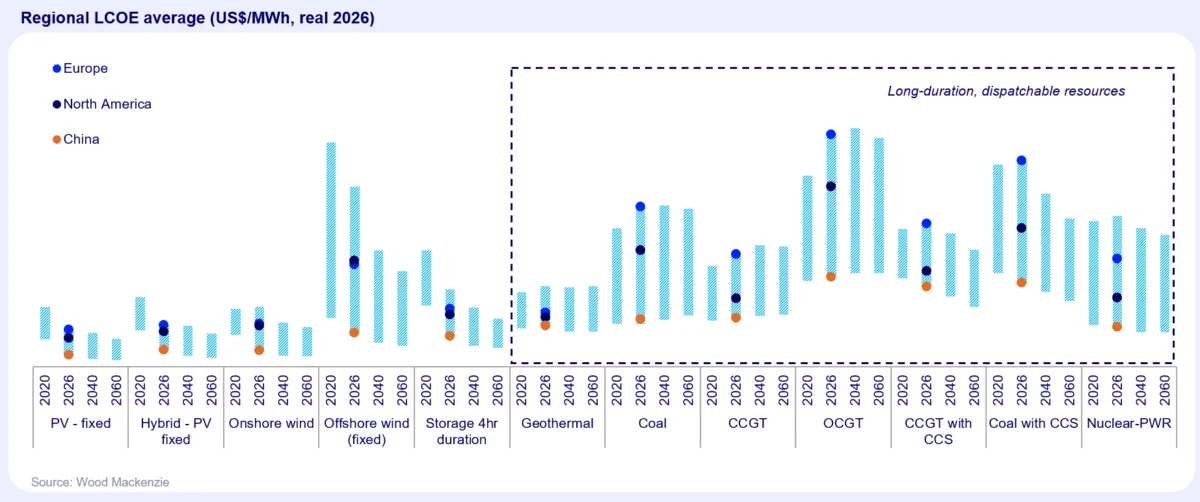
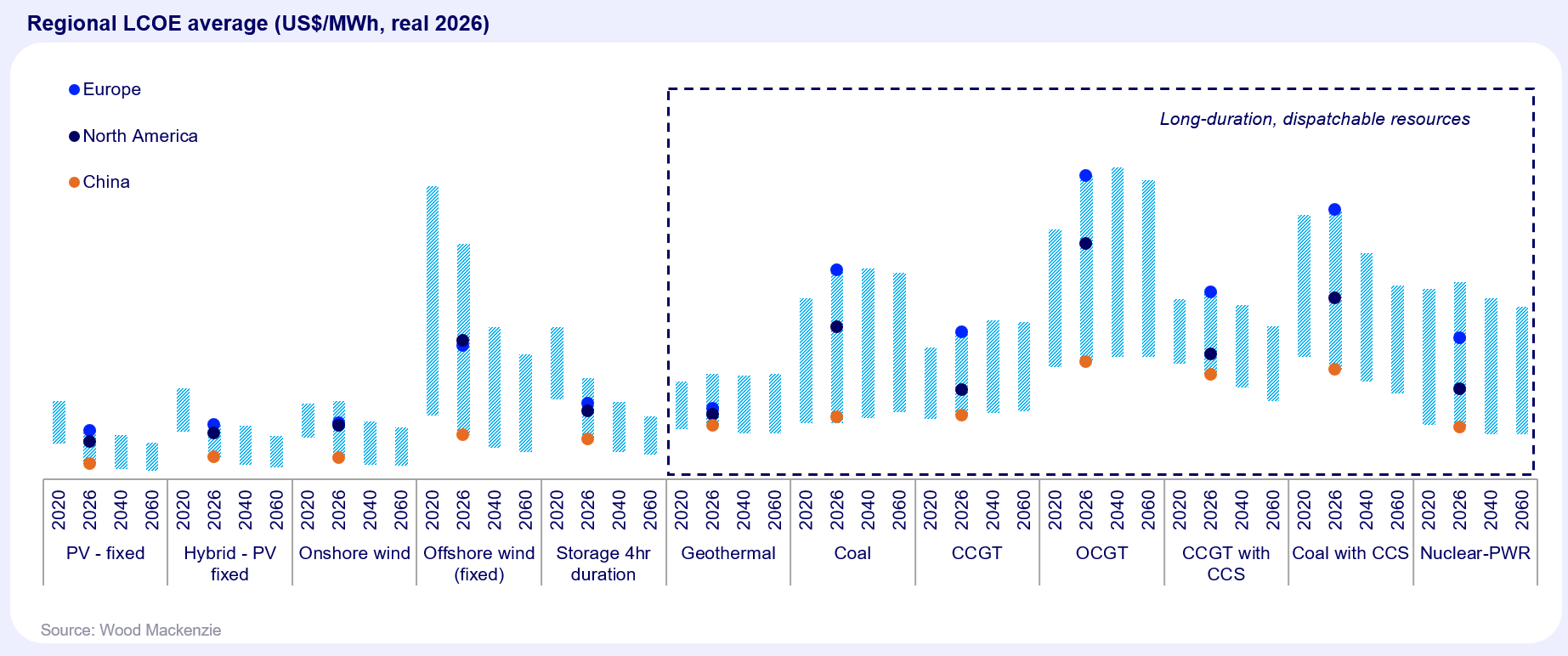
GLOBAL — In what energy analysts are calling a defining structural turning point for power sector planning, utility-scale battery energy storage systems (BESS) have officially achieved a historic economic milestone. According to Wood Mackenzie’s latest global Levelized Cost of Electricity (LCOE) report, four-hour battery storage is now cheaper to install than open-cycle gas turbines (OCGT) across all 43 global markets where both technologies were modeled.
Driven by relentless advancements in manufacturing scale—spearheaded heavily by Chinese original equipment manufacturers (OEMs)—combined with mounting fuel price volatility and supply constraints for traditional peaking plants, the economics of power generation have irrevocably shifted. No longer a supplemental technology reserved for niche grid stabilization, four-hour storage is actively displacing gas peaking capacity worldwide, setting the stage for a new era dominated by renewables and advanced battery storage.
Main Facts: The New Global Cost Equilibrium
The Wood Mackenzie report paints a comprehensive picture of a global energy landscape undergoing rapid transformation. At the core of this shift is the undeniable cost-competitiveness of renewable generation coupled with multi-hour storage solutions.
- The Storage Milestone: Four-hour battery storage is now universally more cost-effective than open-cycle gas turbines in all 43 evaluated markets.
- Baseload Dominance: Single-axis tracker solar PV has cemented its position as the lowest-cost new-build power generation technology in 43 out of 48 modeled markets, with onshore wind claiming the top spot in the remaining five.
- Regional Disparities in Storage: China remains the undisputed global benchmark for grid-scale storage, boasting a benchmark LCOE more than 55% below the rest of the Asia-Pacific average. Conversely, regions like Europe and North America face near-term cost pressures due to localized supply chain restrictions, trade barriers, and fluctuating lithium prices.
- Fossil Fuel Pressures: Fossil-fuel generation continues to face severe headwinds. In Europe, levelized carbon costs are projected to surpass fuel costs by 2030, while North America faces an impending gas generation capacity deficit driven by soaring data center load growth.
Chronology: The Trajectory Toward Grid Parity
To understand how battery storage and renewables achieved global cost supremacy, it is essential to examine the technological and economic milestones that have shaped the energy landscape over the past decade:
- The Early 2020s (The Foundation): Solar and wind achieved parity with conventional fossil fuels in optimal sunlight and wind regions. However, storage remained prohibitively expensive for widespread grid-scale dispatchability, keeping gas peaking plants essential for intermittent load-following.
- 2023–2025 (The Scale-Up): Aggressive expansion of lithium-ion battery manufacturing capacity—primarily driven by Asian supply chains—unlocked unprecedented economies of scale. Despite temporary supply chain bottlenecks and lithium price spikes, the long-term capital expenditure (capex) trajectory for batteries pointed sharply downward.
- 2026 (The Tipping Point): Wood Mackenzie’s latest data confirms that four-hour storage has dropped below the cost threshold of gas turbines globally. Concurrently, regional solar costs in the Middle East approach historic lows, targeting sub-$20/MWh figures over the next decade.
- The Horizon (2030–2060): Projections indicate that structural cost declines will continue across all major markets. In regions like Latin America, the Middle East, and Africa, storage LCOEs are forecast to plummet by an additional 33% to 42% by 2035–2060, completely phasing out the economic rationale for new fossil-fuel peaking capacity.
Supporting Data: Regional Breakdowns
The global energy transition is happening at different speeds depending on local resources, regulatory frameworks, and supply chain access. A regional deep-dive reveals distinct market dynamics:
Middle East and Africa: The Epicenter of Low-Cost Power
The Middle East and Africa host some of the cheapest renewable and storage economics on Earth. Utility-scale solar currently anchors the region at a regional average of $37/MWh, on track to fall to $24/MWh by 2035, with Saudi Arabia and the UAE targeting sub-$20/MWh by 2033.
Simultaneously, four-hour battery storage—valued at $120/MWh in 2026—is forecast to drop 33% to $80/MWh by 2035. This dramatic reduction is systematically displacing gas peaking plants across every gas market in the region, supported by an influx of cost-competitive Chinese onshore wind turbines boasting high capacity factors (40% to 45%) in countries like Egypt and Morocco.

Asia Pacific: Manufacturing Scale Versus Regional Premiums
Asia Pacific remains a tale of two realities. China dominates global storage manufacturing, with an LCOE over 55% below the rest of the Asia-Pacific average ($134/MWh). While competitive Chinese supply chains are projected to pull the broader regional storage average down to $92/MWh by 2036, markets such as Japan, Australia, and the Philippines will retain a price premium due to import tariffs, higher installation costs, and domestic manufacturing mandates.
Solar and wind continue to dominate generation costs, though solar disparities between the highest- and lowest-cost markets in the region are expected to widen to 250% by 2030.
Europe: Navigating Carbon Costs and Lithium Rebounds
Europe maintains the highest fossil-fuel generation costs among all modeled regions. Levelized carbon costs are on track to eclipse fuel costs by 2030, reinforcing the urgency of the green transition. Solar PV and onshore wind remain the continent’s cheapest generation assets, though near-term market friction is evident.
Turnkey capex for battery storage rose approximately 2% following a 10% rebound in battery cell prices from 2025 lows, driven by stronger demand and elevated lithium prices. Nevertheless, long-term capex is projected to resume its downward trend once short-term supply corrections stabilize.
North America: Policy Headwinds Meet Surging Demand
North America faces unique near-term cost pressures. Solar and wind development are contending with waves of tariffs, anti-dumping and countervailing duty actions, and Section 232 import restrictions. Residential and commercial solar projects face anticipated module price increases of 6% in 2027 and 14% in 2028.
Despite these headwinds, utility-scale storage benefits from tax credits that help offset foreign entity of concern (FEOC) restrictions. Furthermore, a looming gas generation capacity deficit driven by explosive data center electricity demand is keeping thermal capital costs elevated, cementing the long-term economic imperative for renewables and storage.
Latin America: Structural Advantages and Grid Mandates
Latin America enters the late 2020s with robust structural advantages, anchored by world-class solar resources in Brazil, Chile, and Mexico. Solar PV remains the region’s lowest-cost generation source, with average costs projected to fall 38% by 2060. Onshore wind LCOE is expected to drop nearly 21% by 2030, aided by intense pricing competition from Chinese OEMs.
Grid-scale storage is accelerating rapidly across the region, heavily stimulated by mandatory storage integration requirements tied to renewable energy projects and standalone procurement programs designed to guarantee grid stability.
Official Responses and Expert Analysis
Industry leaders and market analysts emphasize that this shift transcends mere incremental cost reductions; it represents a fundamental rewiring of modern electrical grids.
"This economic shift is decisive and widening," said Ahmed Jameel Abdullah, principal analyst at Wood Mackenzie. "Gas turbine shortages and rising fuel volatility are driving up peaking costs, while expanding battery manufacturing continues to push storage costs down."
Abdullah further underscored the broader systemic implications of the data, noting that the combination of falling storage expenses and world-class renewable generation is entirely closing off the financial viability of new fossil-fuel peaking infrastructure.
"The structural shift we are tracking is no longer just about renewables becoming competitive," Abdullah added. "It is about storage and solar together redefining what the economics of a power system look like. From Latin America to Asia Pacific, long-term contracted renewables increasingly set the ceiling rather than the floor on power costs."
Implications: The Future of Global Energy Markets
The crossing of this critical economic threshold carries profound implications for utilities, policymakers, investors, and industrial consumers worldwide:
- The Obsolescence of Gas Peakers: With four-hour battery storage proving cheaper than open-cycle gas turbines everywhere, utility planners can no longer justify investing in new gas-fired peaking plants for short-duration grid support. The traditional "gas backup" model is rapidly becoming a stranded asset risk.
- Accelerated Grid Transformation: The pairing of low-cost solar and wind with scalable battery storage allows emerging markets to leapfrog traditional fossil-fuel-dependent infrastructure phases. Developing nations in Africa, Latin America, and Southeast Asia can build decentralized, highly resilient power systems at a fraction of historical costs.
- Supply Chain Geopolitics: The heavy concentration of battery and turbine manufacturing capacity in Asia—particularly China—creates both an economic accelerator for global decarbonization and a strategic vulnerability for Western economies attempting to build domestic manufacturing bases through tariffs and trade protections.
- Resilience Against Fuel Volatility: Unlike gas turbines, which remain exposed to geopolitical conflicts, supply chain bottlenecks, and volatile fuel commodity markets, battery storage relies on storable electrical energy harvested from infinite, localized renewable sources. This insulates power grids from external price shocks and enhances national energy security.
As the energy transition matures through the latter half of the 2020s, the message from global markets is unequivocal: the future of power generation is not just renewable—it is stored, flexible, and economically undeniable.