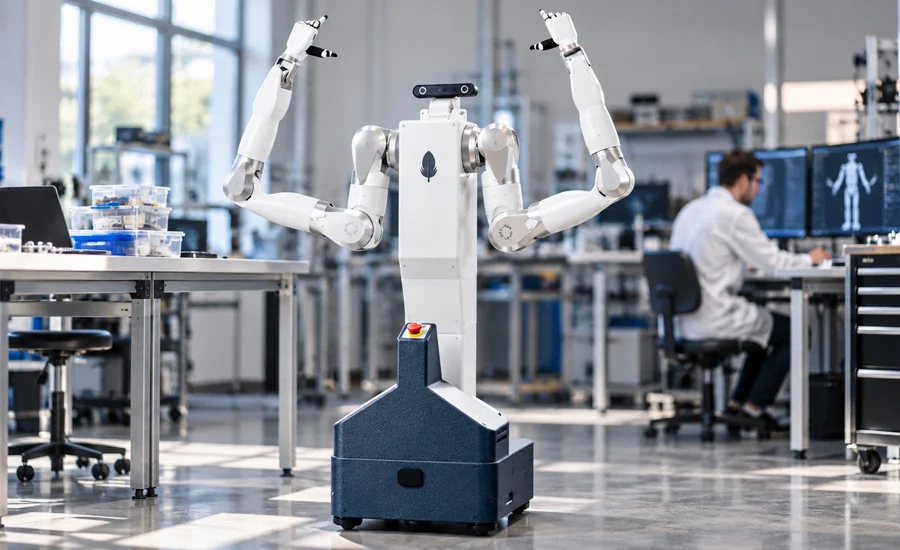
EAST PALO ALTO, CA — In a market increasingly crowded by vertically integrated tech giants and proprietary automation ecosystems, Silicon Valley startup Feather Robotics Inc. has officially entered the fray with a disruptive value proposition. The company has pulled the curtain back on its flagship creation: a two-armed mobile humanoid robot priced under $30,000.
Aimed at lowering the barrier of entry for researchers, independent developers, and industrial automation firms alike, the newly unveiled "Feather" robot arrives with a starting price tag of $29,990. By decoupling hardware manufacturing from artificial intelligence development, Feather Robotics is positioning its machine as a universal, open-platform foundation capable of ushering in a new era of scalable physical AI.
Main Facts: Deconstructing the Feather Humanoid Platform
At its core, the Feather robot is an omnidirectional, mobile dual-arm platform engineered to operate seamlessly within human-centric environments. Unlike closed-loop robotic systems that bundle proprietary software with hardware, Feather provides a hardware-first infrastructure designed to run third-party physical AI models.
Key Specifications and Mobility
The robot rests on a compact, omnidirectional wheeled base capable of moving in any lateral or rotational direction without the need to turn. Measuring a modest 500 by 510 millimeters at its footprint, the machine easily navigates standard industrial and commercial doorways. It boasts a maximum movement speed of 1.3 meters per second (approx. 2.9 mph) and weighs 105 kilograms (231 pounds) when fully configured.
Dual-Arm Dexterity and Payload
The upper torso features two articulated arms, each possessing seven degrees of freedom (DoF) to mimic human-like range of motion.
- Reach: The arms offer a vertical reach of 600 millimeters and a horizontal reach of 1 meter.
- Payload Capacity: Each arm supports a rated payload of 4 pounds for continuous operation, with a peak payload capacity of 15 pounds for heavier lifting tasks.
- End-Effector Flexibility: Customers can equip the arms with either human-like articulated hands or traditional parallel-jaw grippers. Furthermore, these end-effectors are field-swappable, allowing for rapid retooling depending on the operational task.
Power, Control, and Interface
To support untethered mobility, the robot is powered by a redundant pair of hot-swappable 25 amp-hour batteries, delivering an impressive 10 hours of continuous operating time. For local monitoring, setup, and control, the machine includes an onboard 10-inch touch-screen display. Additionally, it features an integrated four-microphone array and high-fidelity speaker, enabling voice commands and conversational interaction between humans and the machine.
Developers can interface with the platform via an open Software Development Kit (SDK), which streamlines the process of writing, testing, and deploying custom physical AI applications.
Chronology: The Journey to Sub-$30,000 Humanoid Robotics
The journey toward affordable, accessible humanoid robotics has been marked by decades of academic research, government-funded defense projects, and, more recently, aggressive commercialization by venture-backed startups.
- The Research Era (2000–2015): Early humanoids—such as those developed by Honda (ASIMO) or Boston Dynamics—served as technological showcases. These machines cost millions of dollars to build, relied on fragile hydraulic or complex electric actuators, and required teams of engineers to operate. They were fundamentally research artifacts rather than commercial deployment tools.
- The Commercial Boom (2020–2024): Fueled by breakthroughs in deep learning, computer vision, and transformer models, a new wave of humanoid startups emerged. Companies like Tesla (with Optimus), Figure, Unitree, Agibot, and 1X began developing general-purpose humanoids. However, nearly all of these entities adopted a vertically integrated strategy, designing both the proprietary hardware body and the proprietary AI foundation models in tandem.
- The Fragmentation and Cost Crisis (2024–2025): As developers sought to build real-world applications for manufacturing, logistics, and warehousing, they ran into a severe bottleneck. Independent AI researchers lacked affordable, reliable hardware platforms. High-end humanoids remained prohibitively expensive, often costing upwards of six figures or remaining locked inside closed corporate ecosystems.
- The Feather Robotics Launch (Late 2025–2026): Recognizing the market gap for reliable, cost-effective unit economics, engineer and entrepreneur Hoa Mai founded Feather Robotics. Eschewing the hyper-expensive, fully proprietary model, Mai’s team spent months engineering a robust, modular, and open-platform hardware body. This trajectory culminated in the official 2026 launch of the Feather robot at a sub-$30,000 price point, intentionally designed to decouple hardware from software development.
Supporting Data: Comparative Market Metrics and Industrial Fit
To understand the disruptive nature of Feather Robotics’ pricing strategy, it is helpful to examine the broader economic and technical landscape of current humanoid robotics.
| Metric / Feature | Feather Robotics (Feather) | Industry Averages (Vertically Integrated Humanoids) |
|---|---|---|
| Starting Price | $29,990 | Often $80,000 to $250,000+ (or unreleased/pilot-only) |
| Business Model | Open hardware platform (Runs 3rd-party AI) | Closed ecosystem (Hardware + Proprietary AI bundled) |
| Battery Life | 10 hours (Hot-swappable 25 Ah batteries) | 2 to 6 hours (varying configurations) |
| Mobility | Omnidirectional wheeled base (1.3 m/s) | Bipedal legs or specialized wheeled/tracked bases |
| Payload per Arm | 4 lbs (Rated) / 15 lbs (Peak) | 3 lbs to 44 lbs (Highly dependent on model scale) |
| Integration Timeline | Weeks (via open SDK and flexible models) | Months to years (restricted by proprietary APIs) |
The decision to utilize an omnidirectional wheeled base rather than bipedal legs is a deliberate data-driven choice aimed at industrial reliability and cost-efficiency. While bipedal walking robots capture headlines, they introduce massive mechanical complexity, high power consumption, and balancing risks that drive up manufacturing costs and failure rates. By opting for a stable wheeled footprint that fits through standard 500-millimeter doorways, Feather maximizes operational uptime and cargo capacity while radically driving down unit production costs.
Official Responses and Vision: The "Android of Robotics"
The philosophy driving Feather Robotics is rooted in democratization and modularity. Hoa Mai, CEO and co-founder of Feather, points to his own background in embodied artificial intelligence as the catalyst for the company’s distinct business model.
"My background is in building embodied AI systems, and I’m on a mission to solve physical AI," says Mai. "लेकिन when I looked for a hardware platform to build on top of, none of the options had the unit economics, reliability and support logistics that I needed to succeed as an independent developer. That’s why I built Feather—to give every team, no matter their size, the infrastructure to scale physical AI."
Mai’s ultimate ambition is to replicate the historical trajectory of the smartphone industry. Just as Google’s Android operating system provided a universal, open software standard that hardware manufacturers could adopt—preventing any single company from monopolizing the mobile revolution—Feather aims to become the universal hardware standard for physical AI.
Rather than competing with companies building advanced AI foundation models, Feather actively embraces collaboration. Engineers and enterprises utilizing the Feather platform are free to deploy state-of-the-art physical AI models developed by industry leaders such as Nvidia, Skild AI, and Physical Intelligence. According to company engineers, this architectural separation allows development teams to transition a trained machine learning model from simulation to physical deployment on the factory or warehouse floor in a matter of weeks.
Implications: Reshaping Manufacturing, Logistics, and Software Development
The introduction of a sub-$30,000, open-platform humanoid robot carries profound implications for the future of industrial assembly, supply chain logistics, and the broader robotics ecosystem.
1. Democratization of Industrial Automation
Historically, small- and medium-sized enterprises (SMEs) have been priced out of advanced robotics integration. Custom robotic cells, specialized conveyors, and legacy industrial arms require massive capital expenditure and dedicated integration teams. At under $30,000, a mobile humanoid with dual-arm dexterity approaches the cost of human labor depreciation over a short operational window. This opens the door for smaller machine shops, third-party logistics (3PL) warehouses, and electronics assembly plants to experiment with flexible automation.
2. A Shift Toward Hardware-Software Agnosticism
For years, the robotics industry mirrored the early days of computing, where specific hardware could only run proprietary software from the same manufacturer. Feather’s hardware-first, AI-agnostic approach signals a maturation of the market. By allowing customers to choose their preferred physical AI foundation models—whether sourced from Nvidia’s ecosystem or specialized startups like Physical Intelligence—developers can continuously upgrade their robot’s cognitive capabilities without purchasing new physical hardware.
3. Accelerating the Deployment Timeline
In traditional automation engineering, tuning a robot to perform a new task requires tedious, manual programming or complex computer vision scripting. With physical AI models capable of zero-shot or few-shot learning, combined with Feather’s open SDK, deployment cycles shrink from months of custom integration down to weeks. As engineering teams bypass hardware design constraints, the pace of real-world AI deployment is expected to accelerate exponentially.
As Feather Robotics begins processing initial orders for its groundbreaking platform, the industry will be watching closely. If the startup succeeds in making scalable physical AI hardware as ubiquitous and affordable as personal computing, the factory floors and warehouses of tomorrow may look vastly different—powered not by closed corporate monopolies, but by an open, collaborative ecosystem of builders.