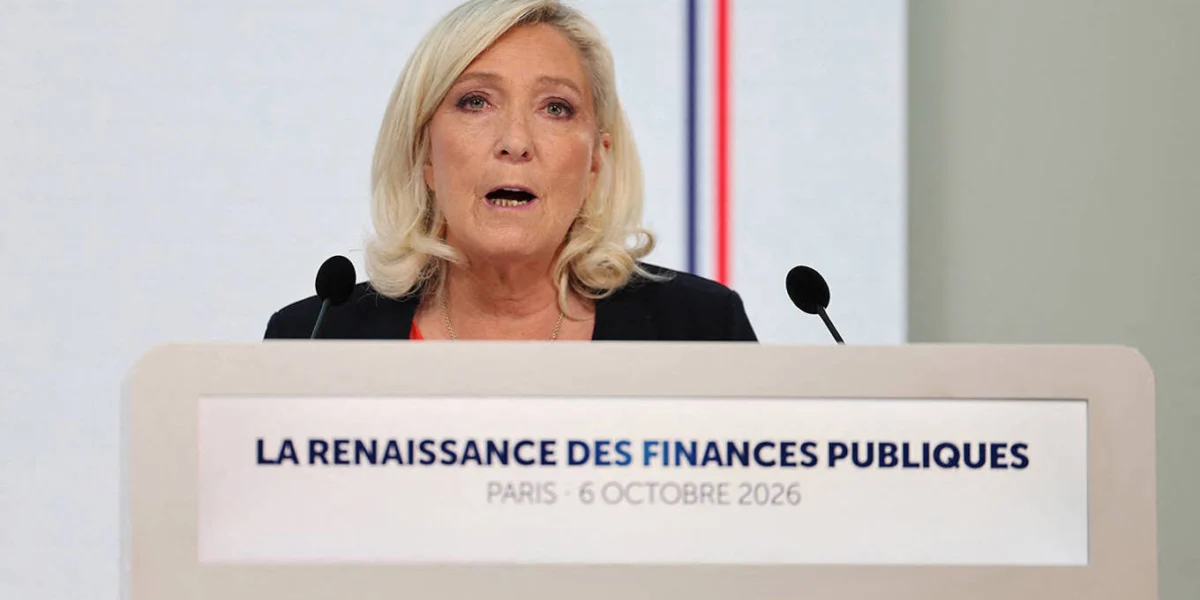
PARIS — In a political landscape defined by shifting ideological boundaries and mounting economic pressures, French far-right leader Marine Le Pen has unveiled an economic program that defies conventional political categorization. In a recent high-profile speech detailing her economic roadmap, the leader of the National Rally (RN) put forward what can only be described as a populist vision of fiscal consolidation.
Long known for championing expansive, state-funded social protections and populist entitlements, Le Pen’s pivot toward fiscal restraint marks a profound tactical and ideological evolution. Whether she can successfully reconcile the inherently contradictory demands of populism and austerity will now determine not only her own political future, but potentially the trajectory of Europe’s broader nationalist right.
By staking her credibility on rapid fiscal consolidation—a policy area more commonly referred to as austerity—Le Pen has broken sharply with her party’s recent history of opposing budgetary discipline. In doing so, she has aligned herself with a longstanding, yet historically fraught, tradition on the European right: attempting to balance the books while maintaining anti-establishment appeal.
Main Facts
The core of Marine Le Pen’s newly announced economic strategy rests on a delicate balancing act. Historically, the National Rally has campaigned on platforms featuring generous public spending, early retirement ages, and wealth redistribution financed by protectionist trade measures and anti-immigration policies. However, faced with France’s spiraling national debt and mounting pressure from European Union fiscal watchdogs, Le Pen’s latest policy framework introduces stringent fiscal targets aimed at reducing the public deficit.
Key elements of the unfolding political and economic scenario include:
- The Policy Pivot: Le Pen has embraced rapid fiscal consolidation, framing it as a necessary measure to restore national sovereignty and economic health.
- The Populist Paradox: The strategy attempts to merge traditional right-wing budgetary rigor with populist rhetoric that promises to protect the purchasing power of ordinary French citizens.
- Political Stakes: The success or failure of this paradoxical formulation will serve as the ultimate litmus test for Le Pen’s viability as a credible candidate for the French presidency.
- European Repercussions: Across the European Union, nationalist and far-right parties are watching closely, as the French model could establish a template for how anti-establishment movements transition from opposition protest parties to governing forces.
Chronology of Events: The Evolution of the National Rally’s Economic Platform
To understand the magnitude of Le Pen’s current fiscal turn, it is necessary to examine the evolution of the National Rally’s economic messaging over the past decade.
1. The Post-2008 Protectionist Turn (2012–2017)
Following the global financial crisis and the subsequent Eurozone debt crisis, Marine Le Pen—having taken over the leadership of the National Front (later rebranded as the National Rally) from her father, Jean-Marie Le Pen—embarked on a deliberate strategy of "social-patriotism." Recognizing that the working-class electorate had been alienated by traditional free-market capitalism, Le Pen positioned her party as the defender of the welfare state. The economic platform heavily emphasized protectionism, opposition to globalization, withdrawal from the Eurozone (a policy later softened), and increased public spending funded by tariffs and wealth taxes.
2. The Presidential Bid and Broadening Appeal (2022)
During her robust 2022 presidential campaign against Emmanuel Macron, Le Pen retained many of her populist welfare proposals, such as lowering the retirement age and cutting value-added tax (VAT) on energy products. However, her team began facing intense scrutiny from economists and financial markets over how these costly measures would be funded. Despite these critiques, her strategy of focusing on the "cost of living crisis" propelled her to a historic run-off performance, cementing the RN as a mainstream governing alternative.
3. The Legislative Breakthrough and Fiscal Realities (2024–2025)
Following significant gains in the French legislative elections, the National Rally found itself thrust into a position of unprecedented parliamentary influence. Concurrently, France’s public finances deteriorated significantly, drawing reprimands from the European Commission and credit rating agencies. The French state faced mounting pressure to rein in a deficit that far exceeded EU limits. It became increasingly clear to Le Pen’s inner circle that any future bid for the Elysée Palace would require reassuring financial markets and international creditors that an RN government would not default or trigger a sovereign debt crisis.
4. The 2026 Fiscal Consolidation Speech (October 2026)
In her recent address in Paris, Le Pen formally unveiled her revamped economic program. Eschewing the purely expansionary rhetoric of past campaigns, she outlined a path toward fiscal consolidation. This pivotal moment signaled a definitive transition: the RN is no longer just a party of grievance, but an organization actively attempting to pass the credibility test required of a party of government.
Supporting Data: France’s Economic Realities and the Fiscal Dilemma
Le Pen’s policy pivot is not occurring in a vacuum. It is a direct response to the stark economic data currently confronting France.
- Public Debt: France’s national debt has hovered near historic highs, exceeding 110% of its Gross Domestic Product (GDP), placing it among the highest burdened economies in the Eurozone behind only nations like Italy and Greece.
- Deficit Projections: The French public deficit has consistently breached the European Union’s 3% stability pact threshold, drawing intense oversight from Brussels and forcing successive governments to propose painful budgetary adjustments.
- Voter Demographics: Polling data indicates that while Le Pen’s base remains deeply concerned about inflation and the cost of living, middle-class and affluent voters—whom she must win over to secure a presidential victory—are increasingly anxious about fiscal stability, inflation, and the long-term viability of public pensions.
- Market Sensitivity: Following the political instability of recent French elections, sovereign bond spreads have shown sensitivity to domestic political rhetoric, making financial market appeasement a practical necessity for any viable candidate.
Official Responses and Political Reactions
The unveiling of Le Pen’s fiscal consolidation program has triggered immediate and polarized reactions across the French and European political spectrum.
The Government and Centrist Coalition
Emmanuel Macron’s centrist allies and government officials have met Le Pen’s new stance with deep skepticism, characterizing it as a transparent political maneuver rather than a serious economic strategy. Government spokespersons have argued that the National Rally cannot simultaneously promise increased purchasing power, protectionist subsidies, and strict budgetary discipline without resorting to unsustainable fiscal gymnastics or severe cuts to vital public services.
"You cannot square the circle of populism and austerity," a senior government official noted privately. "Either the promises to the voters are false, or the promises of fiscal responsibility are a ruse."
The Left and Labour Unions
On the political left, Le Pen’s pivot has been met with outright condemnation. Figures from France Insoumise (LFI) and traditional labor unions have accused the far-right leader of dropping her populist pretense to court the business community and the wealthy elite. They argue that any far-right version of "fiscal consolidation" will inevitably fall on the backs of workers, public sector employees, and social welfare recipients through stealth cuts and regressive taxation.
International Markets and Observers
Conversely, financial analysts and international observers have offered a more nuanced, albeit cautious, assessment. While many remain doubtful about the mathematical coherence of her program, some market strategists view her shift as a necessary acknowledgment of economic reality. By signaling a willingness to respect fiscal boundaries, Le Pen is attempting to mitigate the "Le Pen premium"—the higher borrowing costs that financial markets traditionally demand when populist candidates surge in the polls.
Implications: A High-Stakes Gamble for Europe’s Nationalist Right
The ramifications of Marine Le Pen’s economic pivot extend far beyond the borders of France, carrying profound implications for the future of European politics.
1. The Transformation of the European Right
For decades, Europe’s far-right and nationalist parties thrived on an anti-establishment, economically left-leaning platform that challenged neo-liberal consensus. However, as these parties transition from the margins to the mainstream—winning elections in Italy, polling strongly in the Netherlands, and contending for power in France—they face the ultimate test of governance: managing the state budget. Le Pen’s gamble represents a broader evolutionary phase for the European right, forcing nationalists to choose between ideological purity and the pragmatic compromises required to hold state power.
2. The Credibility Trap
The central risk for Le Pen lies in the inherent contradiction of her messaging. Populism relies on promising all things to all people—lower taxes, better public services, higher wages, and fiscal prudence. When these promises collide with the harsh arithmetic of austerity, voter disillusionment can be swift and punishing. If Le Pen fails to convince the electorate that her brand of fiscal consolidation is both fair and effective, she risks alienating her core working-class base without fully winning over the traditional conservative establishment.
3. The Path to the Presidency
Ultimately, this economic repositioning is designed for one primary purpose: clearing the final hurdle to the French presidency. By neutralizing the argument that an RN victory would trigger economic chaos and a confrontation with the European Union, Le Pen is seeking to make herself electable to the moderate bourgeoisie. Whether this strategy succeeds will define the next chapter of French political history and set a precedent for nationalist movements across the democratic world.
Conclusion
Marine Le Pen’s embrace of fiscal consolidation is a calculated high-wire act. By attempting to marry the irreconcilable forces of populist welfare promises and rigorous budgetary discipline, she has charted a new course for the National Rally. As France grapples with its deep-seated economic challenges, the success or failure of this paradoxical vision will serve as a bellwether for the future of governance, testing whether the European nationalist right can successfully navigate the transition from perpetual opposition to responsible statecraft.